

Manufacturing in 2026 is no longer driven by production capacity alone. Success depends on real-time visibility, supply chain agility, operational efficiency, and the ability to make faster decisions using connected data.
It’s not easy to keep track of production schedules, supply chains, inventory, compliance, and workers’ efficiency, all at the same time. That’s where manufacturing and ERP solutions come in. They give companies a single platform to streamline all of their operations.
Picking the right ERP system for manufacturing can mean the difference between being able to grow quickly and having a lot of operational chaos. The 9 best ERPs for manufacturing in 2026 are broken down in this guide. The options cover both large businesses and custom manufacturing ERP needs.
What is Manufacturing ERP?
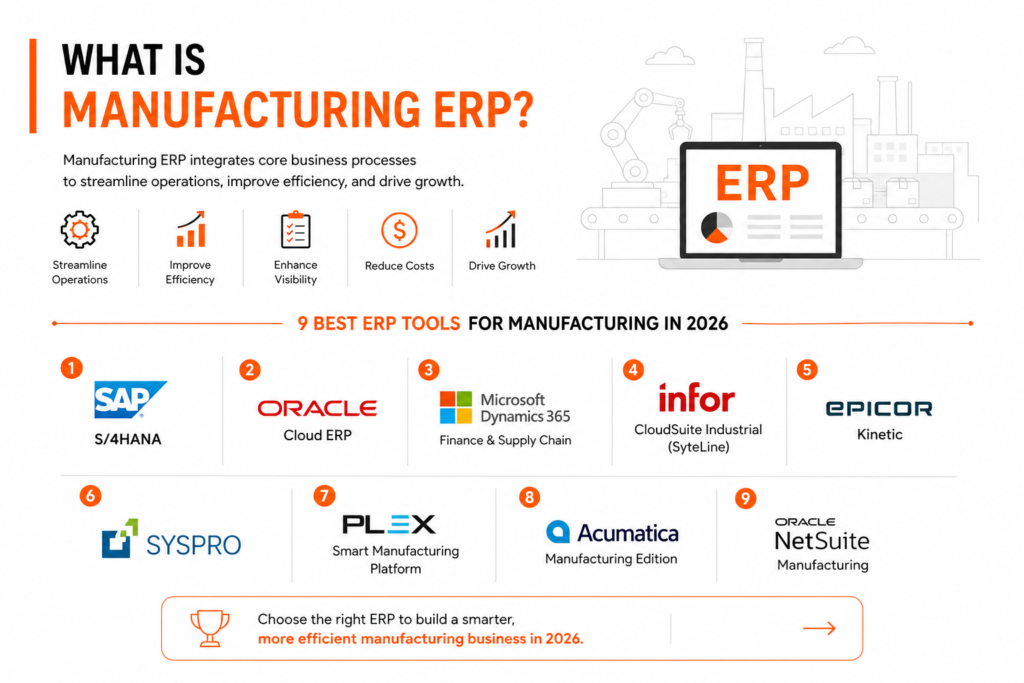
Enterprise Resource Planning (ERP) systems bring together important business tasks like budgeting, purchasing, quality control, accounting, and more into a single platform. For manufacturers, this means they can see the shop floor and the supply chain in real time, keep their data in one place, and make better choices.
9 Best ERP Tools for Manufacturing in 2026
The ERP market offers solutions ranging from enterprise-grade platforms to highly specialized manufacturing systems. Below are nine leading ERP platforms manufacturers should evaluate in 2026.
1. SAP S/4HANA
SAP S/4HANA is still the best choice with larger implementation budgets. And because it has an in-memory database, it can do real-time analytics, advanced planning, and deep supply chain management. It comes with one of the most complete ERP systems for manufacturing and can be used for discrete, process, and mixed-mode manufacturing.
2. Oracle Cloud ERP
Oracle Cloud ERP is great for factories that need to be able to add more users and be flexible. Its manufacturing module can predict demand, keep costs in check, and use IoT to run the shop floor. Built-in AI and machine learning capabilities help manufacturers optimize production life cycles, reduce waste, and improve operational efficiency.
3. Microsoft Dynamics 365 Finance & Supply Chain
With Microsoft Dynamics 365, you can use one suite to run both your factories and your finances. Because it works well with Microsoft 365 and Azure, it’s a good way to work together and look at data. When medium-sized to large manufacturers want flexibility without the full complexity of an enterprise system, this is a great option.
4. Infor CloudSuite Industrial (SyteLine)
It was made just for companies that make things, like those that make cars, planes, and industrial equipment. It works well for managing multiple sites, planning production, and giving manufacturers their own unique ERP setups. Infor’s approach is tailored to each industry. This approach makes customization easier and speeds up the time it takes to get value.
5. Epicor Kinetic
Epicor Kinetic, which used to be called Epicor ERP, is a cloud-based platform made just for manufacturers. As an ERP system for custom manufacturing, it works exceptionally well. It can be used in make-to-order, engineer-to-order, and mixed-mode settings. Epicor Kinetic makes it easier for businesses to respond quickly to changes in the market by giving them built-in analytics and a modern GUI. That said, businesses with highly niche manufacturing workflows may require customization to get the most out of the platform.
6. SYSPRO
SYSPRO is a mid-market ERP solution built specifically for manufacturing and distribution businesses, which has been specifically designed and developed with a focus on the unique needs and requirements of the manufacturing and distribution sectors. It lets you keep track of your inventory, manage your bill of materials (BOM), and plan your production schedule without all the extra work that comes with a big enterprise platform. System Pro represents a commendable and cost-effective choice for manufacturers operating on a small to medium scale who are in search of a concentrated array of features tailored to meet their specific needs.
7. Plex Smart Manufacturing Platform
Plex, which is now owned by Rockwell Automation, is in the middle of ERP and MES (Manufacturing Execution Systems). It’s one of the most cutting-edge ERP tools for improving manufacturing innovation because it has quality management, traceability, and real-time visibility on the shop floor built right in. Ideal for businesses that specialize in the manufacturing of automobiles as well as those engaged in the production and distribution of food and beverage products.
8. Acumatica Manufacturing Edition
Acumatica is quickly becoming popular among manufacturers that are growing. It’s perfect for custom manufacturing ERP deployments because it’s built for the cloud, has flexible licensing (no per-user fees), and has strong project accounting. The Manufacturing Edition of Acumatica encompasses a comprehensive suite of features that includes advanced inventory management, material requirements planning (MRP), and production planning capabilities, all of which seamlessly integrate with the core financial functionalities of the company, thereby enhancing operational efficiency and effectiveness.
9. NetSuite Manufacturing
A lot of companies use Oracle NetSuite as their cloud ERP, and it works for companies of all sizes. Its manufacturing module handles work orders, plans for demand, and coordinates the supply chain. NetSuite has gained significant popularity among manufacturers that are experiencing rapid growth and are in need of an ERP system that possesses the capability to expand alongside their business without necessitating a substantial investment in IT infrastructure.
How to Choose the Right Manufacturing ERP?
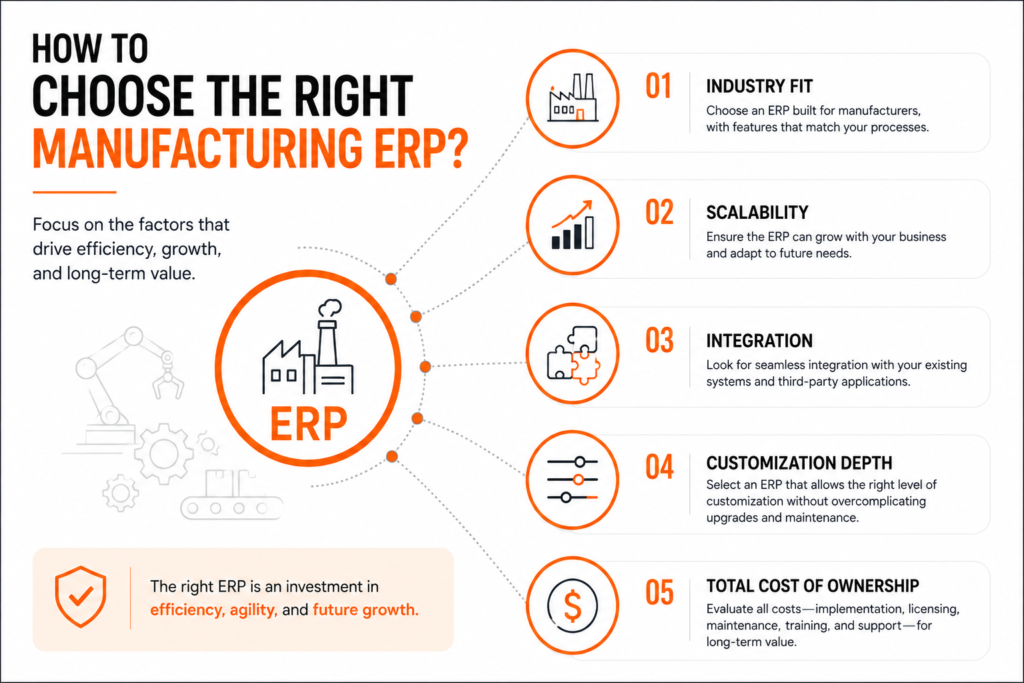
When looking for the best ERP for manufacturing, keep these important things in mind:
- Industry Fit: Does the ERP work with the way you make things (discrete, process, or job-shop)? If the platform suits the type of production you do, you will need to do a lot fewer workarounds and customizations right away.
- Scalability: Your ERP should grow with your business. You should look for a system that can handle growing production sites, more customers, and more complicated operations without needing a full platform switch in the future.
- Integration: The best manufacturing ERP system works with all of your other tools, like CAD, MES, CRM, IoT devices, and third-party logistics platforms, so data can move freely throughout your whole business.
- Customization Depth: If you operate in engineer-to-order or custom manufacturing environments, you need an ERP that can flex around your workflows, not force them to fit the software.
- Total Cost of Ownership: Don’t just look at the license fee. To really understand how much the ERP will cost in the long run, you need to look at how much it costs to set up, train staff, provide ongoing support, and do upgrades.
| ERP | Best For | Company Size | Deployment |
|---|---|---|---|
| SAP S/4HANA | Enterprise manufacturing | Large | Cloud/Hybrid |
| Oracle Cloud ERP | Complex global manufacturing | Large | Cloud |
| Microsoft Dynamics 365 | Mixed-mode manufacturing | Mid-large | Cloud / Hybrid |
| Epicor Kinetic | Custom manufacturing | Mid-large | Cloud |
| Infor CloudSuite Industrial | Process & discrete manufacturing | Mid-large | Cloud |
| SYSPRO | SMB manufacturing | Small-mid | Cloud / On-premise |
| Sage X3 | Multi-site manufacturing | Mid-market | Cloud / On-premise |
| Acumatica | Growing manufacturers | Small-mid | Cloud |
| JobBOSS² | Job shop & make-to-order | Small | Cloud / On-premise |
| DELMIAworks (IQMS) | Repetitive & process manufacturing | Mid-market | Cloud / On-premise |
Final Thoughts
In 2026, there will be more and better manufacturing and ERP for custom manufacturing options than ever before. Whether you’re a large enterprise needing SAP’s depth, a mid-market manufacturer exploring Epicor or SYSPRO, or a growing business evaluating NetSuite, there’s a solution built for your needs.
If you get the right ERP system for manufacturing, it will do more than just automate tasks; it will also become the operational backbone that drives growth, quality, and efficiency for years to come. Carefully consider your options, get your production and IT teams involved early on, and put long-term scalability ahead of short-term ease of use.
FAQs
What is the best ERP for manufacturing in 2026?
There isn’t just one “best” ERP for manufacturers; it depends on their size, industry, and type of work. Even so, SAP S/4HANA, Oracle Cloud ERP, and Epicor Kinetic are still some of the best choices for manufacturing companies in 2026. This is because they offer many features, can grow with your business, and are designed to work with your industry.
What is the difference between ERP and MES in manufacturing?
An ERP system manages the business side of making things, like finances, buying things, keeping track of inventory, and the supply chain. An MES (Manufacturing Execution System) is designed to handle operations on the shop floor in real time. Some platforms, like Plex Smart Manufacturing, do both at the same time.
Which ERP is best for small- and mid-sized manufacturers?
SYSPRO and Acumatica Manufacturing Edition are excellent choices for small to mid-sized manufacturers. Both offer focused manufacturing functionality without the cost and complexity of large enterprise platforms. Acumatica’s flexible, no per-user licensing model makes it especially attractive for growing businesses.
What is custom manufacturing ERP and who needs it?
Custom manufacturing ERPs support make-to-order, engineer-to-order, and job-shop manufacturing. Businesses that build products to customer specifications need an ERP that can adapt to their workflows. Epicor Kinetic and Acumatica are good choices.
How long does it take to implement an ERP system for manufacturing?
Implementation times depend on business size, operations complexity, and ERP platform. Large enterprise implementations like SAP S/4HANA can take 12 to 24 months, while small to mid-sized deployments take 3 to 6 months. Effective planning, data migration, and team training affect timelines.
