

Businesses today are no longer struggling with whether to digitise different business operations, but with how to do it right. The same is applicable for inventory and warehouse management. Many businesses still confuse inventory management vs warehouse management, especially as logistics and omnichannel retail grow more complex, and there are multiple things to consider.
In fact, the inventory management software market reached $2.7B in 2026, while WMS adoption is also rapidly scaling alongside automation and e-commerce demand. This guide significantly breaks down the IMS vs WMS difference, key features, and multiple use cases that will help you choose the right inventory tracking system for your next project.
What is an Inventory Management System (IMS)?
An Inventory Management System (IMS) is an advanced software solution, which is designed to track, manage, and optimise the available stock across the entire business, not just within a warehouse.
The inventory tracking system provides real-time visibility into the available inventory levels, orders, sales, and deliveries. Hence, businesses get the chance to maintain the right balance between supply and demand.
Key Functions of IMS:
IMS enables accurate stock level monitoring, efficient order management, and data-driven demand forecasting. It helps to automate reorder alerts to prevent the chances of disruptions while supporting multi-channel inventory synchronisation across different online and offline platforms.
Inventory Management System Benefits:
It helps prevent the chances of stockouts and overstocking. This also improves cash flow by reducing excess inventory and ensuring proper demand planning accuracy.
Best Use Cases:
IMS is also ideal for retail stores, e-commerce businesses, and small to mid-sized companies looking for a reliable IMS for small business operations.
What is a Warehouse Management System (WMS)?
A Warehouse Management System (WMS) helps to manage and optimise day-to-day warehouse operations. It also assists with ensuring the movement, proper storage, and handling of inventory within a warehouse. These together ensure faster and more accurate order fulfilment.
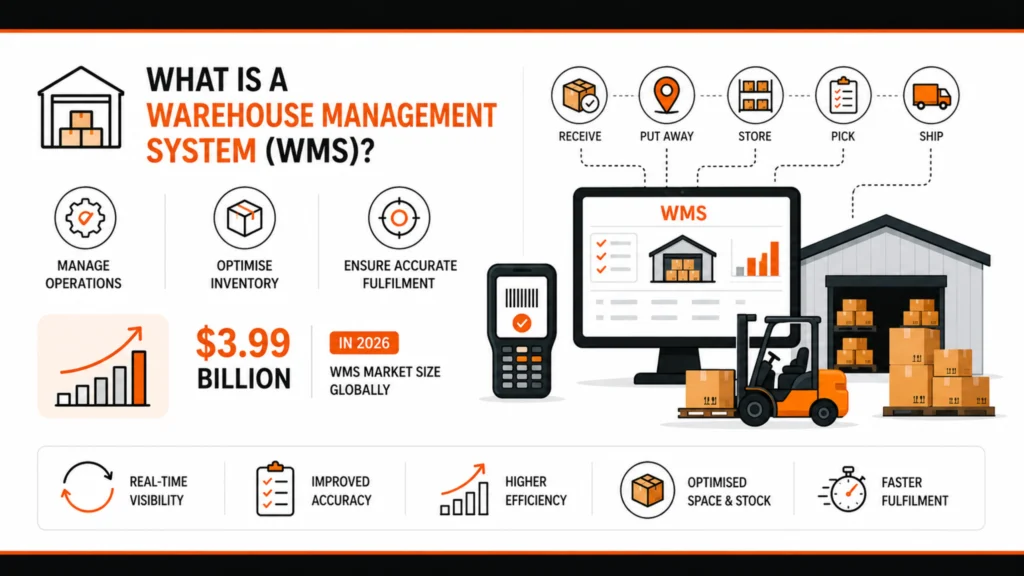
As supply chains become more complex, WMS adoption is rapidly increasing, with the global market reaching around $3.99 billion in 2026, driven by e-commerce growth and automation needs.
Core Warehouse Management System Features:
Among the core warehouse management system features, Modern WMS systems enable seamless location tracking. It also works on checking, picking, and packing processes, and RFID or barcode scanning. The software also helps with seamless labour management along with streamlined shipping.
Best Use Cases:
WMS is actually considered ideal for logistics companies, different distribution centres, and also large-scale enterprises. Businesses searching for the best WMS for logistics can successfully scale their business and also operate efficiently.
IMS vs WMS: Key Differences Explained
Understanding the difference between an advanced Inventory Management System (IMS) and a Warehouse Management System (WMS) is actually considered essential for choosing the right solution for your business operations. While both deal with the best inventory, their roles and depth of overall functionality vary significantly.
Core Focus:
While learning inventory control vs warehouse control, IMS strongly focuses on tracking stock levels, different orders, and availability, whereas WMS is strongly designed to optimise warehouse operations, which include storage, picking, and shipping.
Scope of Operations:
IMS provides the best business-wide inventory visibility across multiple channels, while WMS is limited to certain warehouse-specific execution and control.
Complexity:
IMS is much simpler and faster to implement, making it ideal for smaller businesses. Comparatively, WMS is more complex and also process-driven.
Automation Level:
IMS offers basic automation, which includes alerts and tracking. Similarly, WMS includes advanced automation such as AI-driven workflows and robotics.
Users & Data Granularity:
IMS is used by retailers and SMEs with quantity-level data, whereas WMS serves as an excellent logistics tool for teams with detailed, location-based, and superior movement-based insights.
Inventory Control vs Warehouse Control
Understanding the difference between inventory control and warehouse control is necessary to have a clear idea of the efficient supply chain. However, both of these functions strongly align to ensure accuracy, speed, and different cost-effective operations.
| Aspect | Inventory Control | Warehouse Control |
|---|---|---|
| Primary Focus | Managing stock levels and reorder points | Managing storage, movement, and handling of goods |
| Perspective | Financial and planning-oriented | Operational efficiency-oriented |
| Key Objective | Ensure optimal inventory levels while avoiding overstocking or understocking | Ensure smooth, fast, and accurate warehouse operations |
| Core Activities | Demand forecasting, proper stock monitoring, and replenishment planning | Picking, packing, shipping, and receiving |
| Data Focus | Quantity-level data across locations | Location-level and excellent movement-based data within the warehouse |
| Business Impact | Improves seamless cash flow and inventory turnover | Improves order fulfillment, greater speed, and operational productivity |
Inventory control ensures the right quantity of stock is available, while warehouse control ensures it is stored and moved efficiently. When integrated, these can successfully create a seamless, accurate, and responsive supply chain.
ERP vs WMS vs IMS: How They Work Together
When learning about the advanced ERP vs WMS vs IMS, you should know how modern businesses rely on it. Each system has a significantly different purpose. Below is a table that provides clear insights.
| System | Role | Core Functionality |
|---|---|---|
| ERP or Enterprise Resource Planning | Works as a central system | It helps manage finance, HR, seamless procurement, and also business planning |
| IMS or Inventory Management System | Helps with inventory visibility | It tracks different stock levels, orders, and also adds real-time inventory data into the ERP system |
| WMS or Warehouse Management System | It works as an execution layer | The system successfully handles warehouse operations like storage, picking, packing, and shipping |
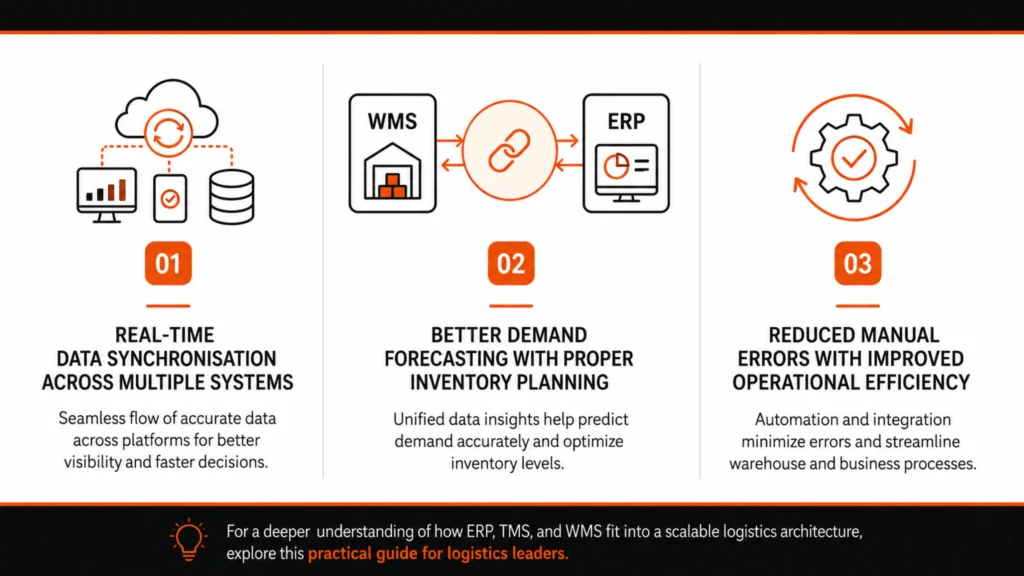
Why Integration Matters: WMS Integration with ERP
WMS vs IMS: Which is Better?
Learning between IMS vs WMS difference usually depends on your business size, operational complexity, and the proper growth stage. Both systems serve different purposes, and the right choice usually comes from aligning the latest technology with your current needs and future goals.
WMS vs IMS: Which is Better?
Learning between IMS vs WMS difference usually depends on your business size, operational complexity, and the proper growth stage. Both systems serve different purposes, and the right choice usually comes from aligning the latest technology with your current needs and future goals.
| Business Stage | Best Solution | Why It Works |
|---|---|---|
| Small Businesses | IMS | Lower cost, faster implementation, and easier training make it ideal for basic inventory tracking and order management |
| Growing Businesses | IMS + Basic WMS | As operations expand, it helps with combined inventory visibility with warehouse control |
| Modern Enterprises & Logistics | WMS | Advanced features like automation, real-time tracking, and workflow optimisation support high-volume and certain complex operations |
| Decision Factors | Consideration |
|---|---|
| Business Size | Smaller businesses benefit from IMS, while the larger ones require advanced WMS capabilities |
| Order Volume | Higher order volumes demand WMS for better efficiency and accuracy |
| Warehouse Complexity | Complex storage and workflows require advanced WMS features |
| Budget | IMS is cost-effective, but the WMS requires a higher investment with long-term ROI |
Cloud WMS Software vs Traditional Systems
As businesses move toward real-time data ecosystems, understanding how logistics data is categorized and tracked within the cloud system can improve overall visibility.
Furthermore, cloud WMS accounted for over 55% of the market share in 2025 and continues to grow at a fast pace, clearly signaling a move away from all the traditional on-premise systems.
| Aspect | Cloud WMS Software | Traditional (On-Premise) WMS |
|---|---|---|
| Cost Structure | Lower upfront cost with the latest subscription-based pricing | High initial investment in the case of both hardware and infrastructure |
| Scalability | Highly scalable as the business grows with time | Limited scalability, and it requires additional infrastructure |
| Accessibility | Remote access from anywhere with internet | Restricted to certain on-site systems |
| Updates & Maintenance | Automatic updates with minimal downtime | Manual updates with higher maintenance effort |
| Control and Security | Managed by the provider and secure | Full control over data and the latest systems |
| Deployment Speed | Assists with faster implementation and seamless onboarding | Longer deployment time |
With benefits like scalability, flexibility, and cost-efficiency, the majority of businesses are actively adopting cloud WMS software, making it an ideal option for future-ready supply chains.
Common Mistakes When Choosing IMS or WMS
Choosing the wrong system or implementing it incorrectly often leads to inefficiencies. According to Gartner, 76% of logistics transformation initiatives, including WMS implementations, also fail to meet key performance, timeline, or even the budget targets. This usually happens due to poor planning, certain integration gaps, and a lack of performing a WMS software comparison.
Choosing WMS When IMS is Already Sufficient:
Many small businesses currently invest in complex WMS solutions without the need for any software for warehouse operations. This increases both cost and complexity unnecessarily.
Ignoring scalability:
Businesses often choose systems that cannot be scaled. As order volumes increase, limited systems create certain chances of bottlenecks, forcing certain costly upgrades or replacements later.
Lack of ERP integration:
If you plan for WMS integration with ERP, taking it lightly for just work may not give you the best results. Therefore, opting for seamless ERP-WMS integration without using the best ERP software, businesses may face duplicate data, certain inventory mismatches, and order delays.
Conclusion
The real question is not about WMS vs IMS which is better; it’s about how well they work together to simplify your business operations. These systems are unique in their own way, solving different layers of operational challenges in their own unique way.
However, the right choice always depends on your business scale, overall complexity, and also the latest growth plans. Therefore, adopt smart, integrated, and cloud-based ecosystems that seamlessly combine ERP, IMS, and WMS while bringing end-to-end efficiency.
