

As e-commerce grows, with sales expected to exceed USD 8 trillion by 2027 old logistics models are struggling. They rely on planning and reactive fixes and are finding it hard to survive under pressure from changing demand, geopolitical tensions and sustainability rules.
In such a scenario, artificial intelligence stands as a game-changer in logistics. AI powered analytics and automation can cut costs significantly in this technically forward era. Apart from that, AI also contributes to warehouse management, route optimization, operations execution, and more.
Imagine warehouses working with precision. Trucks changing routes in time to avoid delays. Supply chains predicting disruptions before they happen. This isn’t science fiction; it’s reality driven by artificial intelligence.
The shift from operations to artificial intelligence-driven systems is a big change. Before spreadsheets and instincts decided inventory and routing. Now artificial intelligence uses lots of data to deliver forecasts and optimizations. This aligns with rising goods volumes being transported from one part of the world to another, some of which even demand same-day deliveries and clear visibility.
Current AI Trends in Logistics
In 2026, artificial intelligence in logistics has evolved beyond basic automation into sophisticated, adaptive systems that drive unprecedented efficiency and resilience.
Leading the charge is agentic AI, autonomous agents capable of executing multi-step tasks without constant human oversight. These systems excel in predictive maintenance, analyzing sensor data from trucks and warehouse equipment to forecast failures days in advance, scheduling repairs proactively to slash downtime.
Similarly, for route adjustments, agentic AI integrates real-time inputs like traffic, weather, and port delays to dynamically reroute fleets, minimizing empty miles and ensuring on-time deliveries even amid disruptions.
A pivotal shift this year is toward connected AI ecosystems spanning warehousing, transport, and procurement. AI in warehouses optimizes picking and inventory via robotics, while transport modules handle dynamic routing, and procurement agents negotiate freight rates based on live market data.
Key AI Applications
Route Optimization
Companies use tools to find the best routes for their trucks because fuel consumption is a major expenditure in the logistics industry. AI tools consider what’s happening on the roads in real time like traffic, congestion, and weather to suggest the best time and route of travel, so that the least amount of fuel is consumed
Trimble and Google Cloud are working on such AI tools used in logistics and transportation in general. They are really helpful because they can help the trucking company plan their routes in a few minutes instead of taking hours to do it. This saves the company a lot of time and eventually a lot of money.
Predictive Analytics & Demand Forecasting
Analytics and demand forecasting use machine learning to stop stores from running out of goods and having too much of them. They do this by looking at things that happen outside of the store like what’s popular, holidays and how the economy is doing. Past records of how the product performed also plays a role in such decisions.
Then they use this information to figure out how it affects sales. This way is better than the way because it can look at lots of different kinds of information like what people are saying on social media or how the weather is affecting food that goes bad.
Demand forecasting and predictive analytics can get it right 20 to 30 percent more often than the old way. This helps a lot because it can stop stores from losing a lot of money, around USD 1.1 trillion every year.
Warehouse Automation
AI empowers robots to pick, pack and track inventory. This is also called RPA or robotic process automation.
AI guides robots that move around the warehouse. These robots help reduce mistakes when picking items. They also help reduce the time and human intervention it takes to complete a cycle by forty percent.
Further, the use of RFID and digital copies of the warehouse run by AI helps keep track of inventory with high accuracy. This accuracy eliminates the need for workers to manually count items. It also helps predict when to restock items.
Real-Time Tracking & Visibility
Real-time tracking helps us see where our goods are. It uses AI powered surveillance to spot defects on packages during delivery at docks or during last-mile delivery.
Computer vision checks packages for damage while they are being transported. If it finds any issues it flags them immediately so we can fix the problem either by rerouting the package or compensating the customer.
AI powered blockchain makes sure deliveries match orders perfectly with no mistakes. This complete visibility helps reduce theft, which can be up to 5% of the cargo value.
Benefits and ROI
Cost Reductions
The use of Artificial Intelligence saves money by making every part of the supply chain more efficient. From predictive maintenance to operational optimization and strategizing, there’s nothing that AI cannot contribute to.
Artificial Intelligence can also find the routes for vehicles, which reduces the amount of fuel we use. And fuel is the biggest cost that can matter in logistics. By doing this the fuel expenses can be significantly cut. Businesses also use AI to stock or restock products as well as manage warehouses using robots and IoT. Getting human workforce to get all these done would cost significantly and leave room for error.
Faster Decisions
Time artificial intelligence analytics helps to make decisions really fast, in just a few hours.
When all the systems are connected together they can look at an amount of information that comes from Internet of Things sensors, weather information and market updates.
This gives us information in real time that can be acted upon instantly like changing routes, ordering products, recalling deliveries, and more. It also helps companies stay ahead of their competitors when things are changing quickly.
Sustainability Gains
Using intelligence to plan the best routes for vehicles reduces the amount of fuel that is used. This can lower the pollutants that we put into the air called Scope 1 emissions by 15 to 20 percent. This is what many countries are doing, like the European Union with its ETS rules for ships.
Artificial intelligence in warehouses is also very helpful. It makes sure that unnecessary energy is not wasted by using lighting and scheduling robots at the right time.
Real-World Case Studies
DHL’s AI Route Optimization
Challenges: DHL faced rising fuel costs and delays from traffic, weather, and port bottlenecks in global shipping, eroding customer trust during peak seasons.
Solutions: Deployed AI-driven route optimization via Resilience360 platform, integrating real-time IoT data, weather APIs, and machine learning to dynamically reroute 100,000+ daily shipments across 220 countries.
Maersk’s Agentic AI for Carrier Evaluation
Challenges: Maersk struggled with inconsistent carrier performance evaluation, manual bidding processes causing 10-15% overpayments and unreliable global lanes amid Red Sea disruptions.
Solutions: Implemented agentic AI that autonomously scores carriers on metrics like ETA accuracy, cost, and sustainability via multi-step workflows. These self-executing systems analyzed historical data, live tracking, and market rates to negotiate and select optimal partners.
DEO Framework at a Global Manufacturer
Challenges: A Fortune 500 firm grappled with siloed decisions across procurement, warehousing, and transport, leading to $50M in excess inventory and reactive crisis management.
Solutions: Adopted Decision Engineering Optimization (DEO), structuring AI around key decisions. Traceable models integrated unstructured data (e.g., emails, news) for enterprise-wide outputs.
Implementation Steps
- Begin by defining precise objectives, such as boosting forecasting accuracy or cutting route deviations directly tied to KPIs.
- Next, adopt decision-first frameworks like DEO (Decision Engineering Optimization). This approach engineers AI around critical decisions using modular, auditable models.
- Then, integrate targeted AI tools gradually. Start with proven platforms like FourKites for routing optimization and o9 Solutions for analytics, piloting on 10-20% of operations to gather data and refine algorithms before enterprise rollout.
- Finally, scale to connected systems through API orchestration, linking warehouse management systems (WMS) with transport management systems (TMS) and ERP for holistic visibility and automated handoffs, unlocking network-wide efficiencies.
Future Outlook
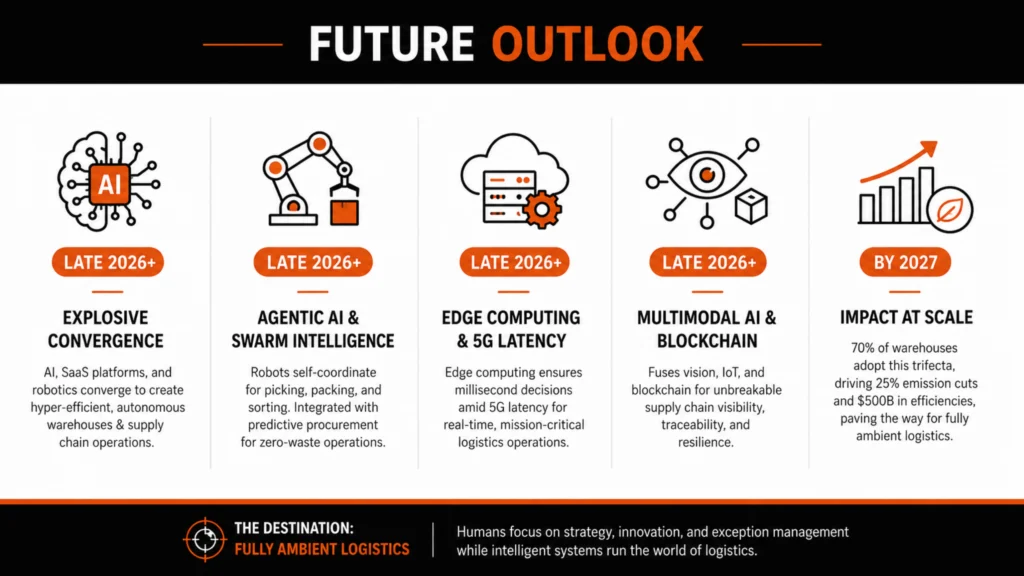
Looking ahead to late 2026 and beyond, AI in logistics will see explosive convergence of AI, SaaS platforms, and robotics, birthing hyper-efficient, autonomous warehouses and supply chain operations.
Agentic AI will evolve into “swarm intelligence,” where robots self-coordinate for picking, packing, and sorting without human input, integrated with predictive procurement for zero-waste operations. Edge computing ensures millisecond decisions amid 5G latency, while multimodal AI fuses vision, IoT, and blockchain for unbreakable supply chain resilience.
By 2027, expect 70% of global warehouses to adopt this trifecta, driving 25% emission cuts and $500B in efficiencies, paving the way for fully ambient logistics where humans focus on strategy.
FAQs
What is AI in logistics?
AI in logistics is about using NLP, machine learning, and cognitive computing to make supply chain processes better. They use data to find ways to work efficiently.
How does AI optimize supply chains?
AI helps make supply chains better in ways. It optimizes routes to reduce fuel consumption and uses analytics to forecast demand and cut stockouts. In warehouses AI automation speeds up picking, sorting, packing, and more. With real-time tracking AI provides visibility and predictability in every step of supply chain and logistics operations.
What are AI logistics trends for 2026?
The trend is clear: AI is here to help businesses. 2026 trends are all about AI that can do things on its own like maintenance and evaluating carriers. It will also connect parts of a business like warehousing, transportation and procurement. These connected AI systems will help businesses run smoothly from start to finish.
