

Modern ports generate large volumes of operational, financial, and vessel data daily. This data includes the movements of containers in Terminal Operating Systems (TOS), financial transactions in ERP platforms, and real-time information about ships from marine systems.
Ports can improve operational visibility and decision-making by integrating data from ERP systems such as SAP, ORACLE and other platforms as well. This enables unified tracking of vessel, cargo, and financial data.
This guide outlines how ports can build a scalable data lake architecture and successfully connect TOS, ERP, and vessel systems by using up-to-date methods.
Key Takeaways
- A port data lake acts as a unified hub that brings together data from operations, finance, and vessel systems.
- It connects platforms like TOS, ERP (SAP/Oracle), and marine systems to create a complete operational view.
- By removing disconnected systems, ports gain clear visibility and faster access to insights.
- Integration enables quicker decisions, smoother workflows, and reduced manual effort.
- The system is built using layers such as data ingestion, storage, processing, analytics, and governance.
- Technologies like APIs and middleware ensure seamless and real-time data exchange between systems.
- Strong governance practices help maintain data accuracy, security, and compliance.
- A well-implemented data lake supports automation, predictive analytics, and smarter planning.
- Over time, it helps ports become more efficient, scalable, and future-ready.
What Is a Port Data Lake?
A port data lake enables storage and processing of structured and unstructured data from various systems present in one place. All of this can be done using a port data lake, acting as a centralized data repository.
A data lake is different from traditional databases because it can accept raw data from many sources, such as Terminal Operating Systems (TOS), ERP platforms, vessel tracking systems, and external partner networks, without having to follow strict formatting rules.
Why Ports Need Data Lake Integration
This is why ports need to connect to a data lake:
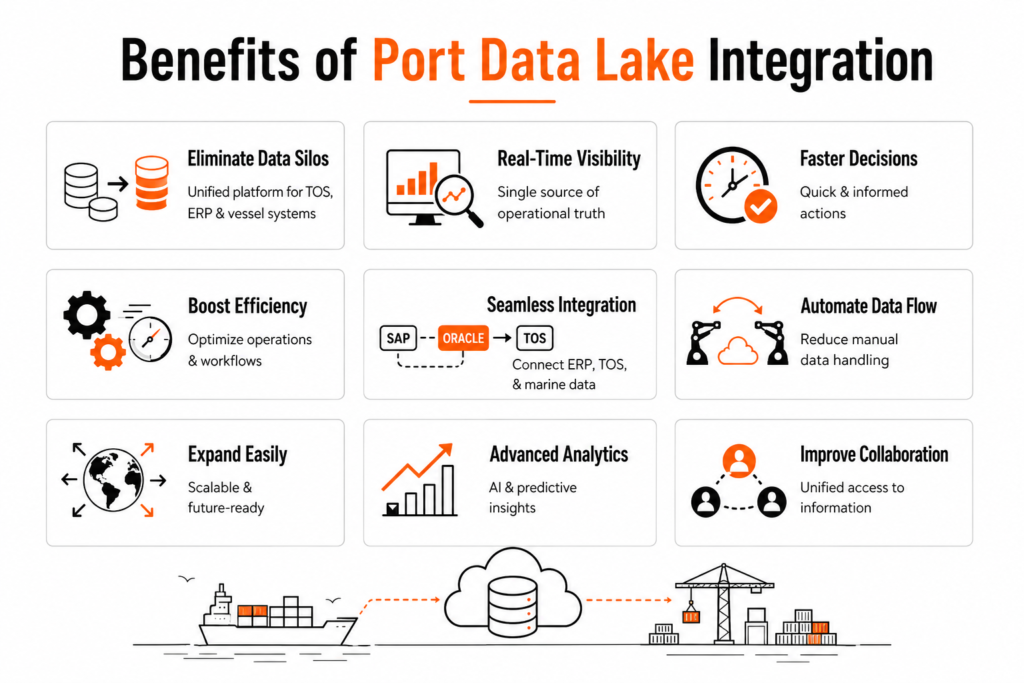
Eliminates data silos across systems
Combines TOS, ERP (SAP/Oracle), and vessel systems into a single platform, getting rid of data environments that are spread out in different places.
Improves real-time visibility
Effective port data lake integration makes it possible for operations, finance, and logistics to all use the same source of truth.
Enables faster and more accurate decision-making
Reduces reliance on manual reporting and delayed insights, so operators can act right away.
Improves operational efficiency
It speeds up the process of finding delays, traffic, and inefficient workflows across terminals.
Enables seamless integration between TOS and ERP systems
It links operational data to financial systems, such as Oracle port data and SAP port terminal integration.
Reduces manual data reconciliation
Automates the flow of data between systems, which cuts down on mistakes and raises the level of accuracy.
Allows integration with outside platforms
Links up with systems that deal with customers, like eCommerce portals, port data, and logistics partner networks.
Supports scalable expansion across multiple terminals
It allows the addition of new data sources and technologies without affecting any systems that are already placed properly.
Allows for advanced automation and analytics
It helps build a foundation for AI, predictive insights, and optimization based on data.
Helps departments work together
It helps ensure that everyone in the port ecosystem has proper access to accurate and updated information.
Important Systems to Add to a Port Data Lake
To make a useful data lake, you need to connect all the main systems that run the port. If you put all of these systems together, it will give you a complete picture of the entire port ecosystem. Linking and synchronizing a system with the data lake is crucial for the success of TOS ERP integration port strategies.
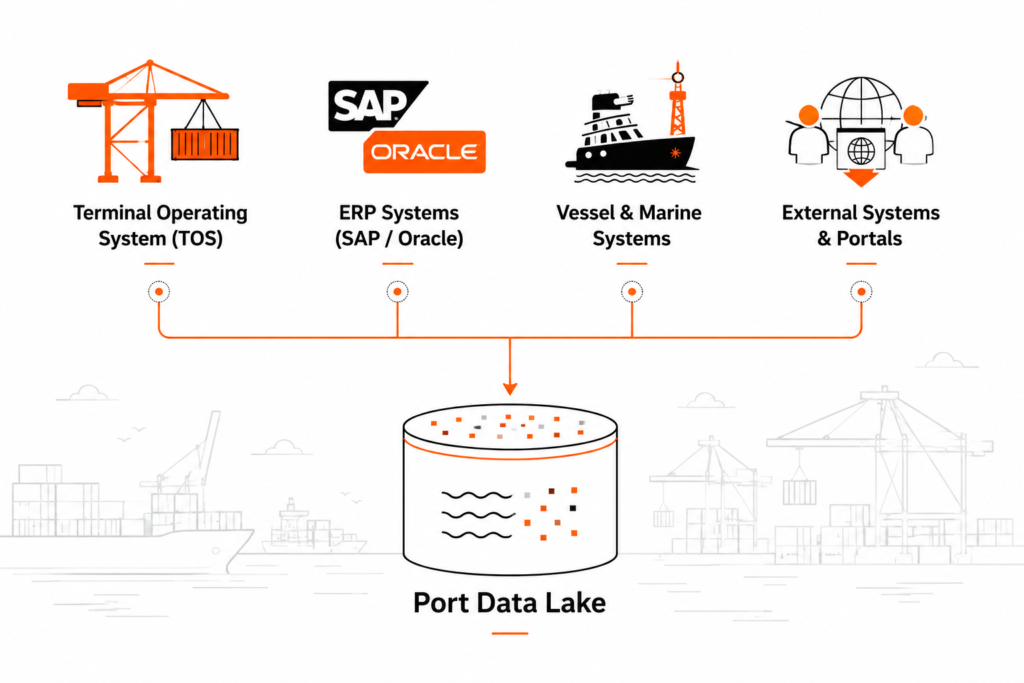
Terminal Operating System (TOS)
The Terminal Operating System (TOS) is the core operational system managing terminal activities. It controls the movement of containers, yard planning, equipment assignment, and gate operations. It generates real-time operational data about how cargo is handled and what’s going on at the terminal.
By adding TOS to the data lake, ports can collect operational data like the status of containers, the productivity of cranes, and how the yard is being used. This information is the basis for analytics, which helps with better planning, tracking performance, and improving operations.
ERP Systems (SAP / Oracle)
ERP systems, such as SAP and Oracle, handle the port’s finances, purchases, billing, and management of resources. Ports can link financial information with operational tasks by integrating SAP port terminals and adding Oracle port data to it.
This integration helps ensure that the operational performance, revenue and costs are in line with each other. This enables decision-makers to evaluate operational efficiency and financial performance holistically. Based on all real-time operational data, it lets you automate billing and invoicing processes.
Vessel & Marine Systems
Vessel and marine systems provide critical data on vessel movement and scheduling, where to dock, how to track them with AIS, and when to do things. This information is essential for planning arrivals, departures, and all the traffic in the port as a whole.
Once vessel data is added to the data lake, it helps improve visibility across all maritime operations and improves berth planning and vessel scheduling decisions and when to schedule them. It facilitates the prediction of ship turnaround times and the management of traffic congestion.
External Systems & Portals
Customs officials, logistics providers, shipping lines, and customers are just some of the outside groups that ports work with. For full visibility, it’s important to have data from these systems, especially through platforms like eCommerce portal port data.
Adding data from outside sources to the data lake enables seamless communication across the supply chain and work together. It makes things better for customers by giving them updates in real time and better for business by coordinating port activities with outside partners.
All of these systems work together and support the port data lake. This lets all its parts work together and allows data-driven port operations to reach their full potential.
Architecture of a Port Data Lake
A proper port data lake architecture lets data flow easily from various systems and supports scalability and real-time processing, as well as advanced analytics. The architecture is made of various layers, all of which work together to make it easy to connect the port data lake to ERP, TOS, and vessel systems, as well as other platforms.
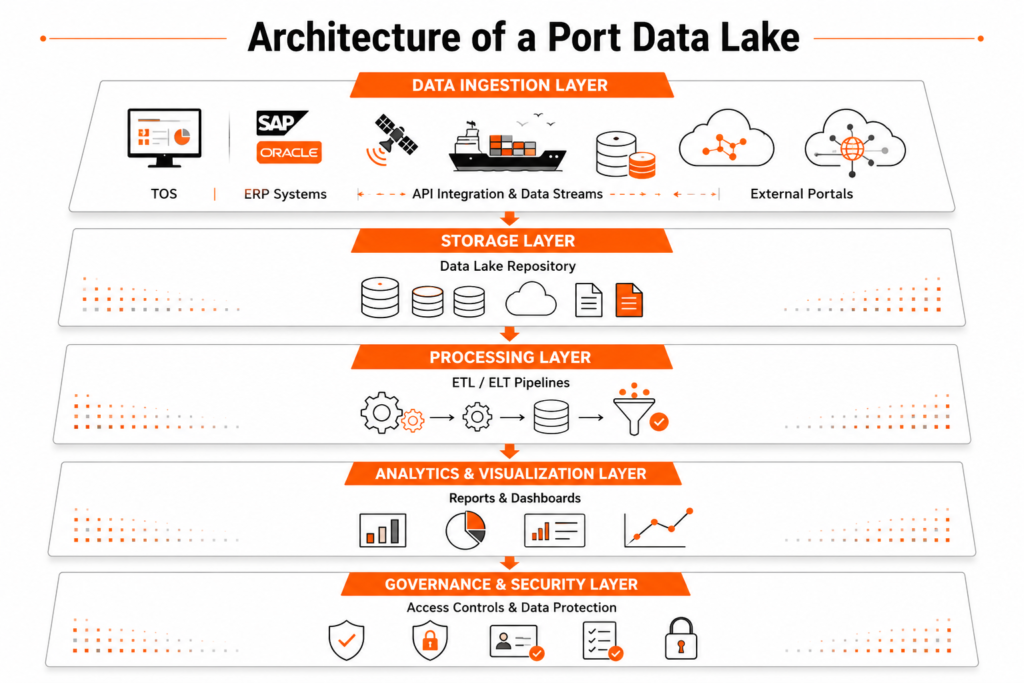
Data Ingestion Layer
The data ingestion layer collects data from multiple sources and put into the data lake. It gets information from TOS, ERP systems like SAP and Oracle, systems that track ships, Internet of Things (IoT) sensors, and outside portals.
API-based integration is critical for real-time data ingestion because it lets them take in data in real time. To make sure that data keeps flowing, tools like batch uploads, streaming data pipelines, and middleware are also used.
Storage Layer (Data Lake Repository)
The storage layer retains raw data in its original format in the storage layer. This layer, which is usually hosted in the cloud, lets ports handle large amounts of structured and unstructured data quickly.
Ports keep their flexibility for future analysis by storing raw data. This includes advanced use cases involving Oracle port data, operational logs, and historical records. This layer serves as the foundation for all analytics and reporting.
Processing Layer (ETL/ELT Pipelines)
This layer transforms and cleans data, and preparing it for analysis. Pipelines for ETL and ELT make sure that data from different systems is usable and consistent as well.
This feature is an important step for lining up data from the TOS, ERP, and vessel systems. This ensures consistency for reporting and analytics. It helps with automation and ensures that the insights coming from the data lake are all accurate.
Analytics and Visualization Layer
After processing, data is used for reporting, dashboards, and advanced analytics. This layer provides stakeholders information about operations, finances, and logistics that they can use.
Ports can use this layer for real-time monitoring, performance tracking, and predictive analytics. It also lets you connect to platforms that deal with customers, like eCommerce portal port data, which improves visibility and decision-making.
Governance and Security Layer
A strong data governance framework ensures data security, quality, and compliance of high quality, and consistent. This involves establishing access controls, monitoring data ownership, and ensuring adherence to industry regulations.
To keep private business and financial information safe from hackers, you need security measures, such as encryption, monitoring, and authentication.
These layers work together to form a strong structure that allows ports to combine data from various systems, support advanced analytics and create a foundation for a digital transformation that can grow.
Steps to Build a Port Data Lake
If you want to create a port data lake, you have got to follow a structured process that matches technology with operational goals. Every step is important for a successful port data lake integration across TOS, ERP and other vessel systems.
Step 1: Define clear goals and use cases.
The first step is to make it clear what the port wants to do with the data lake. This could mean making operations more visible, allowing real-time analytics, improving the customer experience, or helping with automation.
Figuring out specific use cases, like tracking performance, automating billing, or planning ahead, helps direct the overall architecture and integration strategy.
Step 2: Identify data sources
Next, ports must compile a comprehensive list of all data sources that require connectivity. This usually includes TOS for operational data, ERP systems like SAP and ORACLE for financial data, vessel systems for marine data, and port data from outside sources such as logistics networks and eCommerce portals. If you know a lot about the data sources, you won’t miss any important information during integration.
Step 3: Select integration approach
For data to flow smoothly, it’s important to choose the right integration method. Depending on how the infrastructure is set up, ports can use APIs, middleware platforms, or tools for streaming data.
API integration terminal software is used in modern implementations to connect systems in real time, which makes data exchange faster and more reliable.
Step 4: Design a scalable architecture.
Ports should have a data lake architecture that is adaptable and scalable so it can handle data and new sources. Cloud-based solutions are often used to help with performance as well as scalability.
In this step, you also set up the data storage, processing pipelines, and integration layers that will help the business grow in the long term.
Step 5: Build ETL/ELT data pipelines.
It is the job of data pipelines to get data from source systems, change it into formats that can be used, and load it into the data lake. These pipes make sure that the data from the TOS, ERP, and vessel systems is all the same and can be analyzed.
Well-thought-out pipelines make data more accurate and allow insights to be gained in real time or very close to real time.
Step 6: Establish data governance framework
To ensure data quality, security, and compliance, it’s important to set up strong port data governance. This includes setting rules for standardization, who owns the data, and who can access it.
Governance frameworks guarantee system consistency and enable the use of data for informed decision-making.
Step 7: Enable analytics and visualization tools
The final step is to make it possible for reports, dashboards and analytics platforms to use data. This way, stakeholders can learn about operations, finances, and performance metrics.
Over time, ports can add more advanced analytics tools like AI driven insights and predictive models. This helps them get the most of their data lake. Ports can build scalable and strong data lakes that make integration easy, help improve visibility and lead to smarter, data-driven operations by following the proper steps.
Plans For Putting TOS, ERP, And Vessel Systems Together
Here are the plans for putting the TOS, ERP, and vessel systems together:
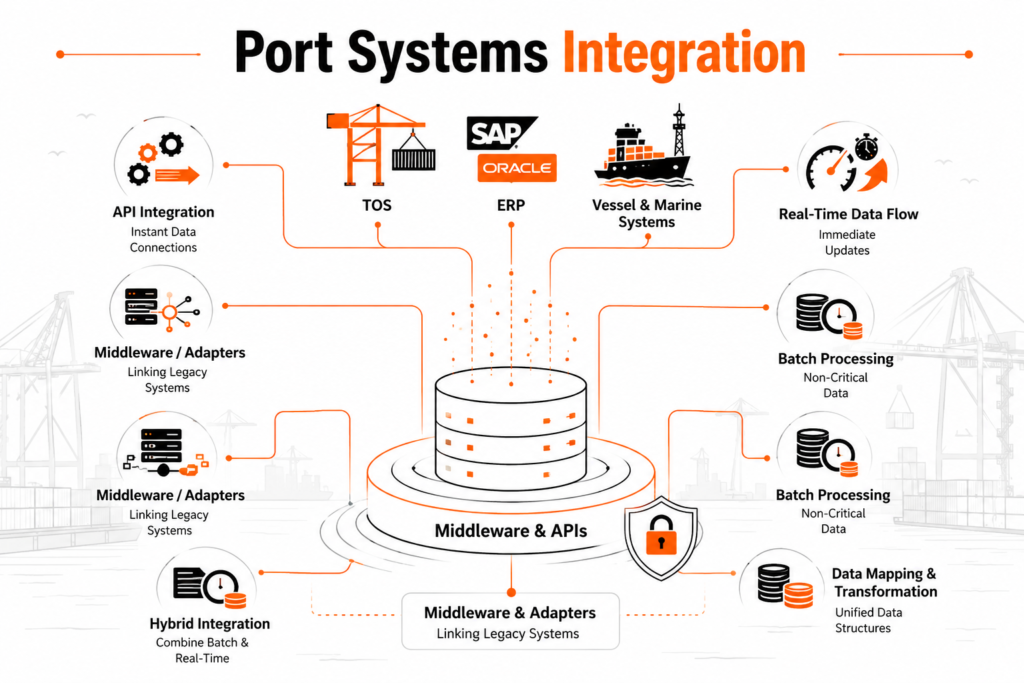
API-based integration for real-time data flow
API-based integration connects ERP, TOS, and vessel systems, allowing data to be sent instantly.
Middleware enables integration with legacy systems
It is useful in TOS ERP integration port settings because it acts as a link between the older and the new platforms.
Integration in real time for important tasks
Tracking ships, planning berths, and maintaining live terminal visibility necessitate immediate updates.
Batch processing for non-critical data
This can be used for financial reporting, looking at the past, and storing data without needing to be updated in real time
Approach to hybrid integration
Combine real-time processing and batching to find the best balance between speed, cost, and performance.
Using connectors and adapters to work with old systems
Allows integration of older platforms such as Oracle data systems for ports and SAP port terminal integration.
Standardized data models and mappings
Makes sure that the TOS, ERP, and vessel systems all use the same data structure so that analytics are accurate.
Changes and normalization of data
Makes sense of the different file types and terms from different systems before putting them in the data lake.
Framework for scalable integration
Allows adding new systems and data sources without stopping current processes.
Protocol for safe data exchange
Makes sure that operational and financial data can be sent between systems in a safe and legal way.
Data Governance and Security in Port Data Lakes
Here is what data governance and security in port data lakes look like:
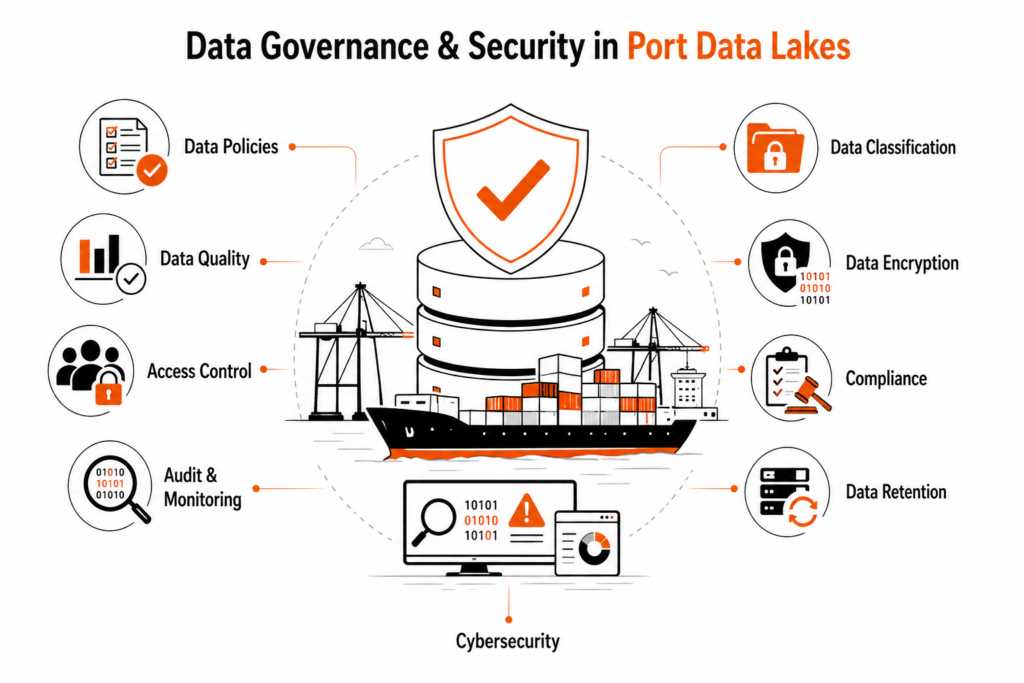
Establishing strong data governance frameworks
Sets standards and policies and determines who owns the data to make sure that it is consistent and reliable across systems.
Quality of data and standardization
Makes sure that the data from the ERP, TOS, and vessel systems is correct and complete. It should be formatted the same way everywhere.
Managing users and controlling access
Sets up role-based access to protect sensitive data and make sure that only people who are allowed to can see or change information.
Classification and separation of data
Sorts data into groups (like “operational,” “financial,” and “sensitive”) so that it can be managed well and the right security measures can be taken.
Following the rules and standards of the industry
Ensure adherence to data protection laws and maritime regulations.
Data encryption and safe storage
Guards data while it’s being sent or stored to stop people from getting to it without permission.
Cybersecurity measures for systems that are linked together
Protection against cyber threats that may arise due to connections with a data lake integration for ports.
Tracks and monitoring for audits
Tracks data access and modifications to ensure their openness as well as accountability.
Managing the lifecycle of data
Tells the computer how to store, back up, and delete data over time.
Connecting to business security systems
Fits with the IT security frameworks that are already in place and are used by ERP systems like SAP and Oracle.
Risk management and planning for how to respond to incidents
Gets ports ready to find and respond quickly to system failures or data breaches.
Building trust in decisions based on data
Strong governance makes sure that the analytics and insights that come from the data lake are correct and reliable.
Conclusion
Building a port data lake is a strategic requirement for modern ports; enabling real-time visibility and data-driven operations, operational efficiency, and making decisions based on data. Ports can get rid of data silos and make a single, accurate source of truth by combining TOS, ERP systems like SAP and Oracle, and vessel platforms into a single architecture.
Terminals can improve operations, automate tasks, and access advanced analytics tools by integrating port data lakes well, using API integration terminal software, and making sure that port data is properly managed. In addition to improving day-to-day operations, this also gets ports ready for new technologies like digital twins, AI-driven insights, and smart port ecosystems.
While integration complexity and initial costs exist and how much it costs at first, but the long-term benefits, like higher customer satisfaction and better efficiency, make it a smart investment. As global trade changes, ports that use scalable and integrated data platforms will be better able to stay resilient, competitive, and ready for the future.
FAQs
What is the difference between a port data lake and a traditional port database?
A conventional database needs to have structured and pre-formatted data. A port data lake is raw data of TOS, ERP, and vessel systems without rules of formatting and is hence free for cross-system analysis and real-time processing.
Which cloud platforms are best suited for building a port data lake?
AWS S3, Azure Data Lake Storage, and Google Cloud Storage are commonly used. They help power massive raw data storage, real-time ingestion pipelines, and connect directly with analytics and AI tools.
How does a port data lake support AI and predictive analytics use cases?
A data lake merges TOS, ERP, and vessel data into a single repository. This provides the AI models with predictive berthing, congestion detection, turnaround forecasting, and automated billing workflow, consistent and cross-system inputs.
How long does it typically take to build and integrate a port data lake?
A fundamental port data lake with fundamental TOS and ERP integration normally requires six to a dozen months. Full integration across vessel systems, governance frameworks, and analytics layers extends timelines to eighteen months or more.
