

Most businesses adopt Odoo as their ERP model, considering the flexibility it has to offer. From integrating processes to streamlining operations, Odoo can help increase the efficiency of businesses. However, the out-of-the-box features may not align with business needs. That’s when businesses should opt for Odoo customization. Around 182,748 websites use Odoo.
Custom Odoo development services ensure that the ERP is aligned with your business’s needs. Customization can play an important role in streamlining the functions, workflows, and operations of your business. This article explores all you need to know about Odoo customization and how it can help you in the long run.
Why Are Custom Odoo Development Services Needed?
Not all businesses are created equal. Therefore, the Odoo requirement won’t be the same either. It’s for this reason that businesses need Odoo custom module development.
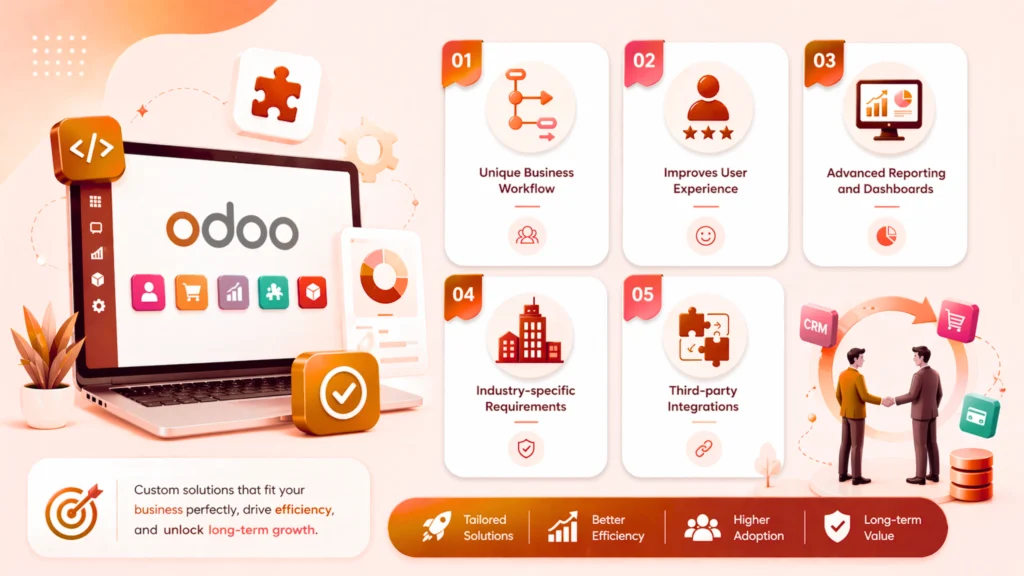
Although Odoo offers a lot of modules and thousands of community apps, there will be specific gaps in that, based on business needs. To address these gaps, most businesses opt for Odoo customization.
Some of the key benefits of choosing custom Odoo development services are as follows:
- Unique Business Workflow: No two businesses have the same workflow. Standard Odoo modules may not cover what your business needs. For this reason, Odoo custom module development is needed. This addresses the unique business requirements and streamlines the process.
- Improves User Experience: Custom Odoo workflow plays an important role in improving the overall user experience. Tweaking UI simplifies complex workflows and drives user adoption. This can play a significant role in reducing the training time.
- Advanced Reporting and Dashboards: Pre-built reports may not be enough for businesses. Therefore, customization is required on the way. Custom dashboards can turn the raw data into actionable insights, which will help in fast decision-making.
- Industry-specific Requirements: Odoo ERP requirements will vary from industry to industry. Customization ensures that those specific needs are addressed. Therefore, it would help in the long run in terms of driving compliance.
- Third-party Integrations: Integrating Odoo with complex third-party systems such as payment gateways, CRM, and eCommerce may not be possible if you have a standard version. However, opting for Odoo custom module development can ease the integration part.
How Does Odoo Studio Customization Help?
Customizing Odoo would involve extending or changing Odoo beyond the standard configuration options. Odoo will have different settings such as automated actions, tax rules, access rights, and workflows. These configurations can play an important role in getting your business started.
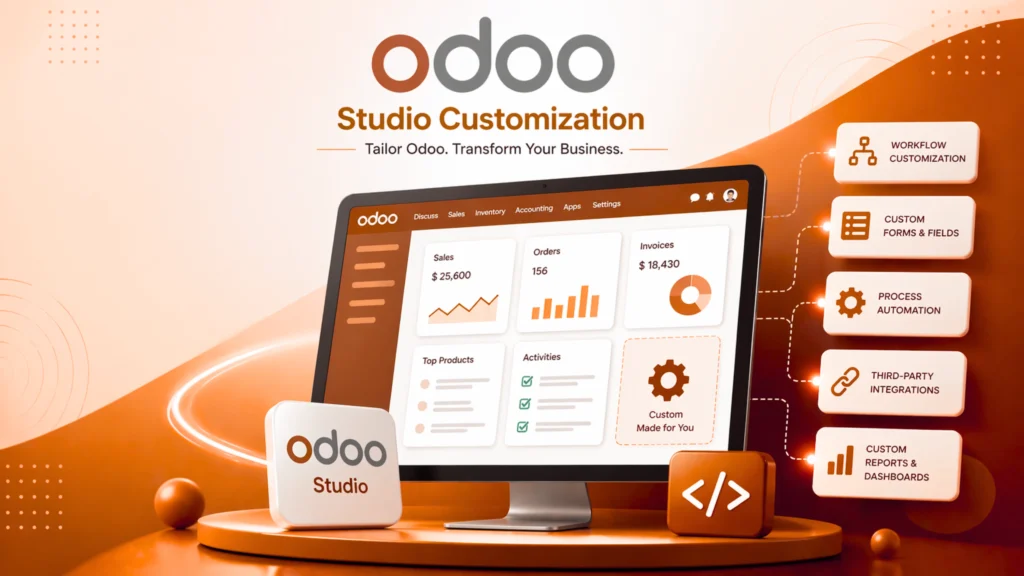
However, maintaining a custom Odoo workflow also comes with its own set of limitations. If Odoo doesn’t offer what your business needs, customizing it is the best way out.
Odoo custom module development can include different components, such as the following:
- Extending or changing the workflow.
- Adding new forms or fields.
- Automating specific business processes
- Building completely new modules.
- Odoo integrations with external systems.
- Creating custom reports and dashboards.
Customization helps your system grow with your business. It can adapt the software to your business needs.
What Are the Challenges of Odoo Customization?
While Odoo customization can be extremely beneficial for the business, it will happen only if you do it right. Several businesses often fail to prepare a custom Odoo workflow the right way, which can cost significant losses as well.
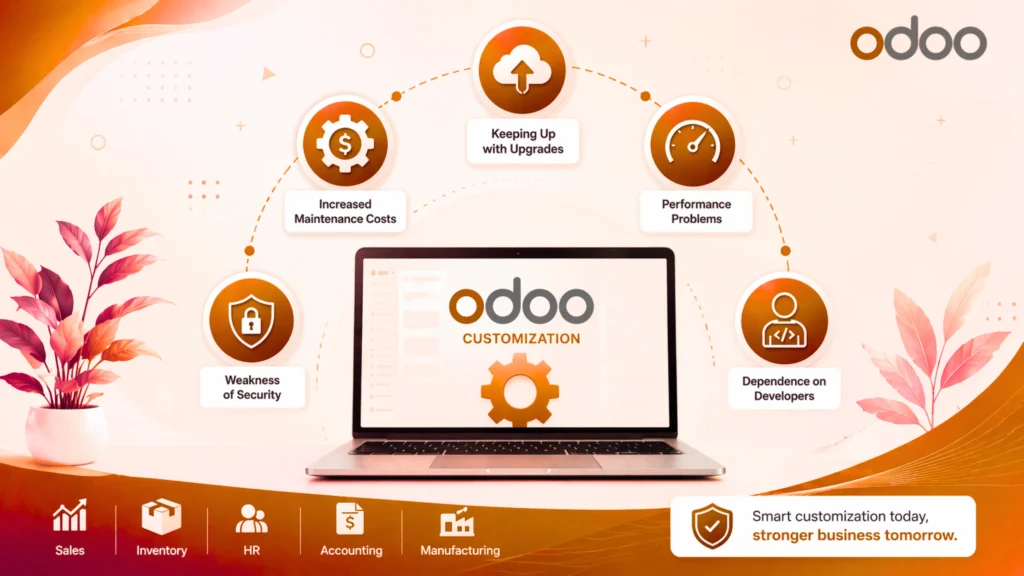
Handling Odoo customization is crucial to prevent the risk of long-term issues. Some of the key challenges of Odoo customization include the following:
1. Keeping Up with Upgrades
Odoo releases new updates every year. If customization isn’t done the right way, especially with the modifications of core files, there will be difficulties. You may face difficulties in keeping up with upgrades, which can also be time-consuming and expensive.
2. Increased Maintenance Costs
As mentioned earlier, more customization means businesses have more code to maintain. This will have a significant impact on the Odoo module customization cost. If all modules aren’t documented or structured well, making changes in the future will become more complicated. Therefore, businesses end up facing challenges.
3. Performance Problems
The Odoo Python developer you hire shouldn’t code poorly or overcomplicate the logic. Excessive complex logics will slow down dashboards, large queries, inventory updates, and accounting operations.
During Odoo custom module development, it is extremely important to consider the performance. Not doing so can have a significant negative impact. A slower performance will harm the reputation of the business.
4. Weakness of Security
Data validation is crucial for maintaining a custom Odoo workflow. However, not doing so can expose sensitive information, which can raise questions about the security of the business.
For custom module development, it is extremely crucial to follow security principles.
5. Dependence on Developers
Several businesses struggle with the customization process when the developers leave. It is very common to depend on the developers, but excessive dependency can also be a problem in the long run.
All the customization regarding the Odoo workflow should be documented. Not doing so can lead to companies struggling if the original developer leaves.
What Are the Benefits of Odoo Custom Module Development?
Odoo OCA modules should be customized in the correct way. It can play an important role in driving growth. Customizing and integrating Odoo can help to overcome numerous business challenges.
Some of the key benefits of Odoo custom module development include the following:
1. Builds a System for Your Business
For the business to be efficient, it is crucial for the process to match the employees. Rather than having your employees learn new processes, it would be beneficial to adapt the software to existing processes.
Having a system tailored to your business can lead to fewer mistakes and eventually increased productivity of employees, lowered training time, and fewer mistakes.
2. Custom Reports
The Odoo custom report can play an important role in better decision-making. Most decision-makers depend on the KPIs that are available in standard modules.
With the help of custom dashboards and reports, you can get complete information on the performance. Therefore, all leaders can react faster, better, and plan accurately.
3. Long-term Scalability
With your business growing, you will need scalability benefits in the long run. Custom Odoo development services can play a role in the long run to drive long-term scalability.
Customization helps companies expand their business workflows. There wouldn’t be a need for rebuilding the system, but its customization should help in the long run.
4. Manual Work Automation
Most businesses have repetitive tasks regarding document generation, updating the records, sending notifications, assigning tasks, and so on. Each of these needs to be done on a regular basis.
Custom rules and workflows can help automate the workflows, which may not be done manually. For this reason, a custom Odoo workflow is needed. This would play an important role in focusing on higher-value work.
5. Seamless Integrations
Odoo custom module development can play an important role in seamless integrations. By customizing, businesses can communicate with external systems that create a centralized ecosystem.
Seamless integration through the system should be helpful in the long run regarding accurate stock tracking, unified customer records, real-time data updates, and faster order handling.
When Should You Customize Odoo?
Odoo custom module development should be done only if the default features don’t match the business’s workflows. At the same time, it is crucial to consider integration and reporting needs. The right time for customization depends on the business complexity, requirements, and implementation strategy.
Odoo custom workflow is an important factor to consider if you have any industry-specific requirements. If changing the process reduces efficiency, in that case, customization will be needed.
Based on your requirements, you’ll have to consider the following:
- Multi-level pricing logic
- Non-standard inventory flows
- Custom approval chains
In most cases, you will have to choose custom Odoo development services after GAP analysis. When you’re planning to integrate Odoo into your business, you’ll have to consider the existing standard features and business requirements. Many mid-size businesses choose Odoo because of the benefits.
You should look for reporting gaps, missing workflows, and extra manual steps. This is one of the best times to decide when you’ll need customization.
What is the Odoo Module Customization Cost?
The exact Odoo modules customization cost can significantly vary depending on what your requirements are. Since there are already existing standard features in Odoo, you’ll have to check what you can use.
If there are features that aren’t enough, customizing is one of the key factors to consider. However, depending on how much you customize, pricing would also depend on it.
Below is a brief insight into the cost of Odoo custom module development:
- Minor or small customizations: $500 – $2,000
- Medium module customization: $2,000 – $10,000
- Large module customization: $10,000 – $50,000+
Note:: Pricing is subject to change
However, the costs vary if you hire individual freelance developers or expert companies. At the same time, it is important to note that while some businesses hire custom Odoo service providing companies, some may go for freelancers.
Some of these businesses charge on an hourly basis, whereas some charge on a project basis. Before initiating the Odoo Studio customization, check what their pricing models are and align them if they fit your needs.
How to Customize Odoo the Right Way?
To ensure that your Odoo custom module development sticks for a long time, it is crucial to customize it the right way. Apart from customizing, it is also advisable to follow a strong Odoo implementation roadmap to prevent any major issues.
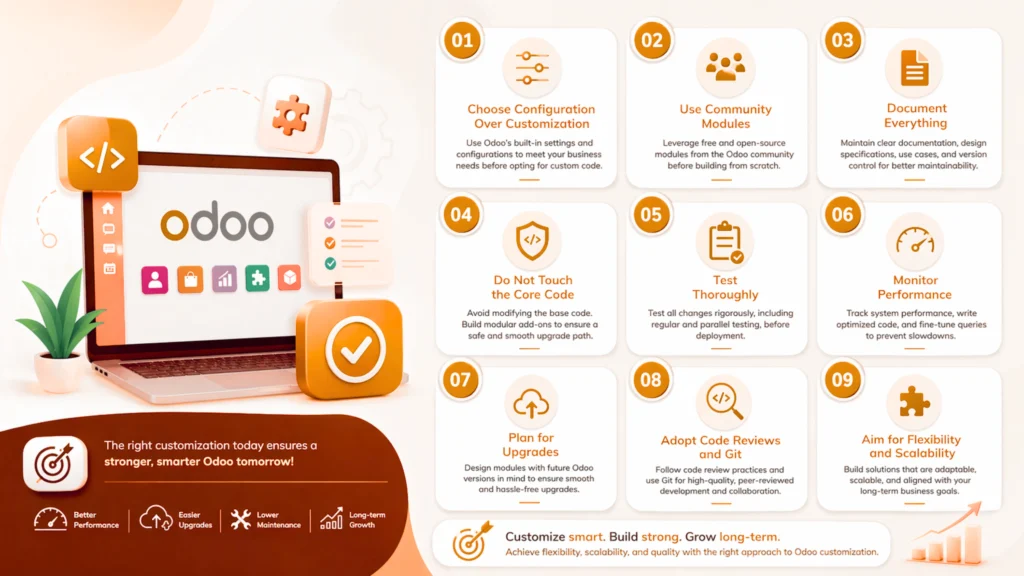
Below are the key practices to follow for customizing the Odoo module:
- Choose configuration over-customization: Most businesses often choose customization. However, before proceeding with customization, businesses must identify what advanced configurations will be needed.
- Use the community modules: While reinventing the wheel may seem like an ideal plan, it is advisable not to do so. It is best to first use the open-source apps.
- Document everything: For successful Odoo Studio customization, it is advisable to document everything. You should use design specifications, case documentation, and version control for maintainability and clarity.
- Do not touch the core code: Initially, it is best to avoid touching the base code. You should prevent the risk of breaking the upgrade path by building isolated or modular add-ons.
- Test thoroughly: Before deploying the Odoo custom module development changes, it is crucial to test thoroughly. Conduct regular tests and also parallel tests to avoid any unnecessary changes.
- Monitor the performance: Always make sure to monitor the performance after you’ve implemented the custom Odoo workflow. Integrate lightweight code, optimize the queries, and prevent the risk of ERP slowdowns in case of worst-case scenarios.
- Plan for upgrades: Always make sure to thoroughly plan for upgrades. In the future, Odoo will release new versions. Ensure that you’re opting for design modules that can be upgraded when Odoo releases updated versions.
- Adopt code reviews and Git: It is extremely crucial to opt for code reviews. It is advisable to conduct high-quality, peer-reviewed development to minimize the risks.
To customize Odoo the right way, it is advisable to achieve flexibility. Following these practices should help you in the long run. It doesn’t compromise on quality or scalability, further providing long-term growth.
Step-by-step Odoo Customization Process
Partner with professionals for custom Odoo development services who follow a detailed, step-wise approach for minimizing the risk and driving measurable outcomes.
Here’s a detailed step-by-step guide to follow for custom Odoo module development:
1. Conduct Requirement Gathering and Gap Analysis
The Odoo customization development company will analyze your current workflow and identify any gaps in regard to the standard features. This should help in identifying what exactly will be required.
2. Prepare Case Documentation
Post gap analysis, case documentation must be prepared. The experts will help to define what needs to be changed. This will be done to prevent any risks.
3. Solution Design
Technical documentation must be prepared. The technical document must highlight data models, architecture, and workflows.
4. Effort Estimation
The scope of work must be broken down thoroughly. The development team will provide a thorough, transparent cost and timeline.
5. Development and Customization
Always be mindful of the core code of Odoo. For successful Odoo Studio customization, it is advisable to integrate features. Do not build isolated modules if you’re planning to alter the core code of Odoo.
6. Conduct Testing
Testing should be done across all stages to determine safety and security. For Odoo customization, it is advisable to conduct different types of testing, such as acceptance testing, integration testing, and unit testing. Missing out on testing even one point will create problems in the long run.
7. Deployment
The custom Odoo development services should assist the businesses with deployment. Roll out the integrated custom features into production. However, check with the agency if that can be done with minimal downtime. While deploying, it is also important to ensure that no business operations are impacted.
8. Post-launch Support
Customization doesn’t end with deployment, but post-launch support is required. The development customization team should thoroughly offer post-launch support. This would conclude fixing the bugs, continuously monitoring, and upgrading versions.
Conclusion
Odoo customization can play a key role in driving growth for businesses. If you’re not satisfied with the standard features, customization will help to drive value. However, it is extremely important to have the right strategy and integrate the best practices.
Customizing your ERP can play an important role in delivering long-term value. You need to partner with professional custom Odoo development services, such as Intech Group, to foster the growth of your business. With the necessary expertise and certificates, Intech Group can help you achieve success with customization.
FAQs
Can Odoo be customized?
Yes, Odoo is a powerful open-source ERP software that can be easily customized to fit the business needs. By customizing Odoo, you can streamline your business workflow and improve efficiency and user experience.
When should businesses customize Odoo?
Businesses should consider customizing Odoo when the standard features do not seem to fit and align with their unique workflow. Furthermore, customization should also be done to meet the specialized industry requirements and integration with third-party systems.
What is the cost of implementing Odoo?
The cost of customizing Odoo depends entirely on the scale of the customization. It usually starts at $2000 and can range up to $50,000 or more. It depends entirely on your business preferences and how you plan to customize it.
How long does an Odoo implementation take?
The timeline for Odoo implementation varies depending on the complexity of the workflow, business size, and the scale of customization needed. While the basic implementation will take a few weeks, the advanced ones can take up to several months based on the module setup.
Can Odoo be integrated with third-party applications?
Yes, Odoo can be integrated with third-party applications like payment gateways, eCommerce platforms, CRM systems, logistics tools, marketing software, and more. Customization also ensures a smooth transfer to ensure seamless communication between Odoo and the external apps that your business relies on.
