

Over 80% of global trade by volume moves by sea, according to UNCTAD, yet the same system faces increasing pressure to accelerate decarbonization. The IMO’s 2023 strategy now guides international shipping toward net-zero emissions by around 2050, with checkpoints in 2030 and 2040 that directly involve ports and terminals in accountability.
This shifts the focus for terminal operators. Green port technology is no longer just a branding tool; it is becoming the essential layer that enables reductions in port carbon emissions, enhances ESG reporting and supports sustainable port operations that can withstand commercial scrutiny.
Green port technology has evolved from a nice-to-have branding tool into the critical digital infrastructure required to actually measure, manage, and reduce carbon emissions. Without the right digital layer connecting assets, schedules, and power grids, even the most expensive green hardware will underperform and fail to withstand commercial scrutiny.
In this article, we explore how digital tools from energy monitoring and digital twins to smart electrification and arrival management are transforming port decarbonization from a compliance burden into a measurable, audit-ready operational advantage.
IMO 2050 Decarbonization Has Turned Port Sustainability from a Side Program into an Operating Requirement
The regulatory direction is now clear enough that terminals can no longer treat decarbonisation as a separate ESG ((Environmental, Social, and Governance)) workstream. Under the IMO’s 2023 GHG strategy, shipping must reach net-zero by or around 2050, while also cutting total annual greenhouse gas (GHG) emissions by at least 20%, striving for 30% by 2030 versus 2008.
That matters because terminal performance shapes vessel waiting time, berth productivity, truck idling, yard energy demand and the practical viability of low-emission cargo handling.
International Maritime Organization (IMO) 2050 decarbonisation does not only reward cleaner fuels. It rewards cleaner coordination. A terminal can buy new assets and still miss its sustainability target if berth windows remain opaque, crane scheduling stays reactive and emissions data is scattered across spreadsheets. That gap matters for one specific reason: decarbonisation is now an operational systems problem before it becomes a procurement story.
According to UNCTAD’s Review of Maritime Transport 2024, shipping accounts for around 3% of global greenhouse gas emissions. That figure does not mean every terminal carries the same reduction burden, and it certainly does not show which interventions are most bankable. It shows why green port technology, sustainable port operations, and port energy-monitoring software are moving into mainstream capex and opex planning.
Port Carbon Emissions Reduction Starts with Better Data, Not Better Marketing
Port carbon emissions reduction usually stalls at the same point: operators know where emissions probably sit, but they cannot measure them at the level needed for daily decisions. Yard tractors, RTGs, reefer racks, berth occupancy, truck queues and shore power use often live in different systems. When that happens, sustainability teams report backward while operations teams manage forward. That separation is expensive.
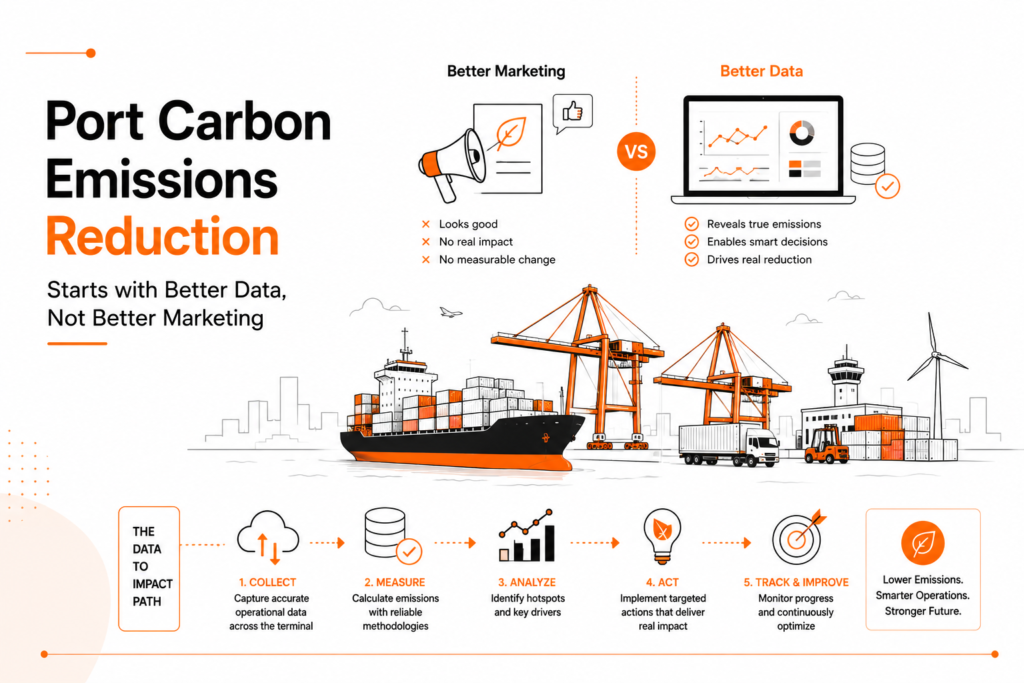
The stronger model is a shared operating picture. The World Bank and IAPH digitalisation initiative argues that better digital collaboration across the maritime chain improves efficiency and lowers emissions.
Put in operational terms: if terminals can see berth readiness, equipment availability, and vessel ETA changes in one control layer, they cut idle moves and unnecessary energy draw before they talk about offsets.
That is where port energy monitoring software becomes commercially useful rather than merely reportable. A serious platform tracks electricity demand by asset class, correlates throughput with energy intensity, and identifies where electrification or process redesign actually improves TCO.
Many port leaders still over-focus on annual emissions totals. The more instructive metric is emissions per move, per call, and per hour of berth occupancy, because those numbers tell operators what to fix next.
Digital Twins and Port Call Platforms Make Sustainable Port Operations More Practical
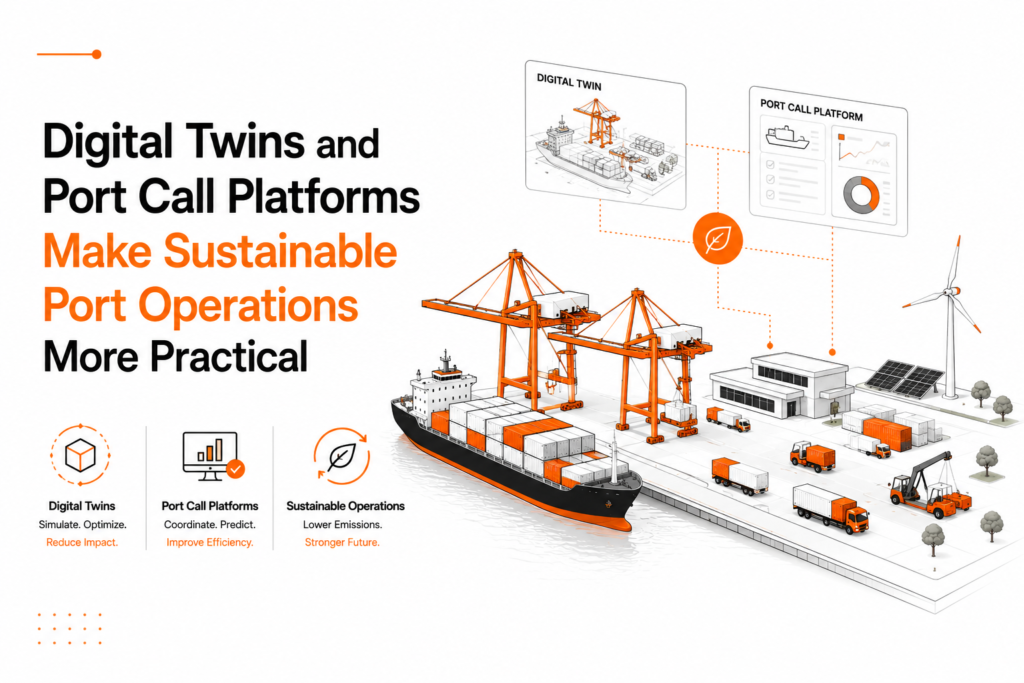
Digital twins are often oversold, but terminals that use them well are not buying visuals. They are buying decision speed. The system is designed to monitor port activity in real time, optimize resource use, reduce energy consumption, and support just-in-time calls, thereby lowering greenhouse gas emissions.
There is a separate story running underneath all of this. A digital twin becomes valuable only when it changes dispatch, maintenance, energy loading, and berth planning. If it remains a dashboard layer without operating authority, it becomes presentation software. That distinction is where many terminal technology projects fail.
Electric Terminal Equipment Delivers More Value When It Is Scheduled, Charged, and Measured Properly
Electric terminal equipment is becoming one of the clearest routes to direct emissions reduction inside the fence line. The problem is not the equipment category itself. The problem is whether the terminal has the digital controls to use it efficiently. Battery-electric fleets without charger planning, shift-level telemetry, and asset utilisation logic can create a new bottleneck while solving an old emissions issue.
That is why leading operators are pairing electrification with software. APM Terminals states that it aims to reduce terminal scope 1 and 2 emissions by 65% by 2030 against a 2022 baseline and reach net zero by 2040, with the transition relying on battery-electric and hybrid equipment, renewable electricity and energy efficiency.
The implication for developers and operators is straightforward: electric terminal equipment works best as part of an integrated energy and scheduling architecture. Worth separating from the headline: electrification alone does not guarantee sustainable port operations.
If grid power is unstable, dwell time remains high and truck turn cycles are poorly coordinated, terminals simply shift inefficiency from diesel tanks to transformer loads. Port energy monitoring software matters here because it turns electrification into a controllable operating model rather than a symbolic procurement win.
Shore Power and Smarter Arrival Management Extend the Impact Beyond the Yard
A terminal’s carbon footprint is not limited to cargo-handling equipment. Vessel emissions at berth and fuel burn before arrival also sit squarely inside the terminal’s sphere of influence. According to the US EPA’s shore power assessment, shore power can effectively reduce ship pollutant emissions at berth.
At the same time, the EPA’s vessel best-practices page notes that overall pollutant emissions can be reduced by up to 98% under the right grid conditions. That caveat matters because the local power mix still determines part of the decarbonisation outcome.
Most public commentary still treats port sustainability as an infrastructure issue. That framing misses the point that in many terminals, the first emission cuts come from better sequencing, cleaner visibility and fewer wasted moves, not from the biggest check.
ESG Reporting Ports Can Trust, Depends on Operational Granularity
ESG reporting ports are becoming more visible, but visibility without audit-grade data creates reputational risk. The ESPO Environmental Report 2024 and EcoPorts reporting framework show how environmental management in ports is becoming more structured, benchmarked, and continuous. Climate change remains a leading concern across European ports, which is not surprising. What matters more is the maturity of the reporting behind that concern.
Good ESG reporting ports can stand behind starts with emissions boundaries, asset-level data capture, and clear ownership between engineering, operations, and sustainability teams. Terminals that still compile annual narratives from disconnected systems will struggle as financiers, shipping lines, and cargo owners ask harder questions about sustainable port operations. Scope narratives are easy. Defensible baselines are not.
That is why green port technology has become a form of governance infrastructure. If a terminal can trace electricity draw, equipment uptime, berth delays, and vessel-side emissions interventions within a single data model, it improves investor credibility as much as environmental performance. Port carbon emissions reduction, electric terminal equipment deployment, and port energy monitoring software all become more valuable when they feed into a single reporting spine.
Terminals do not need every advanced tool at once. They do need a roadmap that links digital controls to measurable decarbonisation outcomes. That is the practical path to IMO 2050. The terminals that move first will not simply report better numbers. They will run leaner operations, make capital decisions with more confidence and turn sustainability from a compliance burden into a competitiveness advantage.
Turn Sustainability Mandates into Operational Advantages with INTECH Group
The runway to IMO 2050 is shrinking. Sustainable port operations require more than new hardware; they demand a unified digital infrastructure that turns scattered emissions data into automated decisions.
This is where INTECH Group bridges the gap between ambitious ESG targets and on-the-ground reality. We specialize in integrating the green port technology, energy monitoring, and asset telemetry needed to make decarbonization a measurable operational advantage.
Whether you are orchestrating a new fleet of electric equipment or scaling a digital twin, our deep IT/OT expertise ensures your sustainability investments deliver real emissions reductions and improved total cost of ownership (TCO).
Don’t let your decarbonization strategy stall at the procurement stage. Partner with INTECH Group to build the digital backbone your terminal needs to run leaner, faster, and more profitably.
FAQs
What should a terminal prioritise first to reduce port carbon emissions?
Most terminals should begin with measurement and coordination before embarking on large-scale asset replacement. If you cannot see berth delays, idle equipment time, and energy intensity by move, you will struggle to target effective reductions in port carbon emissions. The best first phase usually combines port energy monitoring software, equipment telemetry, and vessel-call visibility. That gives operators a defensible baseline for future electrification and reporting.
Is electric terminal equipment enough to achieve sustainable port operations?
No, because electric terminal equipment solves only one layer of the problem. Terminals still need a charging strategy, peak-load management, maintenance planning, and cleaner yard orchestration to deliver sustainable port operations at scale. In practice, the performance gain comes from pairing electrification with scheduling and analytics. Without that layer, utilisation and charging friction can erode the climate and cost case.
How does green port technology support IMO 2050 decarbonisation?
Green port technology supports IMO 2050 decarbonisation by cutting avoidable emissions that sit around the vessel call and terminal operating cycle. That includes just-in-time arrivals, berth coordination, shore power integration, predictive maintenance, and asset-level energy monitoring.
The shipping fuel transition still matters, but terminals influence the emissions profile through waiting time, equipment mix, and electricity use. That makes digital tools an operating necessity, not a side initiative.
Why is port energy monitoring software becoming more important now?
Because ESG expectations are rising while energy costs remain volatile. Port energy monitoring software helps terminals understand where power is consumed, which assets are underperforming, and how throughput relates to emissions intensity. It also improves the quality of ESG reporting ports produced for boards, lenders, and cargo owners. The real value is not the dashboard itself, but the ability to act on anomalies quickly.
What makes ESG reporting portals credible to customers and investors?
Credibility comes from traceability, not branding language. ESG reporting ports usually rest on consistent boundaries, timestamped operational data, and a method for linking emissions outcomes to actual interventions such as shore power, electric terminal equipment, and berth optimisation.
Investors and shipping lines increasingly want proof that sustainable port operations are measurable at the asset and process level. Terminals that build reporting from live systems will be in a stronger position than those relying on annual manual consolidation.
