

Managing cargo without the right software is a real operational challenge. Shipments get delayed, customs filings pile up, quotes take too long, and teams lose hours tracking down status updates by phone. The best freight forwarding software directly addresses these gaps by putting every part of the cargo lifecycle, from quoting to delivery, into one connected system.
This blog covers how modern freight technology actually changes day-to-day cargo management, what capabilities matter most, and how to assess options across different business sizes and geographies.
What Does Freight Forwarding Software Actually Do?
Freight forwarding software is a digital platform that manages the movement of goods across carriers, routes, and borders. It handles shipment bookings, carrier coordination, customs documentation, rate comparisons, and cargo tracking, all from a single interface.
The core difference from general logistics tools is specialization. Logistics software for forwarders is built around the specific workflows freight agents run daily: multi-modal bookings, consignee notifications, BOL generation, and duty calculations. General tools miss too many of these details.
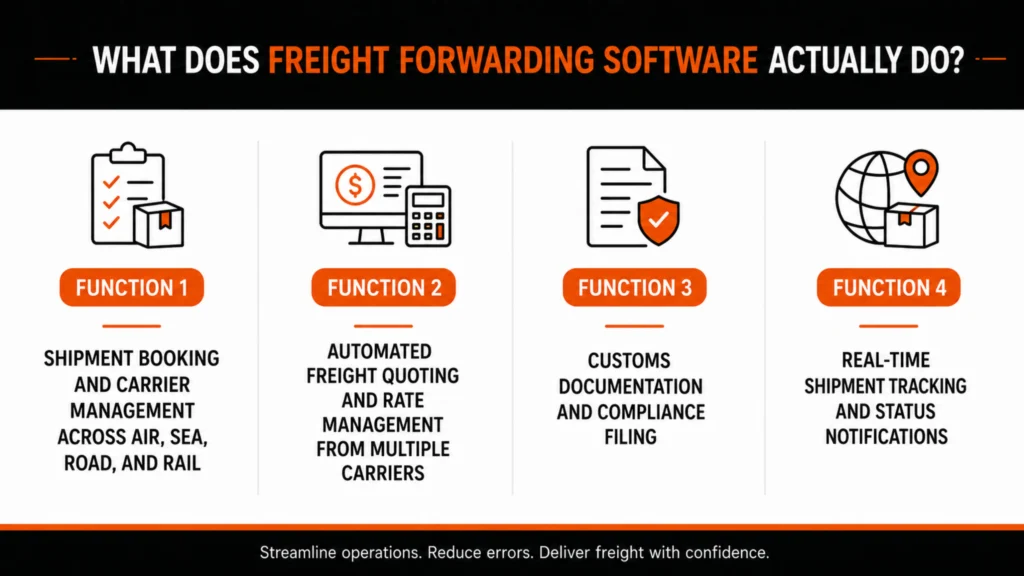
The 4 primary functions covered by most platforms include:
- Shipment booking and carrier management across air, sea, road, and rail
- Automated freight quoting and rate management from multiple carriers
- Customs documentation and compliance filing
- Real-time shipment tracking and status notifications
Core Ways the Best Freight Forwarding Software Improves Cargo Management
1. Real-Time Shipment Visibility
Shipment tracking software gives freight teams live cargo status across every leg of a shipment. No more manual check-ins with carriers or waiting on email updates. Every stakeholder , from the operations desk to the end client , gets accurate, current data.
This matters most when disruptions happen. Rerouting decisions, delay notifications to clients, and proactive customs pre-filing all depend on knowing where cargo actually is at any point in transit.
Early deployments of AI-enabled freight procurement tools showed a 17% increase in on-time performance and over 60% time saved on carrier quoting. (Source: FreightWaves, February 2026)
2. Automated Customs and Compliance Management
Customs management software freight tools automate document validation, HS code verification, duty calculations, and regulatory checks before a shipment even reaches the border. This cuts manual filing time and reduces rejection rates from customs authorities.
For freight brokers and forwarders handling high shipment volumes, manual customs work is a bottleneck. Automating it removes that constraint and gives compliance teams more time for exception handling.
Customs broker Customs Assured achieved a 30% productivity gain by automating customs declarations using AI-powered Descartes e-Customs with AiDock technology, with productivity continuing to rise as the system learns from more examples. (Source: https://www.globenewswire.com/news-release/2025/09/08/3145949/0/en/Customs-Assured-Realizes-30-Productivity-Gain-by-Streamlining-Customs-Declarations-with-Descartes-and-AiDock.html)
3. Freight Quoting at Speed
Freight quoting software pulls rates from multiple carriers simultaneously, applies margin rules automatically, and sends client quotes in minutes rather than hours. This is one of the most direct ways the best freight forwarding software cuts operational cost and improves win rates on new business.
For small businesses especially, manual quoting is where time gets lost. Freight software for small business brings the same quoting speed as larger operations without requiring a dedicated pricing team.
The 3 main benefits of automated freight quoting:
- Faster response time to client rate requests
- Consistent margin application across all quotes
- Multi-carrier comparison without manual lookups
4. Cloud-Based Operations and Remote Access
A cloud-based freight management system lets teams work from any location with full access to shipment data, documents, and carrier communications. This is no longer a nice-to-have. For forwarders with distributed teams or multiple offices, cloud access is a baseline operational requirement.
Cloud platforms also reduce IT overhead. There is no on-premise server maintenance, no manual version updates, and no local backup management. The software vendor handles infrastructure, and the freight team focuses on operations.
In Descartes’ 9th Annual Global Transportation Management Benchmark Survey of 616 logistics companies, 96% reported using generative AI in operations. However, only 17% are fully automated, and fully automated top performers outpace low performers by 46 percentage points on automation adoption. (Source: Descartes Systems Group, September 2025)
Manual Process vs. Freight Forwarding Software: A Direct Comparison
The table below shows how the best freight forwarding software changes outcomes across 5 critical cargo management functions:
| Capability | Manual Process | Freight Forwarding Software | Impact |
|---|---|---|---|
| Shipment Tracking | Phone/email follow-ups | Real-time GPS + status alerts | Zero blind spots |
| Freight Quoting | Manual rate lookups | Instant multi-carrier quotes | 75% faster sourcing |
| Customs Filing | Paper forms, manual checks | Auto-validated digital filing | 30% productivity gain |
| Document Management | Physical/email filing | Centralized cloud repository | Fewer errors, faster access |
| Reporting & Analytics | Spreadsheet exports | Live dashboards + forecasts | Data-backed decisions |
How a Freight Forwarding ERP System Differs from a Standalone TMS
A freight forwarding ERP system covers the full business , accounting, CRM, HR, procurement, and operations , in one platform. A freight forwarding TMS software (Transportation Management System) focuses specifically on transport planning, carrier management, and shipment execution.
For most forwarders, the right choice depends on 3 factors:
- Business size: smaller forwarders often benefit from a focused TMS; larger enterprises need ERP integration.
- Existing systems: if accounting and CRM are already in place, a standalone TMS may integrate cleanly.
- Growth plans: companies scaling across regions usually move toward an ERP to avoid data silos.
A freight forwarding TMS software handles transport operations precisely. An ERP brings all departments under one data model. The best freight forwarding software for a given business depends on which of these gaps is more pressing.
What to Look for in a Freight Management Software Comparison
A proper freight management software comparison goes beyond feature lists. The real differentiators show up in integration depth, geographic support, and how well the platform handles exceptions , not just standard flows.
The 5 evaluation criteria that matter most:
- Carrier network breadth: how many carriers and modes are natively supported
- Customs coverage: which countries and regulatory frameworks are included
- API and EDI integration: how the system connects to carrier portals, ERP, and WMS
- Reporting and analytics: whether dashboards give actionable data, not just raw exports
- Scalability: can the system handle volume growth without platform changes
Businesses operating in the Middle East should specifically evaluate freight forwarding software UAE-compatible platforms. UAE operations involve specific free zone regulations, multi-currency requirements, and customs authority integrations that not every top freight forwarding platform covers out of the box.
IATA’s cargo digitalization program showed Brazil reduced cargo release times from 5 days to just 5 hours through digital freight processes, with potential to cut manual processing by up to 90%. IATA set a January 2026 deadline for all member carriers to achieve ONE Record digital standard capability. (Source: https://www.iata.org/en/publications/newsletters/iata-knowledge-hub/accelerating-cargo-digitalization/)
Does Freight Software Work for Small Businesses Too?
Freight software for small businesses has become genuinely accessible. Cloud-based platforms removed the infrastructure barrier, and SaaS pricing models mean smaller forwarders pay based on volume rather than a flat enterprise license.
A small forwarder handling 50 to 200 shipments per month gets the same core advantages as a large operation: automated quotes, digital documentation, real-time tracking, and carrier connectivity. The difference is in the depth of analytics and ERP integration, which smaller teams typically do not need at launch.
The key is choosing cargo management software that scales. Starting with a clean, focused platform prevents the need to switch systems as volume grows.
Global adoption of electronic Bills of Lading rose from 33.0% in 2022 to 49.2% in 2024 according to ICC and FIT Alliance survey data, with 94% of respondents indicating eBLs will drive broader digital transformation in freight. Full eBL adoption could unlock $18 billion in gains for the trade ecosystem. (Source: https://iccwbo.org/news-publications/news/survey-shows-steady-rise-of-global-adoption-of-electronic-bills-of-lading/)
Choosing the Right Platform for Your Freight Operations
The best freight forwarding software does not look the same for every business. A UAE-based forwarder handling air cargo has different requirements from a European SME managing road freight. The right top freight forwarding platform aligns with actual operational workflows, not just a general feature checklist.
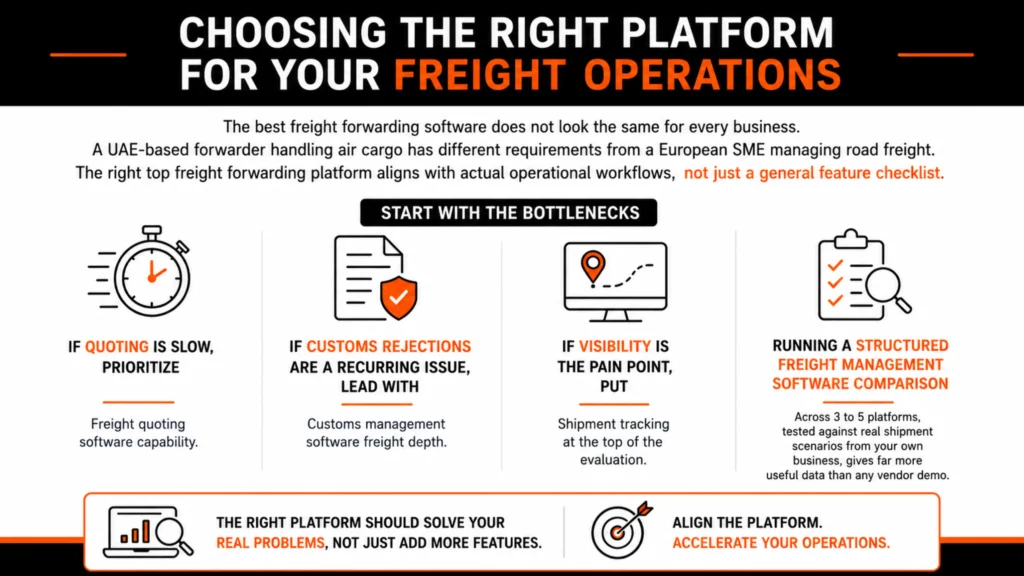
Start with the bottlenecks. If quoting is slow, prioritize freight quoting software capability. If customs rejections are a recurring issue, lead with customs management software freight depth. If visibility is the pain point, put shipment tracking at the top of the evaluation.
Running a structured freight management software comparison across 3 to 5 platforms, tested against real shipment scenarios from your own business, gives far more useful data than any vendor demo.
FAQs
What is the best freight forwarding software for small businesses?
Cloud-based platforms with SaaS pricing are well suited for small forwarders. The best freight forwarding software for small businesses covers quoting, tracking, and customs without requiring large upfront investment or IT infrastructure.
How does shipment tracking software reduce cargo delays?
Shipment tracking software gives freight teams real-time cargo location and status across all transport legs. Early delay alerts allow teams to reroute shipments or pre-notify clients before problems escalate.
What is the difference between a freight forwarding TMS and an ERP?
A freight forwarding TMS software manages transport operations specifically. A freight forwarding ERP system covers the full business including finance, HR, and procurement. Larger forwarders typically combine both for end-to-end visibility.
Does freight forwarding software support UAE customs compliance?
Some platforms include freight forwarding software UAE-specific modules that cover free zone regulations, FTA customs integration, and multi-currency transactions. These features are not universal, so UAE-based forwarders need to verify coverage during evaluation.
How does cargo management software cut documentation errors?
Cargo management software automates document generation, validates data against carrier and customs rules, and flags inconsistencies before submission. This removes the manual re-keying step where most documentation errors originate.
