

What Supply Chain Problems Drive Network Modernization?
To resolve the operational blind spots, IT directors adopt the future of IoT in supply chain. Manual tracking leaves massive gaps in global freight networks. Managers lose sight of shipments the moment cargo enters isolated transit phases. This lack of constant telemetry creates scheduling bottlenecks at every receiving dock.
Poor visibility directly causes massive spoilage rates across the globe. About 620 million metric tons of global food loss occurs annually due to poor temperature control. To stop this waste, organizations use IoT cold chain management systems. These platforms log exact climate conditions constantly.
Transport companies face 4 severe operational failures:
- Unplanned equipment breakdowns halt daily delivery schedules completely.
- Spoiled inventory destroys profit margins and damages vendor trust.
- Missing location data creates massive scheduling conflicts at loading docks.
- Inaccurate arrival estimates frustrate modern procurement teams and buyers.
You rely on IoT logistics applications to track moving assets across borders. Legacy systems depend on manual driver check-ins. The dispatcher guesses the truck location, if a driver forgets to call. This causes severe disruptions in just-in-time manufacturing models. The future of IoT in supply chain replaces human reporting with continuous digital telemetry. Planners rely on precise data streams to calculate exact arrival windows. Smart logistics IoT devices attach directly to pallets and shipping containers. These sensors transmit their exact coordinates every few minutes.
What Forms the Foundation of Connected Logistics Networks?
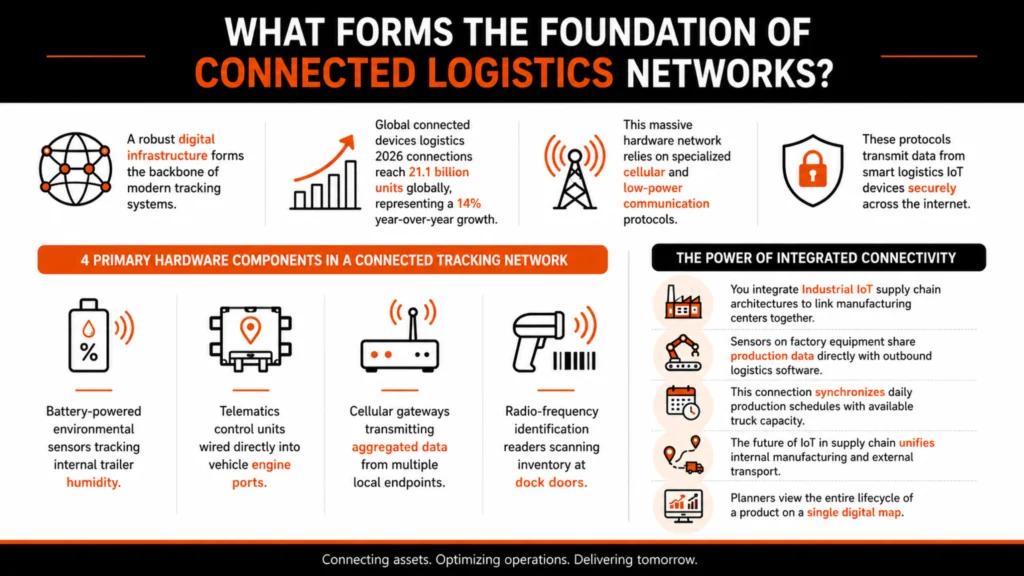
A robust digital infrastructure forms the backbone of modern tracking systems. Global connected devices logistics 2026 connections reach 21.1 billion units globally, representing a 14% year-over-year growth. This massive hardware network relies on specialized cellular and low-power communication protocols. These protocols transmit data from smart logistics IoT devices securely across the internet.
Hardware units draw power from energy-harvesting modules or long-lasting batteries. To manage the internal movement of goods, engineers use IoT warehouse management platforms. Automated guided vehicles carry pallets directly to outbound loading docks. The system removes manual barcode scanning from the daily floor workflow.
There are 4 primary hardware components in a connected tracking network:
- Battery-powered environmental sensors tracking internal trailer humidity.
- Telematics control units wired directly into vehicle engine ports.
- Cellular gateways transmitting aggregated data from multiple local endpoints.
- Radio-frequency identification readers scanning inventory at dock doors.
You integrate Industrial IoT supply chain architectures to link manufacturing centers together. Sensors on factory equipment share production data directly with outbound logistics software. This connection synchronizes daily production schedules with available truck capacity. The future of IoT in supply chain unifies internal manufacturing and external transport. Planners view the entire lifecycle of a product on a single digital map.
What Options Exist for Transportation Modernization?
Different freight methods require different digital monitoring tools. Over-the-road transport companies rely heavily on IoT fleet tracking systems. These platforms replace human dispatchers with continuous GPS coordinates and engine telemetry. Route calculation software merges live traffic data with active vehicle locations. You bypass congested roads and reduce overall diesel consumption. IoT fleet tracking catches wasteful idling behaviors and speeds up delivery times.
For ocean and rail transport, organizations deploy IoT real-time cargo monitoring hardware. These active sensors sit inside the shipping containers alongside the freight. The devices record shock impacts, light exposure, and precise geographic location. The light sensor triggers a theft alert, if someone opens the container doors prematurely.
| Monitoring Hardware | Primary Function | Ideal Freight Category |
|---|---|---|
| Telematics Control Units | Records engine diagnostic trouble codes continuously | Over-the-road trucking |
| Internal Cargo Sensors | Detects physical shock impacts and temperature changes | Rail and ocean shipping |
| Dual-Mode Radio Modules | Switches between cellular and satellite networks | Remote global transit |
| Bluetooth Beacons | Broadcasts location data to nearby warehouse receivers | Indoor facility logistics |
The global cold chain temperature monitoring market reached $8.06 billion in 2025. Pharmaceutical distributors use IoT cold chain management to protect delicate vaccines. The digital audit trail proves cargo remained safe throughout its entire journey. To guarantee customer satisfaction, forwarders deploy IoT freight visibility portals. The future of IoT in supply chain makes live visibility a baseline requirement for enterprise operations.
How Do IT Managers Execute Platform Integration?
Connecting new sensors to legacy accounting software poses severe technical hurdles. Old financial platforms rely on batch processing of structured data. Modern tracking devices generate continuous, unstructured data streams. IT directors use IoT ERP integration logistics projects to bridge this gap. Software engineers define exactly how location coordinates translate into automated billing events.
IoT ERP integration logistics feeds live truck coordinates directly into enterprise resource planning software. Financial modules generate invoices the moment a truck crosses a delivery geofence.
There are 4 distinct workflows automated by deep software integration:
- Automated invoice generation triggers upon verified physical delivery.
- Inventory level updates occur when a smart shelf registers removal.
- Maintenance work orders generate automatically upon engine fault alerts.
- Customer portal updates display live arrival times without human intervention.
To process the incoming telemetry, enterprises deploy IoT data analytics supply chain modules. The software compares live vehicle speeds against historical traffic patterns. IoT logistics applications filter out regular sensor noise and highlight actionable anomalies. You receive an alert, if a truck deviates completely from its calculated baseline. The future of IoT in supply chain depends on these automated analytical filters. IoT warehouse management systems apply these analytics to internal workflows. The software calculates the most efficient walking path for floor workers to collect items. This reduces physical fatigue and speeds up the order picking process.
What Financial Returns Justify the Infrastructure Investment?
Deploying hardware across a global network requires a massive capital expenditure. Chief Financial Officers demand clear return on investment calculations for these connected projects. Reduced fuel consumption and fewer lost assets offset the initial hardware costs rapidly.
Using IoT predictive maintenance logistics prevents catastrophic engine failures entirely. Telematics algorithms detect subtle changes in oil pressure and engine vibration over time. AI-powered predictive maintenance decreases equipment stoppages by 30% to 50%. IoT predictive maintenance logistics extends the usable lifespan of massive transport vehicles. You delay the massive capital expenditure of buying brand new trucks.
There are 5 financial metrics upgraded by connected logistics networks:
- Overall fuel expenditures drop as route algorithms eliminate unnecessary miles.
- Inventory replacement costs shrink as sensors prevent spoilage events.
- Labor costs decrease as automated systems replace manual stock counting.
- Vehicle maintenance budgets stretch further as software prevents catastrophic failures.
- Insurance liability costs fall as dashcam footage proves driver innocence.
To secure these financial returns, you build resilient Industrial IoT supply chain architectures. Security administrators deploy zero-trust access policies across the entire sensor network. IoT real-time cargo monitoring relies on end-to-end data encryption. This protects telemetry data transmitted over public cellular networks. The future of IoT in supply chain mandates strict hardware-rooted trust chains for every device. IoT freight visibility portals also require strict user authentication.
How to Handle Data Overload in Modern Sensor Networks?
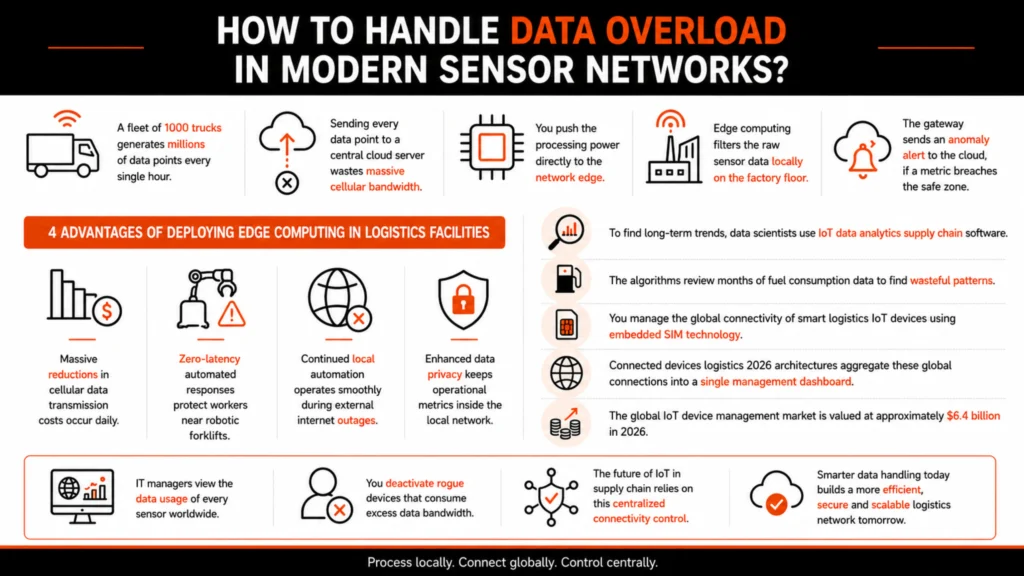
A fleet of 1000 trucks generates millions of data points every single hour. Sending every data point to a central cloud server wastes massive cellular bandwidth. You push the processing power directly to the network edge. Edge computing filters the raw sensor data locally on the factory floor. The gateway sends an anomaly alert to the cloud, if a metric breaches the safe zone.
There are 4 advantages of deploying edge computing in logistics facilities:
- Massive reductions in cellular data transmission costs occur daily.
- Zero-latency automated responses protect workers near robotic forklifts.
- Continued local automation operates smoothly during external internet outages.
- Enhanced data privacy keeps operational metrics inside the local network.
To find long-term trends, data scientists use IoT data analytics supply chain software. The algorithms review months of fuel consumption data to find wasteful patterns. You manage the global connectivity of smart logistics IoT devices using embedded SIM technology. The embedded chip lets the device switch network providers automatically over the air.
Connected devices logistics 2026 architectures aggregate these global connections into a single management dashboard. The global IoT device management market is valued at approximately $6.4 billion in 2026. IT managers view the data usage of every sensor worldwide. You deactivate rogue devices that consume excess data bandwidth. The future of IoT in supply chain relies on this centralized connectivity control.
FAQs
What causes battery failure in tracking devices?
Extreme sub-zero temperatures destroy lithium battery chemistry rapidly. You deploy specialized insulated hardware when tracking frozen cargo or operating in arctic environments.
How do you protect sensor data from cyberattacks?
You set up end-to-end encryption and hardware-rooted trust chains. Network micro-segmentation blocks a compromised sensor from accessing main corporate financial databases.
Why do legacy accounting systems struggle with sensor data?
Old software relies on slow batch processing of structured data. Modern sensors produce a continuous stream of unstructured telemetry that requires API translation layers.
What is store-and-forward technology in maritime shipping?
Devices save temperature and location data to internal memory during ocean crossings. They upload the complete historical log immediately upon reconnecting to terrestrial cellular networks.
How does predictive maintenance save capital expenditure?
Replacing components right before they fail prevents catastrophic engine destruction. You extend the total usable lifespan of the vehicle and delay purchasing new trucks.
