

Selecting the right office location has always been the key to determining the long-term success of GCC, according to experts. GCCs are likely the next catalyst to drive India’s growth in the future. It’s time that India prepares to embrace business transformation through GCC.
The GCC market in India was valued at USD 69.85 billion in 2025. It is expected to reach USD 130.50 billion by 2030, growing at a CAGR of 8.1%. This itself is proof of how India is entering the next phase of GCC.
The future transformative phase of GCC in India is driven by AI adoption, global digital ownership, and end-to-end ownership. The key GCC technology trends show that GCC is likely to expand to the Tier-2 cities of India as well.
How Have GCCs in India Transformed from Cost Centers to Global Innovation Hubs?
GCCs in India aren’t now only “back offices” but contribute more than that to operations. These are now being transformed into Global Brain Trust and Strategic Value Centers. Therefore, enterprise technology innovation is now taking up global P&L responsibility, end-to-end service ownership, and core product development.
Both Tier-1 and Tier-2 cities are noticing a significant shift, thereby contributing to the growth of GCC. According to FY 2024-25, around 24 GCCs crossed the $1 billion mark in revenue as compared to 19 GCCs in the previous year.
Here’s how the GCC technology trends in India are contributing to the transformation from cost centers to innovation hubs:
1. End-to-end Ownership
The GCCs in India now focus on end-to-end ownership of the products, right from designing to deployment. With more innovation, there will be higher chances of market entry and value creation. Therefore, there won’t be a need for only back office operations.
2. Continuous Upskilling
The GCCs across India are investing significantly in employee upskilling, digital, and leadership development. This is contributing to strategic workforce transformation. Not only does this drive business transformation, but it also drives global competitiveness.
3. Adoption of Growing Technologies
The GCC technology trends are being heavily adopted across India. The integration of AI, ML, Blockchain, and IoT has led to the development of digital innovation centers. Around 50% of leaders are now prioritizing AI in GCC India as a core function within the next three years.
4. Shift Towards Strategic Business Roles
GCCs now significantly contribute towards innovation roadmaps, corporate strategy, and customer design experience. This helps the businesses to now position themselves as global decision-making centers across multinational companies.
Why is India the Next Hub for GCCs taking shape?
India’s strong position as the Global Capability Center isn’t only about cost advantage. It also solidifies the position to 2026 and beyond. From AI to cloud transformation, every factor contributes significantly to the growth.
1. High Economic Value and Growth Projection
The GCC landscape in India is being strengthened by business resilience and has been enhancing digital competitiveness. This contributes significantly to constant value creation.
2. An Evolving Talent Pool
The digital, tech-savvy, and upskilled workforce with talented, fresh graduates is the evolving talent pool of India. This diverse talent pool boosts India’s global positioning and strategic alignment. The GCC workforce in India is expected to exceed 2.5 million by 2030. Moreover, the technology professionals pool of India is the second largest globally.
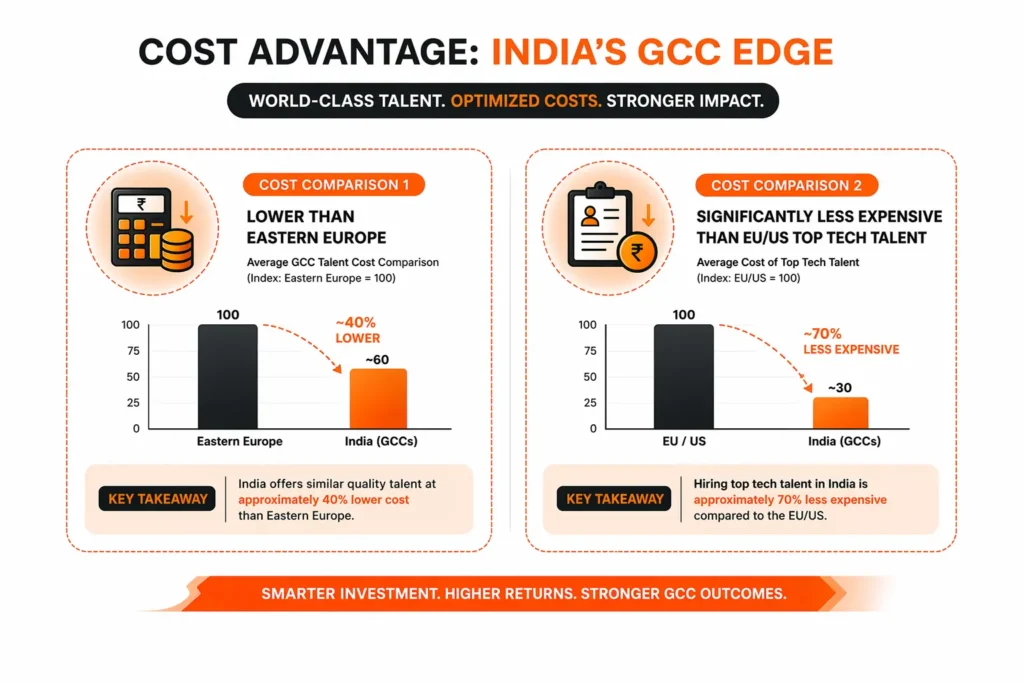
3. Cost-Efficient and Talent Competitiveness
Enterprise technology innovation in India contributes significantly to cost-efficiency and talent competitiveness. The exceptional talent pool contributes to long-term growth and sustainability. India offers significant operational cost benefits.
4. Significant Focus on AI
India is likely the center of next-gen tech adoption. AI in GCC India is the core focus. The Indian GCCs are leading in AI adoption, data engineering, and digital competitiveness. While 70% GCCs are investing in AI adoption, others are contributing to digital transformation projects.
5. Expansive Global Market Share
The vast GCC ecosystem in India offers operational scale to global enterprises. It further helps with cross-industry expertise, innovation delivery, and strategic alignment. As of now, there are 1,700 GCCs, projected to grow up to 2,400 by 2030. This will account for up to 55% of the global GCC market size.
Why Do Global Businesses Turn to India for GCC Expansion?
India is one of the preferred locations for businesses to boost capability, foster cloud transformation, and strengthen digital innovation. GCCs are choosing India for expansion for the following reasons:
1. Innovation and Collaboration
Data engineering GCC India is known for fostering innovation and collaboration. The advanced technologies create an accelerated environment for growth. Around 86% of GCCs are actively involved in Machine Learning and AI projects. Cross-functional teams also contribute to growth.
2. Improved Scalability and Flexibility
Scalability and flexibility are the key reasons for the growth of India’s GCC ecosystem. Companies are now leveraging GCC technology trends to access the vast talent pool and well-developed infrastructure. This helps fast-paced businesses to adapt to market changes swiftly.
3. Compliance and Governance
The evolving regulatory landscape in India is focused on data protection and privacy. Therefore, most of the GCCs prefer India. The local expertise can be handy for navigating complex regulatory environments across the global market.
Key Trends Shaping GCCs in India
From cloud transformation to AI and the growth of a skilled workforce, everything contributes significantly to the growth of GCCs in India. There’s been a significant shift from cost optimization to strategic innovation.
Through these key GCC technology trends, businesses focus on digital transformation and core business value. Some of the top trends shaping the growth of GCC in India are as follows:
1. Expansion into Tier-II and Tier-III Cities
AI in GCC India is gradually penetrating Tier-2 and Tier-3 cities. Most of the businesses are establishing the GCCs across these areas to tap into the emerging market.
The expansion helps to reduce costs and operational risks while also boosting the economic development of the region. Most of the GCCs located across these Tier-2 and Tier-3 cities have significantly increased their revenue. This has also helped to enhance operational efficiency across smaller regions.
2. Robotic Process Automation (RPA) and Hyper Automation
GCCs in India are adopting Robotic Process Automation (RPA) and hyperautomation to streamline workflows. The growth of RPA and hyperautomation helps to increase the productivity of employees.
The creation of intelligent systems also helps in key sectors, as bots and humans can collaborate for better functioning. This drives significant accuracy and better operational agility. The Indian RPA market is expected to reach $4582 million by 2032.
3. Workforce Transformation and Future Skills Development
The GCC technology trends in India are shaped by continuous upskilling and workforce transformation. Through these technologies, the GCCs are able to build innovation-ready and agile teams.
Each of the teams is constantly evolving with technology and business landscapes. A significant number of GCCs are investing in reskilling and upskilling the internal teams. The integration of data engineering GCC India also fosters the adoption of cybersecurity, Cloud, and GenAI.
4. AI-driven Transformation Across Functions
AI in GCC India is acting as a performance booster for core operations. This helps with intelligent decision-making, process optimization, and predictive analytics.
Different sectors in the business, like supply chain, HR, finance, and customer experience, can leverage these benefits. Around 70% of GCCs in India are currently investing in AI with significant focus on finance (53%), customer experience (65%), and IT and cybersecurity (45%).
5. Global-Local Mindset of the Leadership
Visionaries drive the modern GCCs in India. To drive cloud transformation GCC, it is important to have leaders who blend global practices with local insights. Such leaders help to build an inclusive culture, agile decision-making, and innovative leadership development.
Promoting cross-functional and cross-geography initiatives can be extremely beneficial in the long run. Better collaborations help in smooth alignment with the HQ teams as well.
6. Focus on Sustainability and Green Operations
Sustainability is becoming extremely crucial for businesses of all sizes. To keep up with these evolving trends, the GCCs in India are adopting eco-friendly practices as well.
The integration of energy-efficient infrastructure and responsible sourcing aligns with ESG and corporate responsibility goals. Approximately 52% of GCCs in India have integrated refined internal ESG policies.
7. Better Cybersecurity and Data Governance Frameworks
With increasing enterprise technology innovation, GCCs in India are focusing on data privacy, cybersecurity, and governance frameworks. This plays a key role in safeguarding information and ensuring regulatory cybersecurity compliance.
Most GCCs are opting for cloud modernization for their HQs. It has become a prime mandate for businesses to secure the multi-cloud environment. The increase in these mandates has also led to the adoption of advanced encryption and cloud-native security tools. A significant number of GCCs in today’s time are using cloud-native security platforms.
8. Strategic Decision-Making
GCCs are constantly evolving into strategic centers of excellence, which have a significant influence on product innovation and corporate strategy. It also fosters customer engagement across global headquarters.
The strategic vision of GCCs in India is to grow and contribute approximately billions to the GDP by FY’30. This will help to transform from scale-driven operations to capability-led mandates with R&D and global decision-making.
9. Driving Inclusion and Purpose-led Leadership
The GCC technology trends in India are being driven by inclusion and purpose-led leadership. Modern GCCs in today’s time prioritize inclusion, leadership, and purpose, thereby fostering the growth of work environments.
The adoption of inclusion, purpose, and leadership helps to boost creativity, engagement, and belonging. This strengthens the employee’s brand value globally. Around 95% of companies are excelling in inclusion and empowerment.
10. Advanced Analytics and Predictive Intelligence
GCCs are to use advanced analytics and predictive intelligence to their fullest capabilities. GCCs are using big data for forecasting trends and optimizing business performance. This also plays an important role in making proactive decisions.
All these concepts help to transform data into actionable insights, further driving continuous innovation and competitiveness. Around 50% of GCCs in India have evolved their portfolio significantly, especially across transformation hubs.
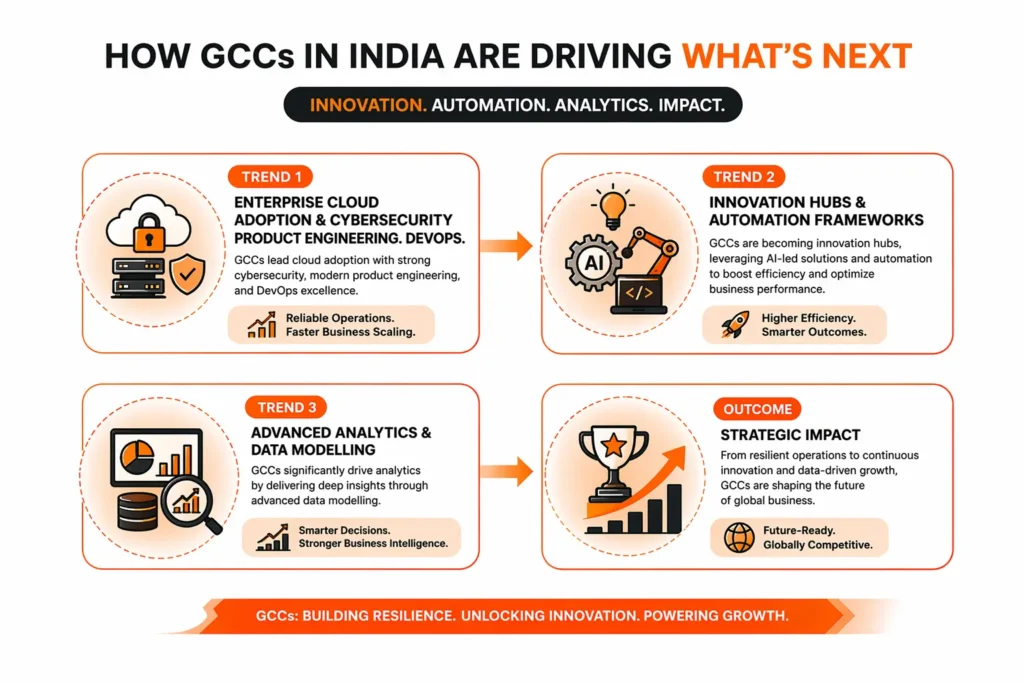
How Do GCCs Transform Technologies and Analytics in India?
India’s GCCs are bringing a major shift across global enterprises, especially in the use of data and technology. It focuses on operational efficiency and innovation, thereby helping businesses build strong digital foundations. It contributes to a significant smart business system.
Here’s how the GCCs in India are transforming the technology and analytics sector in India:
How Will the GCC Landscape Shape in India?
The GCC landscape in India is likely to grow with digital excellence, innovation, and strategic transformation. The global centers will be used significantly for enterprise innovation, AI-driven operations, and R&D. They focus on data security, automation, and sustainability.
Tier-2 cities in India are also shaping up GCC technology trends. India is likely to bring the new wave of global capability centers across hybrid work models and agility. It also plays an important role in fostering future-ready leadership. This would also drive global enterprises to boost efficiency, resilience, and technological advancements.
Intech- Building Future-ready GCCs
The Intech Group has been helping scale future-ready GCCs with advanced technology solutions. The experts assist businesses with end-to-end HR operations, recruitment, payroll management, compliance, and more. By streamlining business operations, it becomes easy to identify top talent, streamline onboarding, and boost agile workforce models.
The cutting-edge and tech-driven solutions help to operate efficiently without hurdles. The integrated approach enables businesses to drive operational excellence and optimize costs. It also builds sustainable and drives future-focused GCCs across an evolved landscape.
Conclusion
The GCC in India is growing significantly and helps to streamline the global business operations. Better technology and expanding infrastructure through top talent help build capability centers. Industries across the country are scaling GCC across various sectors like RPO services, IT staffing, and permanent recruitment. The innovation-led GCC drives global value creation and business excellence.
FAQs
Which industries are likely to expand the most with GCC technology trends?
The top industries that are likely to expand with GCC technology trends include healthcare, manufacturing, technology, and BFSI.
What are the key trends shaping GCC technology?
The key trends shaping GCC technology include workforce transformation, robotic process automation, sustainability, and more.
Is GCC expanding to Tier-2 and Tier-3 cities?
Yes, GCC is expanding significantly to Tier-2 and Tier-3 cities. It boosts cost efficiency, infrastructure readiness, and an emerging talent pool. Furthermore, it also helps to drive sustainable growth.
