

Most mid-size US businesses don’t collapse from a single major software failure. They bleed out slowly. A spreadsheet in one tab, a legacy system, and a tool to manage everything. The costs don’t appear on a single line on the profit and loss statement.
They show up when a big retailer flags a compliance failure, when a fleet customer pulls their contract, or when the CFO asks why sales doubled, but margins didn’t move. These five US businesses were in exactly that spot before implementing Odoo ERP.
What happened after is documented and worth reading if you’re evaluating whether this platform is right for your operation.
Why Are US Businesses Choosing Odoo Over SAP and NetSuite?
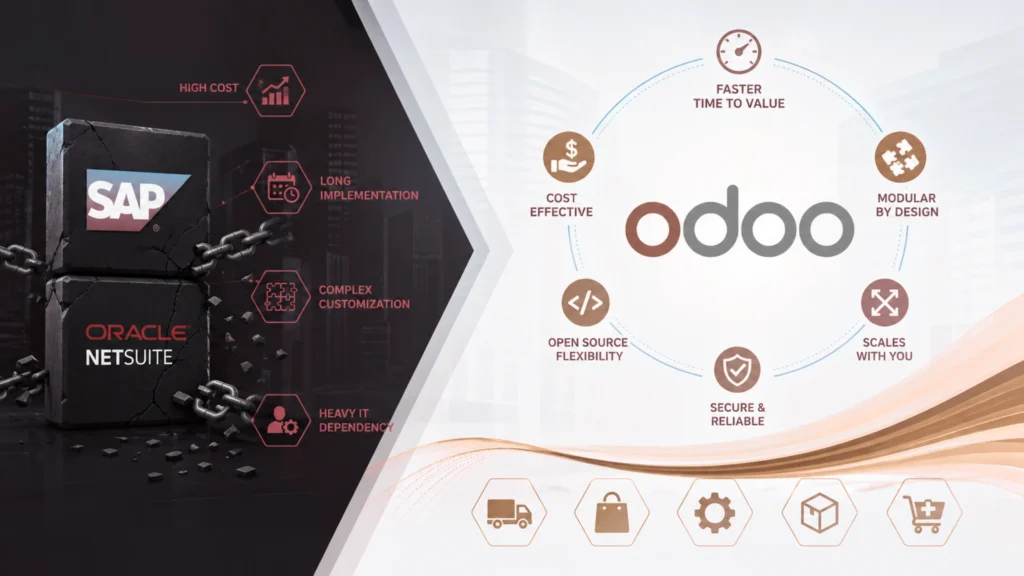
The ERP market is crowded at every price point. SAP runs global supply chains for Walmart and ExxonMobil. Oracle NetSuite handles financial operations for thousands of mid-market companies. So, when a business with 50 to 500 employees runs a proper evaluation, why does Odoo keep making the finalist list?
The short version: enterprise platforms are priced and built for enterprise budgets. SAP and Oracle implementations carry licensing fees, annual maintenance costs, and consultant day rates that reflect who they were designed for.
Odoo’s open-source architecture and modular design come from a different philosophy entirely: give mid-market businesses access to enterprise-grade capabilities without requiring an enterprise-sized IT department to run them.
There’s also a time-to-value gap that matters more than most businesses realize. A typical Odoo deployment goes live in three to six months. SAP and Oracle projects at comparable complexity routinely run twelve to twenty-four months.
For a manufacturer managing production schedules or a distributor running 10 locations, a year of implementation overhead isn’t just expensive; it’s a significant burden. It’s a year of operating on a system that’s already showing its cracks.
The five businesses below cover a lot of ground: distribution, branded merchandise, precision manufacturing, consumer goods, and regulated retail. The common thread isn’t industry. It’s that all five hit a wall with fragmented systems and came out the other side with Odoo doing the work the patchwork couldn’t.
Case 1: How a Pittsburgh Distributor Went from 85% to 97% Order Fulfillment?
Point Spring and DriveShaft Co. is a family-owned commercial truck parts distributor running ten locations across Pennsylvania, West Virginia, and Ohio. Before Odoo, the company ran on a custom Linux-based ERP that a developer had built from scratch over four decades of working with the business.
The system worked, in the way duct tape works: fine until someone needs to hand it off or scale it. Here’s the context that makes the fulfillment number meaningful. Companies like Grainger or Fastenal, industrial distributors operating at a national scale, have built their competitive position largely on availability and speed.
Fleet managers and logistics companies don’t tolerate back-order rates. When a part isn’t there, they call a competitor. Point Spring competes at the regional scale in that same environment, and their 85% fulfillment rate was survivable but not safe. One lost fleet contract rarely comes back.
How the Odoo Implementation Addressed the Fulfillment Gap
The first year was entirely requirements scoping and process documentation. A lot of businesses skip that phase or compress it to hit a go-live date, and they pay for it later. The second year covered development, data migration, and training.
The go-live touched Accounting, Recruitment, Expenses, RMAs, Customer Portal, Credit Card Processing, and full Product and Partner Master Data management.
What the Results Actually Mean for a 10-Location Distributor
Back-order fulfillment climbed from 85% to 97%. The company doubled its sales volume on the same operational base. Each of those 12 percentage points represents real fleet contracts that didn’t walk out the door, real orders that arrived on time, real customers who didn’t need to look elsewhere.
The sales doubling is worth reading on its own. Growing volume without proportionally scaling headcount means the system absorbed growth that a manual operation simply couldn’t have. That’s the argument a CFO can take to a board: not just that the ERP improved operations, but that it created capacity the business could grow into.
Case 2: Pinnacle Promotions: Cutting a 13% Error Rate to 3% in Nine Months
Pinnacle Promotions is an Atlanta-based promotional products company with a messy, complicated, and, honestly, pretty typical B2B operation: custom-branded merchandise, client-specific orders, vendor coordination, and fulfillment across hundreds of product types. Before Odoo, one in eight orders had an issue. That’s what a 13% error rate looks like, put plainly.
Think about what that means in this industry. When a client orders branded merchandise for their national sales kickoff and the logo placement is wrong, or the wrong item ships, that’s not a warehouse problem anymore. It’s visible at the event, in front of their team, with their brand on it.
Companies like 4imprint have built their position in this market partly because their error rates are low enough that clients don’t have to think about it. For Pinnacle, closing that gap was a client retention issue first and an operational issue second.
The Operational Fragmentation Behind Pinnacle’s Error Rate
The errors weren’t about careless staff. They were the predictable output of a system in which order data moved across multiple platforms and manual handoffs before anyone fulfilled anything. Every handoff is a place where something can get dropped, misread, or entered twice. Pinnacle’s 13% error rate was essentially the process’s, not the people’s.
How a 77% Error Reduction Changes Client Retention Math?
The implementation reduced the number of software platforms Pinnacle managed, replaced manual handoffs between tools, and added machine-learning capabilities on top of the core Odoo modules.
A 77% reduction in error in this industry means fewer apology calls, fewer rush replacements, and fewer clients quietly deciding not to renew. That’s a revenue number, not just an ops stat.
Case 3: Southern Hunt Club: Precision Manufacturing, Two Subsidiaries, One Unified System
Southern Hunt Club is a Memphis-based holding company with two manufacturing subsidiaries: Buck Gardner Calls and Rolling Thunder Game Calls. Both make game calls (duck, turkey, goose) through a process that includes CNC machining, laser engraving, pad printing, and hand tuning.
This isn’t simple assembly line work. Each product goes through multiple precision steps, and each step is a place where production and inventory data can diverge if the systems aren’t connected.
There’s a persistent assumption in manufacturing that ERP is built for companies like 3M or Illinois Tool Works, global operations with armies of IT staff and six-figure implementation budgets.
Southern Hunt Club is proof that this is wrong. The gains from unified production management, real-time inventory, and connected DTC channels don’t care how many employees you have.
The Problem With Running Two Subsidiaries on Disconnected Systems
Before Odoo, Buck Gardner and Rolling Thunder were effectively two separate businesses running under one roof. Manufacturing planning, inventory, and sales had no shared data layer.
If management wanted a consolidated picture of how both subsidiaries were performing, someone had to pull it together manually.
Production scheduling decisions were made with incomplete information. Inventory discrepancies between the physical warehouse and the digital records were a persistent background issue.
What a Unified Manufacturing ERP Actually Delivers at This Scale
The Odoo deployment covered CRM, Sales, Purchase, Inventory, Manufacturing, Accounting, and Barcode modules. Custom inventory reports were built to match their product structure.
A Shopify integration tied the direct-to-consumer channel into the same inventory and order management system handling wholesale, a challenge that companies from Solo Brands to Weber Grills have wrestled with as their DTC channels grow.
Director of Operations John Dicken III rated the implementation 10/10 in published documentation. That score reflects more than software working correctly. The team redesigned the operational flow, connecting two subsidiaries into one unified system. That’s a meaningfully different kind of project.
Case 4: Automating EDI for Walmart, Target, and Home Depot from Bentonville
Stout Stuff is based in Bentonville, Arkansas, with manufacturing operations in Ohio and international sourcing. They sell thousands of SKUs through Walmart, Sam’s Club, Walgreens, Home Depot, PetSmart, Target, and Rural King.
That retailer footprint comes with one expensive requirement: you have to manage EDI relationships with some of the most demanding retail supply chain operations.
Walmart’s supplier compliance standards are famously strict. Target and Home Depot aren’t much easier. If you miss an EDI acknowledgment window, send a non-compliant advance ship notice, or have a delivery accuracy issue, you get charged back. Chargebacks come directly off the invoice.
For a business managing eight or more of those retailer relationships on QuickBooks, spreadsheets, and custom middleware scripts, it’s not a matter of whether something breaks. It’s when.
Why Steve Hartman Chose Odoo Over NetSuite
Stout Stuff’s IT Director, Steve Hartman, put together a real evaluation with NetSuite and Odoo as the two finalists. The on-site requirements session in Bentonville with Confianz Global surfaced the full picture of what they were working with.
The legacy environment’s processes were largely undocumented. Systems had been bolted together over the years with custom scripts and middleware that had grown past the point where anyone had a complete map of how it all connected.
From Undocumented Processes to Automated EDI Compliance Across 8 Retailers
The implementation started with process documentation before a single line of development was written. That ordering matters a lot. Going into an ERP migration without documented processes tends to produce the same operational problems inside a cleaner interface.
Odoo centralized and automated the EDI workflow across all of Stout Stuff’s retail partners, eliminating the manual steps where compliance failures kept happening.
For any consumer goods business selling through major retail chains, this is fundamentally a risk story. EDI chargebacks aren’t a theoretical concern. They’re a line on the P&L.
Case 5: North American Food Manufacturer Cuts Production Cycle by 40%
This leading North American bread, snack, and tortilla manufacturer runs make-to-order production across multiple distribution centers in the United States. Their operational reliance on fragmented systems for receiving orders and paper logs for traceability data posed both operational and regulatory risks.
Production scheduling was consistently delayed due to a lack of real-time inventory data, and their systems could not meet the emerging electronic, lot-level records required by FSMA 204 traceability standards.
The Challenge of Achieving FSMA 204 Traceability with Paper Systems
The primary risk was compliance. Traceability data, including ingredient sources and batch records, was manually captured and logged, making audit reconstruction laborious and leading to materials mismatches.
Without electronic, lot-level records, meeting the increasing enforcement pressure of FSMA 204 was structurally impossible. The secondary challenge was cost: inaccurate production data meant consistent operational delays.
How the Odoo Deployment Reduced Lead Time and Ensured Compliance
The Odoo deployment covered the full make-to-order workflow: order intake, manufacturing planning, materials sourcing, inventory validation, production management, and distribution.
The system utilized the Manufacturing, Inventory, Traceability, Procurement, and Accounting modules.
Within five months of go-live, the company achieved a 40% reduction in production cycle time through demand-driven scheduling and constraint-aware resource allocation. Inventory costs dropped by 30%. The traceability module automatically produced FSMA 204-compliant records, eliminating the manual labor previously required for compliance audits.

FAQs
What kinds of US businesses get the most measurable ROI from Odoo ERP implementation?
Businesses with the highest ROI from Odoo ERP implementation typically run multiple disconnected software platforms, have at least one high-cost manual process, and have outgrown their current system’s ability to handle transaction volume.
How long does an Odoo ERP implementation typically take for a US mid-market business?
Odoo ERP implementations for US mid-market businesses typically go live in three to six months for straightforward deployments covering accounting, inventory, and sales. Complex implementations involving EDI integration, multi-location inventory, custom manufacturing workflows, and data migration from multiple legacy systems.
Is Odoo suitable for businesses operating in regulated industries like cannabis retail?
Odoo can be configured for compliance-intensive regulated industries, as the Mary Jane cannabis retail implementation demonstrates, covering inventory traceability, point-of-sale compliance controls, and audit-ready reporting.
What Odoo modules do US manufacturers most commonly deploy?
US manufacturers most commonly deploy the Manufacturing, Inventory, Purchase, and Accounting modules as their core stack, with Sales and CRM added in nearly every case. Manufacturers with direct-to-consumer channels typically add eCommerce integrations, such as Shopify or WooCommerce, and the Barcode module for warehouse operations, as shown in the Southern Hunt Club implementation.
How do Odoo implementation costs compare to NetSuite or SAP for US mid-market businesses?
Odoo Enterprise licensing is cheaper per user than NetSuite, and its open-source Community edition cuts licensing costs for businesses with technical skills. Stout Stuff’s IT Director compared Odoo and NetSuite and found that over two to three years, Odoo generally costs less. However, the real ROI depends mainly on implementation quality, no matter the platform.
