

According to the EY GCC Pulse Report 2025, 92% of GCC leaders now say their centers deliver far more than cost savings and this single statistic proves a dramatic shift regarding India’s Global Capability Center ecosystem. Even just a decade ago, that would have sounded unlikely. The Global Capability Centers in India that were primarily seen as efficient back-office hubs can now actually reduce operational costs, making the scenario different.
This shift has been accelerated by the rapid adoption of multiple intelligent technologies. Nearly 58% of GCCs are already investing in Agentic AI, while 83% are currently focusing on scaling Generative AI initiatives, turning these centers into excellent and strategic platforms for automation, predictive intelligence, and seamless enterprise-wide transformation.
Deeply backed by the technology-first investments, huge talent pools, and by expanding in 2-tier and 3 tier cities, India’s GCCs are strongly leaving a significant mark. The future of GCC in India but it assists with strategic decision-making, helping global businesses to grow in every aspect.
Why Global Enterprises Are Turning to India for GCC Expansion?
GCC market growth India reflects a major GCC expansion and drastic shift, showing how multinational companies successfully scale their business operations. India has also become a preferred location for multiple businesses that aim to build a strong position while adopting digital transformation.
Instead of relying only on the outsourcing vendors, currently, multiple organizations prefer to invest directly in their own GCC setups. This approach not only helps businesses with greater control but also assists with faster decision-making and deeper integration with global goals.
Furthermore, what sets the Indian GCC operations apart from others is the huge access to a vast pool of skilled professionals who know how to bring both technical and domain expertise. This helps to set the future of GCC in India by successfully handling advanced work and dealing with complex product design, data analytics, cybersecurity, and R&D, everything just from one location.
- Strategic Evolution: Leading Beyond Cost Efficiency
GCC market growth in India also reflects how India’s GCCs are changing their working pattern by moving from cost-saving hubs to strategic partners in the case of enterprise decision-making. This survey also showed that more than 65 leaders of GCCs across multiple industries are operating from India with an average headcount of nearly about 800 employees.
As per the GCC industry outlook India, digital transformation significantly tops the priority list for the next 12 months for almost 61% of centers, while the remaining 54% will continue to focus on overall cost optimization. These ratios show properly balanced but forward-looking strategies.
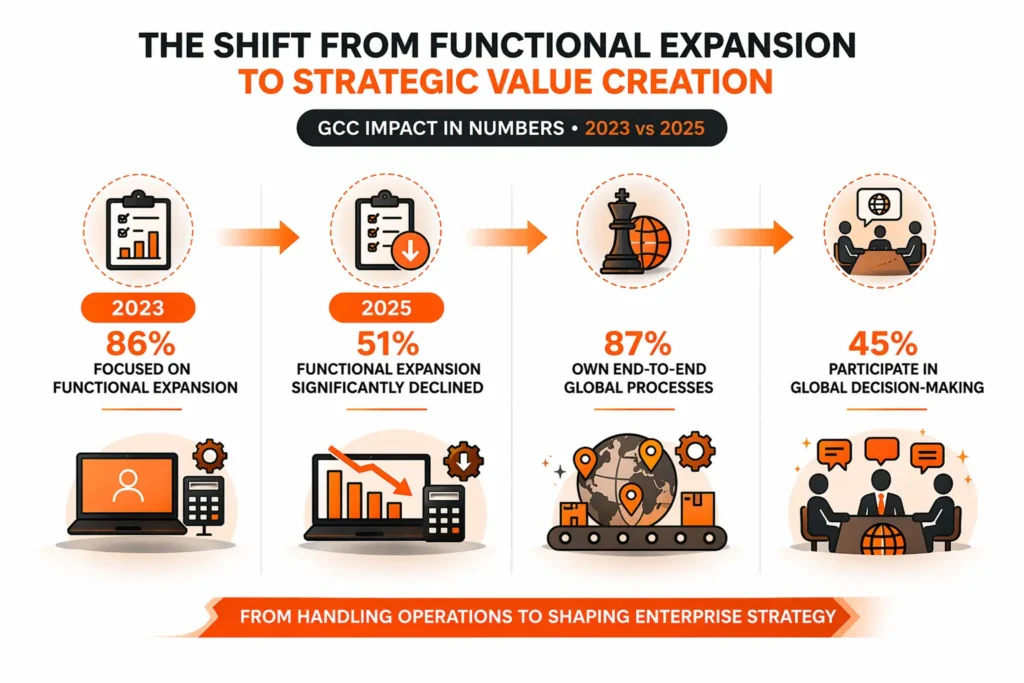
As per the India GCC market forecast, budget allocations also strongly mirror this shift, with nearly 25% of resources going into technology and transformation initiatives and the further 23% toward talent development. These allow multiple centers to focus on a significant shift towards lead innovation while driving enterprise-wide impact.
How GCCs Are Transforming Some Key Sectors in India?
Global capability center trends reflect that India’s Global Capability Centres are already driving a major shift in the concept of how multinational enterprises use the latest technology, talent, and strong data to power different global operations.
Furthermore, by focusing on greater innovation, digital transformation, and operational excellence, India’s GCC ecosystem is currently helping global enterprises build stronger digital infrastructure, smarter business systems, and data-driven decision-making frameworks.
Here’s how India’s GCCs are significantly transforming the concept in certain major sectors:
1. Technology and Digital Engineering
Technology remains the core concept for the GCC operations in India. These GCC centres also play a vital role in helping multiple global enterprises to design, build, and manage certain modern digital infrastructure and platforms. There are also certain Key areas where GCCs contribute include:
Cloud computing and cloud migration strategies
- DevOps and infrastructure automation
- Cybersecurity and data governance for enterprise security
- Software product engineering and platform development
- Enterprise architecture and SaaS platform development
2. Data Analytics and Business Intelligence
In the case of data analytics and business intelligence, the future of GCC in India can also handle nearly 40-50% of global analytics with data processing work for multinational organizations. Their responsibilities also include advanced data modelling, predictive analytics, machine learning pipelines, and business intelligence development.
Some key capabilities include:
- Advanced data modelling and statistical analysis
- Predictive analytics and machine learning development
- Enterprise business intelligence platforms
- Data engineering and data pipeline management
- Customer and market behaviour analytics
3. Artificial Intelligence and Intelligent Automation
Many GCCs now strongly focus and function as AI and automation innovation laboratories for multiple global enterprises. These centers are developing some relevant solutions involving:
- Generative AI applications
- Intelligent process automation
- AI-driven customer experience platforms
- Predictive maintenance models
- Autonomous enterprise workflows
Furthermore, according to recent industry surveys, almost 80% of GCCs in India are actively investing in generative AI initiatives, making the country a popular and key destination for enterprise AI experimentation and development.
4. Banking, Financial Services, and Insurance (BFSI)
GCC market growth India also positively impacts the BFSI sector, where it holds one of the largest GCC ecosystems in India. It is because multiple leading global banks and financial institutions operate at these large capability centers across top cities such as Bengaluru, Hyderabad, and Pune.
GCC teams also strongly support certain critical functions, including:
- Risk analytics and fraud detection
- Regulatory compliance and reporting
- Digital banking platforms
- Fintech product development
- Algorithmic trading systems
5. Healthcare and Life Sciences
Healthcare and pharmaceutical companies are also increasingly expanding multiple GCC operations in India to accelerate clinical research and drug development while handling digital health innovation. These centers also strongly contribute to areas such as:
- Clinical trial data analytics
- Pharmacovigilance and drug safety monitoring
- Health data platforms and AI diagnostics
- Regulatory documentation and compliance
6. Manufacturing and Industrial Engineering
GCC industry outlook India also reflects that leading manufacturing companies are also leveraging GCCs to transform the concept of traditional industrial operations through Industry 4.0 technologies. However, some of the key focus areas include:
- smart factory analytics
- digital twins and predictive maintenance
- supply chain optimization
- robotics and automation systems
- IoT-enabled production monitoring
Global Capability Center Trends Driving GCC Growth in India
As the Indian GCC ecosystem matures with time, several global capability center trends are defining its rapid growth. Together, they highlight why India remains a strong and preferred choice for global companies looking to scale greater innovation and business operations.
1. Large and Skilled Talent Pool
India is known for their largest pool of skilled professionals. Every year, millions of engineers, IT experts, and top management graduates also join the workforce working in hybrid and distributed work models.
This steady supply of top talent also helps the GCCs in India to skillfully handle advanced work in the field of artificial intelligence, data analytics, cybersecurity, and proper product development.
2. Cost Advantages
Among the list of global capability center trends, setting up a GCC in India is much more cost-effective compared to Western countries. Companies can also successfully save on operational costs, which allows them to invest more in research, exclusive automation, and new technologies.
This cost advantage makes India a sustainable and smart choice for many leading global companies.
3. Supportive Government Policies
The Indian government has also introduced several policies to support India’s GCC. It has made it easier for GCCs to start and grow. Also, certain benefits like SEZ incentives and the leading Digital India programmes have also simplified processes for the leading global companies.
There are also many state governments that have created such tech parks and innovation clusters in major and emerging cities while encouraging more GCC investment.
4. Strong Startup and Digital Network
India’s growing startup ecosystem also works closely with GCCs to build excellent digital solutions. Many GCCs also partner with leading startups to create automation tools, AI systems, and some excellent cloud-based products.
These partnerships also strongly encourage faster innovation and greater expertise.
5. Better Compliance and Risk Management
GCC industry outlook India also reflects that India’s business environment has already become more reliable in recent years with their strong risk management capabilities. With proper and improved data protection, cybersecurity rules, and clear compliance systems, many leading and global companies now trust India for handling their sensitive and large-scale business and data operations safely.
6. Convenient Time Zone
India’s time zones are always preferred among colleagues in Asia, Europe, and North America. This allows many global companies to maintain 24-hour operations while responding quickly to global business needs.
7. Focus on Advanced Technologies
India GCC market forecast also shows that GCCs in India are currently leading the way by adopting some of the advanced technologies like cloud computing, automation, and generative AI.
These technologies help organizations work faster while making more data-driven decisions to stay competitive.
8. Expanding Across More Cities
While cities like Hyderabad, Bengaluru, and Pune remain among the top cities, companies are now preferring to open GCCs in smaller cities too, like Coimbatore, Kochi, and Jaipur.
These cities also offer skilled talent with lower costs that help companies spread their business operations accurately with reduced risks.
9. Rapid Growth Ahead
The future of GCC in India is growing rapidly, and it is expected to expand by almost 14% by 2030. Also, the number of GCCs may go beyond 2,550. This growth strongly shows India’s strong position in the global technology and innovation field.
How GCC in India is Driving Global Business Transformation
Global capability center trends are playing a vital role in reshaping the concept of how multinational companies innovate and scale the latest business operations while adopting certain digital technologies. Furthermore, by combining skilled talent, advanced data analytics, and focusing strongly on engineering expertise, GCCs are currently helping global businesses to accelerate significant transformation while delivering strong and strategic business value worldwide.

From Support Centers to Strategic Innovation Hubs
Earlier, GCCs were mainly involved only in some specific transactional activities such as payroll processing, proper accounting, and customer support. Today, it has evolved into a strategic pillar for global enterprises.
Modern GCCs now also lead:
- Digital transformation programs
- Advanced analytics and AI projects
- Product engineering and platform development
- Cybersecurity and risk management
These centers also strongly contribute to revenue growth, overall market expansion, and the latest innovation pipelines.
Enabling Faster Time-to-Market
Leading and dedicated global teams operating across multiple time zones are also a prime reason behind GCC market growth India. Organizations because of these can successfully benefit from round-the-clock productivity. This model not only shortens certain development cycles but also accelerates testing while improving speed to market.
A well-structured GCC in India can also significantly enhance operational agility with responsiveness that could meet both the changing customer needs and market demands.
Supporting Scalable and Sustainable Growth
India also offers unmatched scalability to global companies. Many companies can get the chance to start with small teams and expand rapidly when the business needs evolve. This flexibility and diversified skill sets allow GCCs to support businesses in multiple functions.
Furthermore, this scalability also makes GCC in India a long-term strategic investment rather than opting for making a short-term operational decision.
Future of GCC in India: India’s GCCs On the Rise
The future of GCC in India will not only be shaped from the back office, but from the aspect of the global boardroom, where talent and automation work side by side. With strong digital capabilities, a diversified talent pool, and supportive Government policies, India is considered to be the top choice for many multinational firms expanding their overall global presence.
Below, we mention some of the key trends shaping the future of India’s GCCs:
- Stronger Government and Industry Collaboration:
Focused policies and greater initiatives are helping multiple companies to expand business operations smoothly across major cities.
- Growth in Tier-2 and Tier-3 Cities:
Many leading firms are now building GCCs in some of the emerging cities to get complete access to the skilled talent pool while reducing costs.
- Advanced Technology Integration:
AI, cloud, and data analytics are also significantly transforming how GCCs operate and add excellent value to businesses.
- Collaborations with Startups:
India GCC market forecast that partnerships with such leading companies are also helping GCCs to stay innovative while being future-ready.
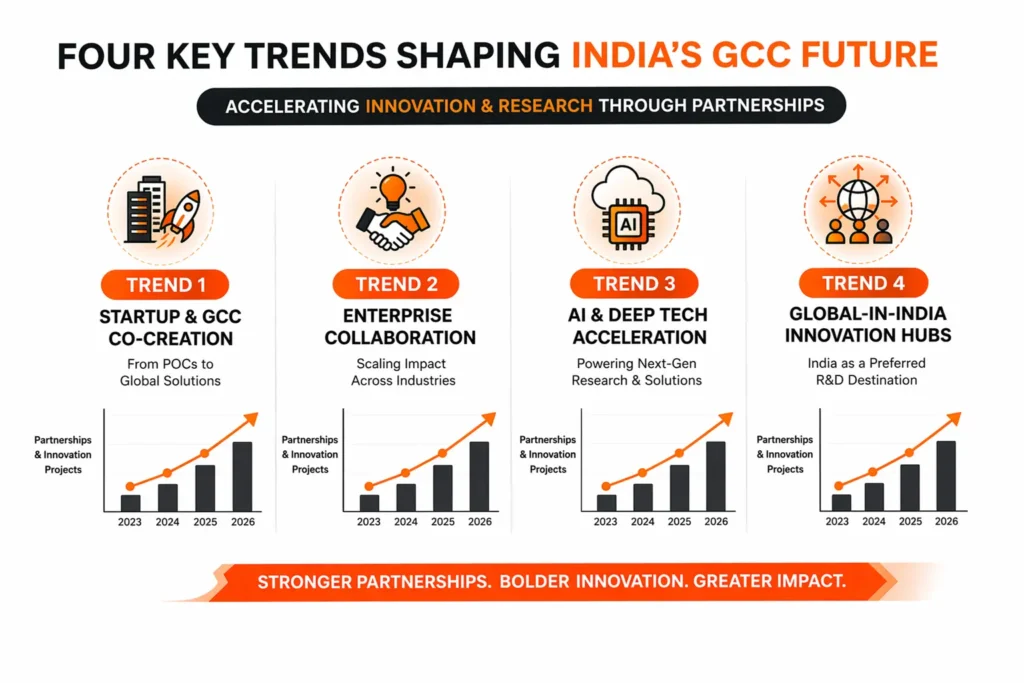
As per the GCC industry outlook India, global capability centres continue to grow in the future with proper diversification across India. It also proves that having the right talent and applying an excellent workforce strategy becomes crucial for sustaining this strong momentum.
Conclusion
The future of GCC in India will be stronger than ever. From the rise of GCC in India to certain shifts in global business operations, India has proven itself as one of the most preferred destinations for building such strategic capability centers.
As more global firms are expanding their presence in India, the role of Indian GCCs will only continue to grow, and it will shape the future of digital transformation, data analytics, engineering, and the best enterprise strategy.
Therefore, if your organization is considering setting up or expanding an ideal Global Capability Center, now, it is the right time to act. Get expert guidance, design the right model, and choose the best location and scale your business with confidence.
