

In 2026, a major global retailer used AI to predict demand and reroute inventory during a port strike, cutting stockouts by nearly 30% while avoiding costly overstock. In simple terms, “AI in the supply chain” means using smart algorithms and data to make better decisions across planning, inventory, logistics, and risk.
This article explains how AI is reshaping end‑to‑end supply chains in 2026, from forecasting and warehousing to transportation and resilience. You’ll see not just what’s possible today, but how forward‑looking companies are already using AI to run faster, leaner, and more adaptable operations.
Why Supply Chains Turned to AI
In the few years supply chains had to deal with a lot of ups and downs. There have been problems at ports and big changes in the geo politics that affect trade. Additionally, consumers’ demand for things has changed quickly. Customers want their things delivered fast and they want to be able to track them. Things need to be fast, predictable, and more efficient than they were a decade ago. With so much going on, the volume of data to be handled and the need to be ahead of any challenge have increased.
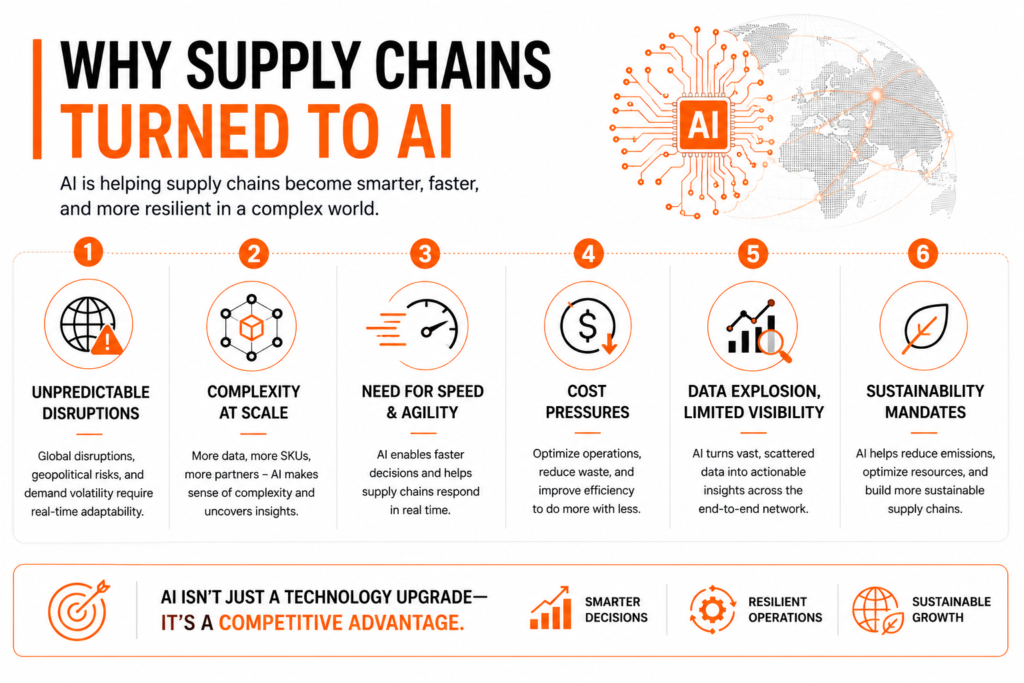
Supply chains have found that artificial intelligence is a powerful tool to help with these problems. Artificial intelligence can look at data and find patterns, which helps companies make faster and smarter decisions about supply chains.
In the following sections we will go through how artificial intelligence’s being used in supply chains for planning what people will want to buy, managing inventory, managing logistics and managing risk in simple and practical ways that companies can use in 2026.
AI in Demand Forecasting and Planning
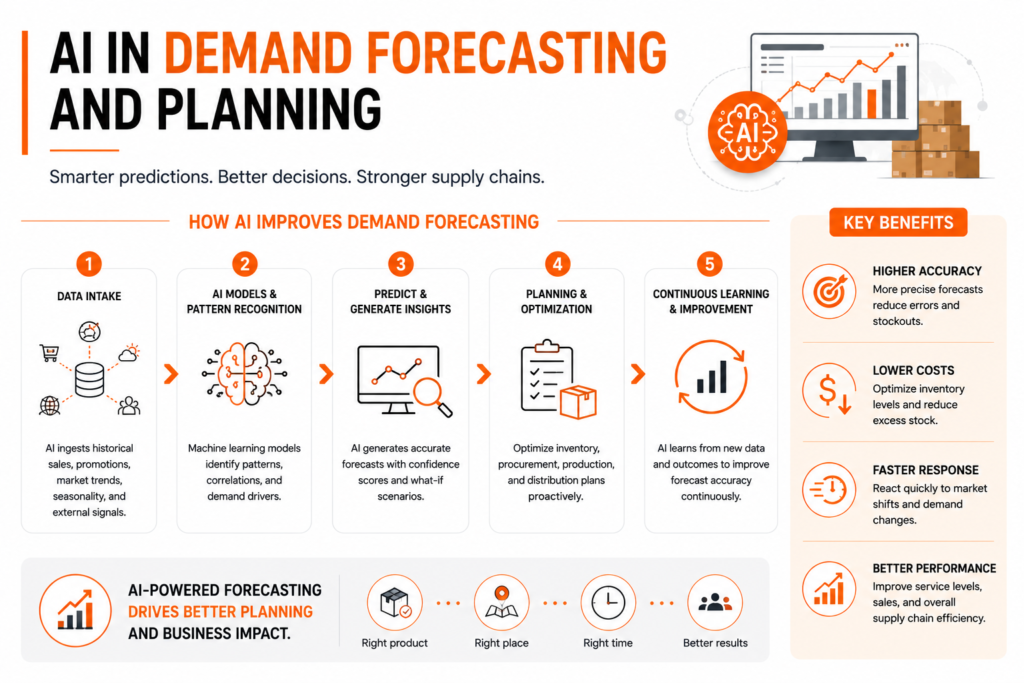
From guess‑based to AI‑driven forecasts
AI‑driven forecasting moves away from gut‑feel and rule‑of‑thumb estimates by using algorithms that learn from vast datasets. Instead of relying on a few planners’ assumptions, the system surfaces patterns across regions, channels, and SKUs, producing more objective, data‑backed forecasts.
Recalibrating forecasts in real time
Because AI models continuously ingest new sales, inventory, and external data, they can automatically recalibrate forecasts as demand spikes or drops. This allows planners to adjust production, replenishment, and promotions in near real time, rather than waiting for monthly or weekly reviews.
The result is fewer stockouts, reduced overstock, and lower inventory costs, helping companies balance service levels and efficiency.
Smart Inventory and Warehouse Optimization
Artificial intelligence is changing the way companies handle the products they have in their stores and other places. They do not have to use a schedule to order more products. Artificial intelligence looks at how many products are sold and how long it takes to get new products to figure out how many to keep in each place.
This helps companies stock correctly so they do not run out or have too many. Artificial intelligence is helping companies manage their products better across warehouses and stores.
Within the four walls of the warehouse, AI‑driven robotics and automation handle repetitive, high‑volume tasks such as picking, packing, and cycle counting. Smart algorithms direct autonomous mobile robots or voice‑guided pickers to the most efficient paths, while computer vision and sensors track inventory in real time.
The benefits are clear: orders are fulfilled faster, error rates drop, and operations can scale more smoothly during peak seasons. With AI‑enabled systems, many warehouses can move closer to 24/7 operation, supporting tighter delivery windows without a proportional increase in labor costs.
AI in Logistics and Transportation
Artificial intelligence is changing the way we do logistics. It is making route planning a dynamic process. Artificial intelligence looks at things like traffic, weather, fuel costs and how long it took to make the trip. Then it uses that information to create the route for trucks, trains and even the trucks that make deliveries.
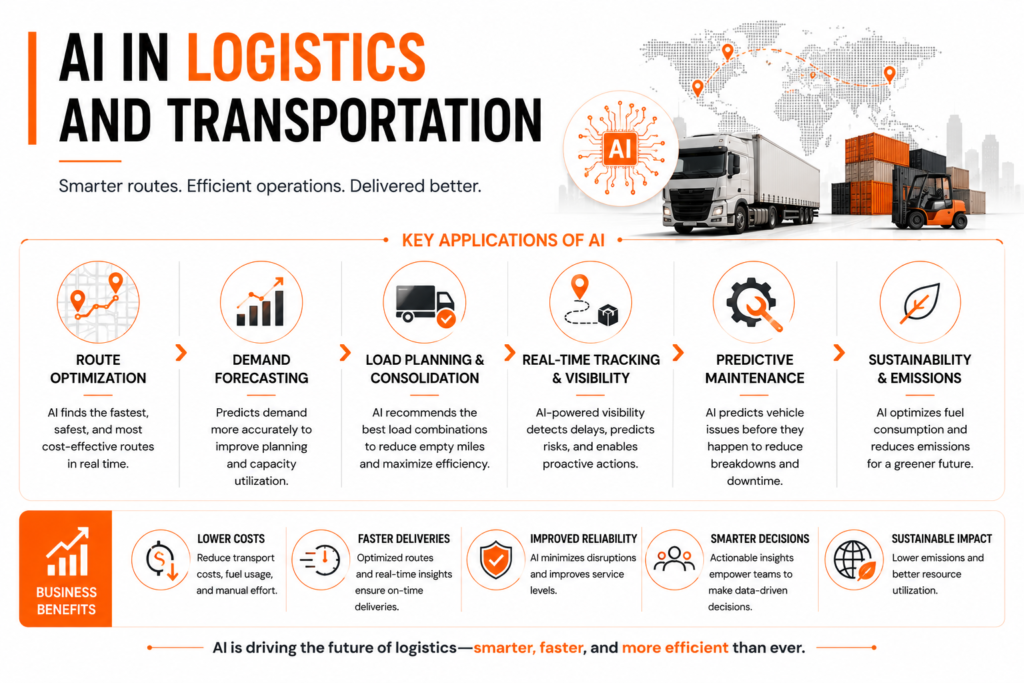
In addition to planning we can also track where shipments are in real time. This is made possible by sensors and devices that send information to artificial intelligence systems. These systems can detect problems like traffic jams, breakdowns or long lines at ports. If a problem is found artificial intelligence can suggest a route or adjust the delivery time.
AI‑Powered Risk Management and Resilience
Early‑warning signals from AI
AI continuously monitors multiple data points across suppliers, ports, weather patterns, and geopolitical developments to detect early signs of disruption. By ingesting news feeds, shipping‑status APIs, financial health indicators, and social‑media sentiment, AI can flag weak‑link suppliers, port congestion, or political unrest before they cascade into major delays.
Simulating “what‑if” scenarios
Predictive risk‑scoring models assign likelihood and impact scores to potential disruptions, helping teams prioritize threats. AI‑driven scenario simulations let planners test “what‑if” options, such as switching suppliers, shifting production lines, or rerouting cargo, under different disruption conditions. These simulations support faster, more confident decisions, turning theoretical resilience into concrete action plans.
Agentic AI: The Next Step in 2026
In 2026, “AI agents” are emerging as semi‑autonomous digital teammates embedded in supply‑chain workflows. Instead of just showing dashboards, these agents can trigger actions within predefined rules. For example, an inbound‑logistics agent can reroute shipments when a port delay is detected, a supplier‑risk agent can flag financial or performance issues and suggest alternatives, and a procurement agent can renegotiate terms or switch to backup suppliers when thresholds are breached. Humans still set the guardrails and review critical decisions, but AI handles routine interventions quickly and consistently, freeing teams for higher‑level strategy.
AI and Human Collaboration in Supply Chains
AI is here to help supply chain planners, not take their place. It automates tasks such as collecting data, updating forecasts, and flagging routine issues. This way teams can focus on strategizing that exclusively requires human intervention.
Challenges and Considerations When Using AI
AI’s effectiveness depends on quality data that is clean and well connected. When the data is poor or siloed, it leads to hindrance at every level as AI heavily depends on the day.
Many businesses find it hard to combine AI tools with systems like ERPs, TMS, WMS and procurement platforms. This can delay implementation. There are also concerns about ethics and governance. For example algorithms may be biased and may not be clear how decisions are made and it may be unclear who is responsible for those decisions.
Dealing with these issues from the start, with data rules, clear guidelines and teamwork helps create expandable AI supply chains.
Industry‑Specific AI Use Cases
Retail: AI for fast replenishment and omnichannel fulfillment
Retailers can use AI to make their supply chain more efficient. It triggers orders based on real-time sales data and forecasts. Dynamic pricing also helps retailers to manage their stock levels. Store-DC rebalancing is another strategy used to keep products in stock. It ensures that products are available in the stores at the right time. This improves the shopping experience for customers.
Manufacturing: AI‑driven planning and maintenance
In manufacturing, AI links demand signals directly to production planning so it can adjust the schedules when the orders change. It does this by using the information from the equipment sensors to find any problems before something breaks. This means that the machines do not stop working unpredictably and we can make the changes to the production line quickly. AI also prevents under or over production by predicting demands.
Future Outlook: 2026-2030 in Supply Chains
Between 2026 and 2030 Artificial Intelligence will become a part of planning, procurement, logistics and risk mitigation. This change is going to make supply chains along with logistics more resilient. AI systems will predict when problems might happen and adjust quickly. At the time companies will likely save money on operating costs, be able to respond faster to changes in demand, and be more sustainable.
Practical Takeaways for Supply Chain Leaders
Supply chain leaders who want to use intelligence should begin with things that will make a big difference like figuring out what people will buy, managing inventory, and dealing with problems that might come up.
Additionally, before they try to do more they should make sure their data is good and easy to use. That they have modern systems that can connect all their tools together. This way they can see everything in one place.
Then they should try out some ways of working like using artificial intelligence to change routes or warn about problems with suppliers and see what works well. After that they can make it bigger and use it more. Only if it makes things faster, cheaper and more reliable.
FAQs
When is the best stage to include AI in supply chain operations?
AI can be introduced at almost any stage, but the best time is when you already have reasonably clean, integrated data and clear pain points—such as poor forecasting, excess inventory, or frequent disruptions. Starting early in a digital‑transformation journey lets AI amplify planning, execution, and risk management rather than trying to patch legacy systems later.
Will AI replace supply chain planners?
AI supports planners by automating routine tasks and data analysis, but humans still steer strategy, exceptions, and relationships. The role shifts from manual number‑crunching to higher‑value decision‑making.
What is the first step to using AI in my supply chain?
Start with one high‑impact area such as forecasting, inventory, or risk and ensure clean, integrated data before scaling to broader AI‑driven workflows.
