

In the second half of 2023, container ships made nearly 250,000 port calls globally. Vessel sizes are growing, berth windows are shrinking, and route disruptions have pushed container ship demand up by 12%. Terminal operations have never faced this level of commercial pressure.
In this environment, choosing the right Terminal Operating System is not a routine software decision. It is a 10-year infrastructure investment that touches every vessel call, yard move, gate transaction, and billing cycle. A wrong fit fragments your data and erodes customer trust. The right TOS connects berth planning, yard management, gate automation, and finance into one real-time operational picture.
Why 2026 Is the Right Year to Re-Evaluate Your Terminal Operating System
Port operators face 3 intersecting pressures that are rewriting what the best terminal operating system must deliver. Knowing these pressures shapes every evaluation decision that follows.
Pressure 1: Mega-vessel berth windows are shrinking. The arrival of 24,000-TEU vessels at major transhipment hubs means each vessel call is a time-compressed, high-stakes orchestration event. A TOS platform must coordinate berth allocation, crane sequencing, and reefer management simultaneously, across multiple terminals within the same port cluster, in some cases.
Pressure 2: ESG reporting is moving from voluntary to mandatory. Port authorities across the EU, Singapore, and the Gulf Cooperation Council are attaching environmental performance requirements to terminal licensing and shipping line contracts. A TOS without native emissions monitoring capability will require costly middleware integration within the next 18 months at the majority of regulated facilities.
Pressure 3: AI-readiness is no longer a future concern. Equipment manufacturers are embedding predictive maintenance sensors into RTGs, AGVs, and quay cranes today. A TOS that cannot ingest, interpret, and act on that sensor data is already behind the operational curve.
For procurement teams reviewing TOS options this year, the question is not “does this system meet our current needs?” It is “does this system meet the operational reality of 2029?” Every criterion in this TOS buyer’s guide is written with that forward-looking lens.
What Does a Modern TOS Actually Do?
The best terminal operating system is not a yard management system with a reporting layer on top. It is an operational platform that connects every physical and data layer of the terminal, from the vessel at berth to the truck at the gate.
7 core capabilities define a modern TOS baseline:
- Berth and vessel planning, dynamic allocation accounting for tide windows, crane availability, and vessel rotation schedules
- Yard orchestration, real-time container positioning with AI-assisted stack planning to cut non-productive crane moves
- Gate automation, OCR-based truck processing that brings gate cycle time below 60 seconds
- Crane and equipment scheduling, integrated work instruction generation for quay cranes, RTGs, and reach stackers
- EDI and API connectivity, live data exchange with shipping lines, customs authorities, and port community systems
- Real-time operational dashboards, role-based visibility for planners, supervisors, and port authority liaisons
- AI anomaly detection, automated flagging of yard congestion, equipment underperformance, and vessel delay cascades
Older platforms cover the first four capabilities in isolation. The gap appears in connectivity and intelligence, the two capabilities that determine whether a terminal can scale.
This capability baseline matters because many vendors describe their platforms as “modern” while delivering capabilities that predate container automation by a decade. The vendor selection criteria in Section 3 give your team the tools to tell the difference.
The 7 Non-Negotiable TOS Evaluation Criteria for 2026
A rigorous TOS buyer’s guide process starts with criteria, not demos. Watching a polished product demonstration before establishing TOS evaluation criteria is the fastest path to a poor selection decision.
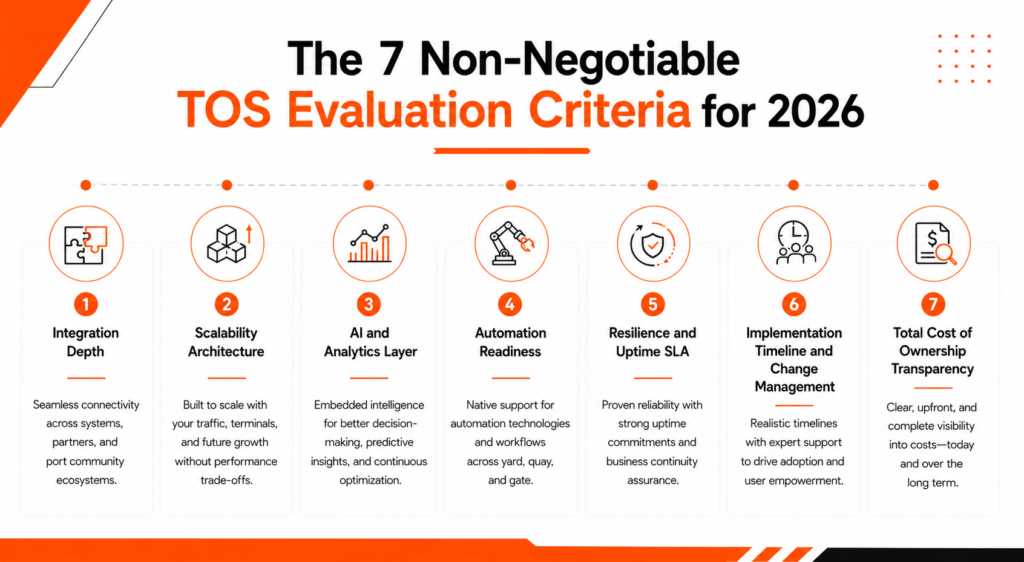
These 7 TOS evaluation criteria are drawn from live port procurement processes across container, bulk, and multipurpose terminals.
1. Integration Depth
A TOS does not operate in isolation. It connects with ERP platforms such as SAP and Oracle, national customs systems, shipping line EDI networks, and port community systems such as Portbase or INAPORT.
Weak integration depth means custom middleware that becomes a long-term liability. Ask vendors: “Show us a live integration with a customs authority EDI system at a terminal of comparable size to ours, in a production environment.”
2. Scalability Architecture
Terminals grow. A TOS selected for 500,000 TEU per year must handle 1.5 million TEU without a full system replacement.
3 indicators of genuine scalability:
- Multi-terminal support with a single administration layer
- Multi-commodity handling across containers, bulk, and ro-ro
- Modular licensing that scales per operational capability, not per user seat
Single-instance architecture requiring full upgrades per module is a warning sign. Ask vendors: “What is the highest annual throughput volume this system manages in a live production environment today?”
3. AI and Analytics Layer
The analytics requirements for a 2026 TOS selection have changed materially since 2022. Predictive berthing, smart stow optimisation, and vessel ETA integration with live port planning are now baseline expectations at high-performing terminals, not premium add-ons.
Ask vendors: “Which AI or ML capabilities are native to the core platform, and which require third-party module licensing?” The distinction between native and bolt-on capability has direct implications for integration overhead and long-term licence cost.
4. Automation Readiness
Crane automation, automated guided vehicles, and OCR gate systems are the 3 automation categories that a TOS must natively support. Terminals not yet automated today are planning automation within the next five years.
A TOS that requires full replacement to support automation is a capital risk, not just a software limitation. Ask vendors: “Which AGV and automated crane manufacturers are currently integrated with your live deployments, and in which terminals?”
5. Resilience and Uptime SLA
Port operations run 24 hours a day, 365 days per year. A TOS downtime event lasting more than four hours can cost a terminal between $500,000 and $2 million in lost throughput and vessel demurrage, depending on cargo volume and schedule density.
3 non-negotiable resilience requirements:
- Minimum 99.9% availability SLA with financial penalties for breach
- Documented failover architecture with a tested recovery time objective
- Geographically redundant data processing for disaster recovery
Ask vendors: “What was your measured system availability across all live deployments in the past 12 months, and how many SLA breach events occurred?”
6. Implementation Timeline and Change Management
TOS implementations at mid-to-large container terminals take between 12 and 24 months. Vendors quoting less than 12 months for a full go-live at a 1+ million TEU terminal are either scoping a partial deployment or underestimating programme complexity.
Change management support, formal training programs, phased go-live structures, and hypercare post-launch, separates a successful deployment from a costly stall.
Ask vendors: “Walk us through the last 3 full TOS implementations your team delivered, including actual vs planned go-live timelines.”
7. Total Cost of Ownership Transparency
Licence cost, typically an annual recurring fee, is just one line item in a five-year budget. The full cost picture covers: implementation services, data migration, integration development, training, annual support fees, and upgrade costs.
Vendors presenting only licence pricing without a five-year TCO model are withholding the information your procurement team needs for a sound investment decision. Ask vendors: “Give us a five-year TCO breakdown, including all implementation, integration, training, and support costs, calibrated to a terminal of our operational size.”
On-Premise vs Cloud TOS: Which Architecture Fits Your Terminal?
The on-premise vs cloud TOS decision is the most consequential choice in any TOS buyer’s guide process, and the one most frequently made without a structured framework. There is no universally correct answer.
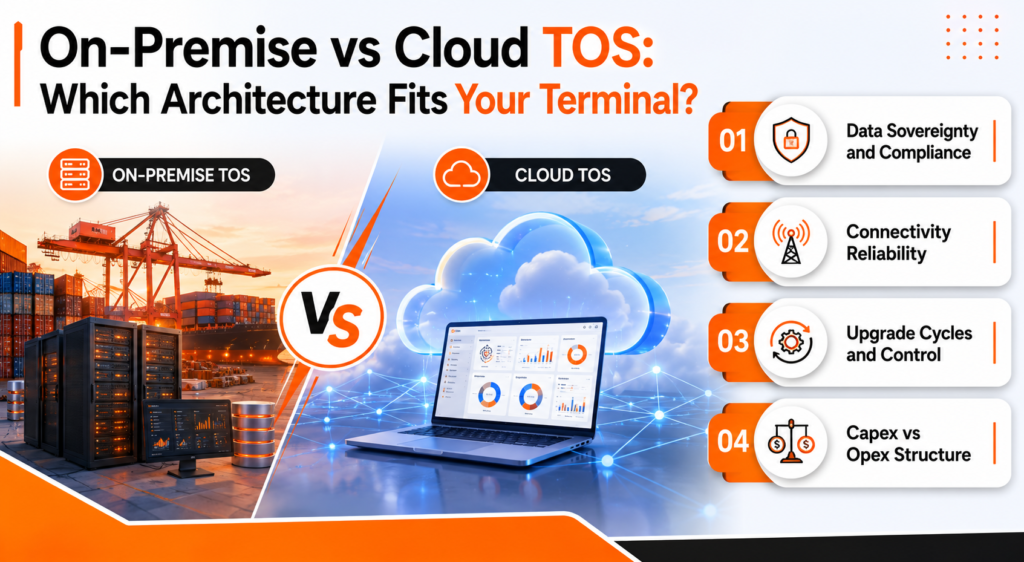
4 dimensions determine the right deployment architecture for your terminal.
1. Data Sovereignty and Compliance
Port authorities in markets such as India, Indonesia, Saudi Arabia, and Brazil operate under data localisation requirements that restrict sensitive operational data from being stored on offshore cloud infrastructure.
On-premise TOS deployment is the required architecture in these markets. Before selecting a cloud-native platform, a legal and regulatory review of data residency obligations is a mandatory step.
2. Connectivity Reliability
Cloud-delivered TOS platforms depend on stable, high-bandwidth internet connectivity. At developed-market container ports with dual-redundant fibre connectivity, this is not a constraint.
At greenfield terminals in emerging markets, or at inland port facilities with limited connectivity infrastructure, on-premise deployment with local data processing maintains operational continuity during connectivity disruptions. A connectivity audit is a pre-requisite to any on-premise vs cloud TOS decision for terminals outside Tier-1 markets.
3. Upgrade Cycles and Control
Cloud TOS platforms receive continuous updates. The benefit becomes a risk when updates are not fully controlled by the terminal operator. A crane scheduling algorithm update pushed without a terminal-specific testing period has caused operational disruptions at multiple facilities in the past two years.
On-premise deployments give the terminal full control over update timing and rollback capability. The trade-off is a heavier internal IT overhead for maintenance and patching.
4. Capex vs Opex Structure
On-premise TOS deployments carry higher upfront capital expenditure, hardware, infrastructure, and implementation services, with lower ongoing licensing fees.
Cloud TOS platforms shift the cost to a subscription model, preserving capital for port infrastructure investment. For terminals in high-growth phases, the opex model carries a more favourable cash flow profile over the first three years.
The emerging third path: Hybrid TOS architecture. In 2026, advanced terminal operators are deploying edge computing for real-time yard and crane operations, where sub-second latency is non-negotiable, while routing analytics, reporting and planning workloads to cloud infrastructure.
This hybrid on-premise vs cloud TOS model combines operational resilience with analytics scalability. It represents the direction that new large-terminal deployments are taking across Asia, the Middle East, and Northern Europe.
Quick Decision Matrix: Which Deployment Model Fits Your Terminal?
| Terminal Profile | Recommended Architecture |
|---|---|
| Small to mid-size regional terminal, stable connectivity | Cloud TOS, lower TCO, faster deployment |
| Large container port, complex integration ecosystem | On-premise or hybrid TOS |
| Multi-terminal operator across diverse regulatory markets | Hybrid TOS with regional data residency controls |
If your TOS buyer’s guide evaluation team is split on deployment architecture, a structured discovery session, mapping connectivity infrastructure, regulatory obligations, and the five-year automation roadmap, is the correct first step before committing to a model.
TOS Comparison: Leading Platforms Side by Side
A structured TOS comparison is not about finding the best platform in isolation. It is about finding the best-fit platform for your terminal’s throughput profile, integration requirements, and automation roadmap. In a well-run TOS buyer’s guide process, the comparison table is a shortlisting tool, not the final decision.
The following TOS comparison covers 5 platforms across 8 evaluation dimensions. All capability ratings reflect production-environment deployments, not vendor-stated roadmap commitments.
TOS Comparison Table: 2026 Edition
| Evaluation Dimension | Navis N4 | CATOS | Tideworks Mainsail | TBA Group Autostore | Intech Smart TOS |
|---|---|---|---|---|---|
| Deployment model | On-premise / cloud | On-premise | On-premise / cloud | On-premise / cloud | On-premise / hybrid |
| AI/ML capabilities | Module-based | Limited | Module-based | Native | Native |
| Integration ecosystem | Broad | Regional | Broad | Moderate | Broad |
| Terminal size fit | Large container | Mid-size multipurpose | Large container | Mid-to-large | Mid-to-large, multipurpose |
| Implementation timeline | 18-24 months | 12-18 months | 18-24 months | 14-20 months | 12-20 months |
| Pricing model | Licence + support | Licence + support | Licence + support | Subscription | Licence / subscription |
| Customer support tier | Global | Regional | North America focus | Europe focus | Global with regional teams |
| Automation readiness | Strong | Moderate | Strong | Strong | Strong |
Reading this TOS comparison correctly matters. A platform rated “strong” on automation readiness at a fully automated terminal in Rotterdam may have no live automation deployments at a developing-market greenfield facility. Ask every vendor for reference deployments that match your specific terminal context, not just their flagship site.
The best terminal operating system for your operation is the one with the deepest match between its live capability and your operational requirements, not the one with the longest feature list on paper.
This TOS comparison works best when combined with the 7 evaluation criteria from Section 3 and the verification checklist from Section 5. Scoring each vendor against the same framework removes subjectivity from the shortlisting process.
According to the World Bank’s 2023 logistics performance data, terminals that run integrated, modern TOS platforms with full EDI connectivity outperform those on fragmented legacy systems by measurable margins across vessel turnaround, gate efficiency, and annual throughput per berth.
Port Software Vendor Selection: Green Flags, Red Flags, and 5 Questions
The port software vendor selection process is where many terminal operators lose objectivity. A polished sales cycle can mask implementation risk, support gaps, and capability limitations that surface 12 months post-go-live. This is the stage of the TOS buyer’s guide process where structured due diligence pays the highest return.
Below is the due diligence framework that structured port software vendor selection processes use.
5 Green Flags in Port Software Vendor Selection
- The vendor has live deployments at terminals with comparable throughput volume to yours, not just comparable terminal type
- A named implementation team lead is assigned before contract signature, not a resource “to be confirmed” post-award
- Customer references take unscripted calls, not only pre-submitted written testimonials
- The vendor roadmap shows capability releases aligned to your 5-year automation plans, not just current-state requirements
- SLA terms include financial penalties for downtime below the guaranteed availability threshold, not just remediation commitments with no financial consequence
5 Red Flags in Port Software Vendor Selection
- Demo environments use synthetic data, no live operational terminal is made available for reference observation
- Integration delivery relies entirely on third-party system integrators, the vendor holds no direct integration expertise in-house
- Implementation timelines are quoted without a site-specific discovery phase, fixed timelines before scope is understood are estimates, not plans
- Support escalation paths are unclear beyond the first year, the hypercare period ends and a standard ticket-queue model takes over with no defined SLA
- Pricing is presented as “standard”, no terminal operation is standard, and pricing that does not reflect scope means the vendor has not understood yours
5 Questions for Your Shortlist Meeting
These 5 questions cut through any port software vendor selection process faster than a scoring matrix:
- “Show us a live terminal operation on your platform, not a configured demo environment.”
- “What were the top 3 reasons your last 3 implementations ran over timeline or budget?”
- “Which of our integration requirements do you rate as technically involved, and why?”
- “What happens to our system if throughput doubles to twice the current volume in three years?”
- “Who specifically will lead our implementation, and how many concurrent TOS deployments is that person managing today?”
Honest answers to these 5 questions give procurement teams the data needed to make a confident, auditable platform choice in the port software vendor selection process.
The Hidden Costs That Never Appear in the Proposal
Every TOS buyer’s guide addresses what vendor proposals consistently underplay. The 5 cost categories below are the ones that most frequently inflate total cost of ownership beyond the headline licence price.
- Data migration from legacy systems. Moving 10 or more years of container history, vessel records, and customer data from an end-of-life TOS to a new platform takes between 4 and 8 months of specialist data engineering work. This rarely appears as a line item in vendor pricing decks. Budget 15-25% of the licence cost for migration work.
- Workforce change management and retraining. A TOS rollout touches every operational team, planners, crane operators, gate supervisors, and finance staff. Formal change management programmes, hands-on simulator training, and phased go-live support add 10-20% to year-one costs at most terminals.
- Custom integration development. Even the broadest integration ecosystems do not cover every terminal’s specific EDI variant or legacy equipment PLC interface. Custom integration work for non-standard connections adds $150,000 to $500,000 to implementation costs, depending on terminal complexity.
- Support tier escalation over time. Many TOS contracts include hypercare support for the first 6 to 12 months post-go-live, then transition to a standard SLA model. The cost of escalating back to premium support tiers in year two or three is a budget item that procurement teams rarely price in advance.
- Downtime during production cutover. Moving from a live legacy TOS to a new platform requires a cutover window where both systems run in parallel or operations are partially suspended. Even a planned 48-hour cutover window at a mid-size terminal carries measurable throughput and demurrage risk.
Factoring these 5 cost categories into the five-year TOS business case gives procurement and finance teams a realistic investment picture before contract negotiation.
How to Build Your Internal TOS Business Case in 4 Steps
A strong TOS buyer’s guide process does not end at vendor selection. The internal business case, the document that secures board or executive approval, is where many TOS projects stall.
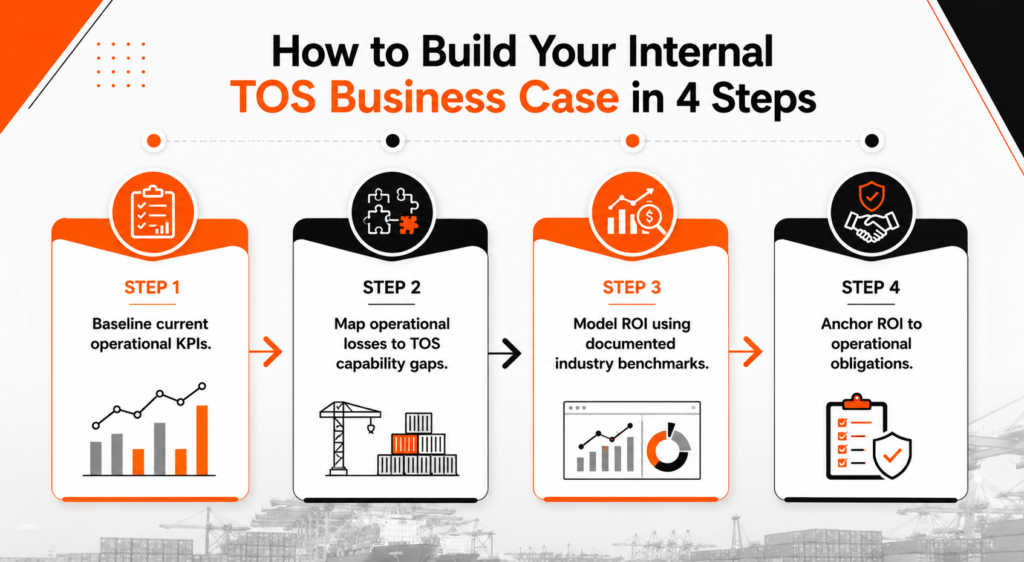
Step 1: Baseline current operational KPIs. Document vessel turnaround time, crane moves per hour, gate cycle time, yard utilisation, and container dwell time as measured averages from the past 12 months. These are the reference points against which the business case measures projected gains.
Step 2: Map operational losses to TOS capability gaps. For each underperforming KPI, trace the specific TOS limitation driving the gap. Vessel turnaround above target? Trace it to yard pre-marshalling delays caused by manual planning. Gate cycle time above 90 seconds? Trace it to the absence of OCR and pre-gate appointment integration.
Step 3: Model ROI using documented industry benchmarks. Reference UNCTAD and World Bank port performance data to build conservative and optimistic scenarios. Terminals that have moved from legacy to modern TOS platforms report 15-25% reductions in vessel turnaround time and 20-30% reductions in crane non-productive moves in post-implementation assessments published by port authorities.
Step 4: Anchor ROI to operational obligations. Connect TOS capability gains to shipping line SLA commitments, ESG reporting requirements, and port authority concession terms. A business case that links technology investment to regulatory and commercial obligations is more durable than one built on operational efficiency metrics alone.
What Mistakes should TOS Buyer Avoid
This TOS buyer’s guide would be incomplete without a frank account of the 5 mistakes that most frequently lead to poor TOS outcomes.
- Selecting the lowest upfront cost over implementation quality. The cheapest TOS proposal at RFP stage is frequently the most expensive over a five-year period. Underfunded implementation programmes result in incomplete integrations, extended go-live timelines, and post-launch operational gaps that require costly remediation.
- Underestimating workforce change resistance. Terminal operations teams have refined workflows around existing systems for years. A TOS transition without a structured change management programme sees productivity dips of 20-40% in the first three months post-go-live, regardless of the quality of the new platform.
- Choosing a TOS for today’s throughput, not tomorrow’s. A platform selected for 400,000 TEU that reaches 900,000 TEU in year four either requires expensive mid-cycle scaling workarounds or premature replacement. Scalability architecture is a TOS buyer’s guide evaluation criterion, not a secondary consideration.
- Skipping the integration discovery phase. Vendors who quote integration timelines without a formal discovery of the terminal’s existing system stack are estimating, not scoping. Integration discovery is a paid, scoped engagement of four to six weeks, and worth every day of it.
- Treating vendor references as a formality. Three pre-provided vendor references are a starting point, not a complete picture. Asking the vendor for references from terminals that experienced a difficult implementation is a more informative due diligence step than speaking only to the vendor’s showcase sites.
The Right TOS Decision Starts With the Right Framework
A TOS purchase is not a software decision. It is a commitment to the operational capacity, automation trajectory, and competitive position of the terminal for the next decade.
The 3 decisions that matter most in any TOS buyer’s guide process are:
- Deployment architecture, on-premise, cloud, or hybrid, based on regulatory, connectivity, and TCO requirements specific to your terminal
- Evaluation rigour, using a structured TOS evaluation criteria framework and a verified TOS features checklist, not a demo scorecard
- Vendor scrutiny, applying green flag and red flag criteria to port software vendor selection, with reference calls that go beyond the vendor’s showcase list
The terminals that make the best TOS decisions in 2026 treat this as an infrastructure commitment, not a procurement formality.
We work with terminal operators across container, bulk, and multipurpose facilities to run structured TOS selection and deployment programs. If your team is at the evaluation stage, reach out to a terminal technology specialist who has delivered TOS programs at ports across 4 continents.
FAQs
What is a TOS buyer’s guide and who should use it?
A TOS buyer’s guide is a structured evaluation framework for terminal operators selecting, replacing, or re-scoping a terminal operating system. It is designed for port directors, terminal IT leaders, operations managers, and procurement teams managing a formal TOS selection process. This guide applies to container, multipurpose, and bulk terminals at both the first-TOS and replacement-TOS stages.
How long does TOS implementation take?
TOS deployment at a mid-to-large container terminal takes between 12 and 24 months, depending on integration complexity, data migration scope, and the level of automation being commissioned alongside the software. Smaller regional terminals with simpler integration requirements reach full go-live in 10 to 14 months with a well-scoped programme.
What is the difference between on-premise and cloud TOS, which is better in 2026?
On-premise TOS gives the terminal full control over data residency, upgrade timing, and system configuration. Cloud TOS delivers faster deployment, lower upfront cost, and continuous vendor-managed updates. Neither model is universally superior. The right choice depends on the terminal’s regulatory environment, connectivity infrastructure, and automation roadmap. Many large-terminal operators in 2026 are moving to a hybrid on-premise vs cloud TOS model, edge computing for real-time operations, cloud for analytics and planning.
How do we run a TOS evaluation without prior RFP experience?
No prior RFP experience is needed. Use the evaluation criteria framework to weight vendors on operational fit, and the features checklist to verify capability depth. Running both together gives procurement teams a structured, auditable shortlisting process.
Can a mid-size terminal justify a full TOS investment?
Yes. A mid-size terminal handling 200,000 to 600,000 TEU annually recovers TOS investment through gate automation savings, yard efficiency gains, and reduction in manual data reconciliation within 3 to 5 years. The business case is strongest for terminals with high truck volumes, multiple shipping line relationships, or crane automation plans within the next five years.
