

India posted a record $824.9 billion in combined merchandise and services exports in FY 2024-25. Big number. But ask a mid-sized exporter from Surat or Ludhiana how their last shipment went, and the story changes fast. Missed container pickups. Customs entries stuck for 3 days. A freight agent unreachable after booking.
That gap between the headline and ground reality is where digital freight forwarding in India fits in. It fixes daily friction that bleeds time and money out of EXIM operations. In 2025, the systems to do that properly are finally in place.
The Infrastructure Behind India Logistics Technology Today
The foundation of digital freight forwarding in India is not private platforms alone. Government-built infrastructure has done much of the heavy lifting.
The Unified Logistics Interface Platform (ULIP) connects 44 systems across 11 central ministries through 136 APIs and over 2,000 data fields. By December 2025, ULIP crossed 200 crore (2 billion) API transactions, with over 1,700 companies registered and 200+ applications built on top. The Logistics Data Bank tracks 100% of EXIM container movement across 18 ports and 5,800 railway stations.
ULIP crossed 200 crore API transactions by December 2025, connecting 44 government systems and enabling real-time tracking across 18 ports and 5,800 railway nodes. (Source: Press Information Bureau, DPIIT Year-End Review, Dec 2025)
That is live, working infrastructure that online freight forwarding India platforms tap into directly. ICEGATE processes electronic customs filings, DGFT’s portal issues e-IECs around the clock, and NSWS cleared 829,750 approvals by November 2025. The pipes exist. The question is who is plugged in.
Where Things Still Go Wrong in Traditional Freight Operations
Before looking at what freight management software India fixes, it helps to name what still breaks. These are recurring problems, not edge cases.
Documents That Travel the Wrong Way
A standard shipment involves a bill of lading, commercial invoice, packing list, certificate of origin, and insurance certificate. In many operations today, those documents still move over email, WhatsApp, and couriers. One wrong HS code on a manual entry holds up clearance. Many smaller agents still print, scan, and re-upload documents as images, defeating the purpose of e-freight India customs systems like ICEGATE entirely.
Customs Clearance That Takes Too Long
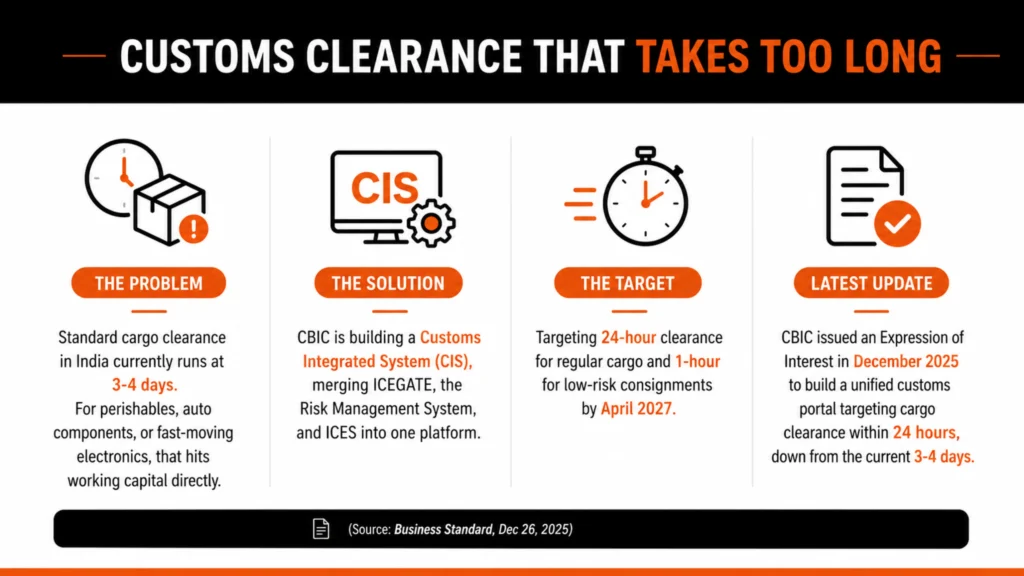
Standard cargo clearance in India currently runs at 3-4 days. For perishables, auto components, or fast-moving electronics, that hits working capital directly. CBIC is building a Customs Integrated System (CIS), merging ICEGATE, the Risk Management System, and ICES into one platform, targeting 24-hour clearance for regular cargo and 1-hour for low-risk consignments by April 2027.
CBIC issued an Expression of Interest in December 2025 to build a unified customs portal targeting cargo clearance within 24 hours, down from the current 3-4 days. (Source: Business Standard, Dec 26, 2025)
No Visibility on Cargo Location
Many SME shippers still cannot confirm where their container is without calling the agent, who calls the shipping line, who checks an internal system. Real-time tracking is routine in e-commerce. In EXIM freight, there is a gap for a large share of shippers.
Rates That Are Hard to Compare
Ocean freight rates shift weekly. Air rates shift daily. Shippers in traditional models rely on a small pool of brokers with no easy way to benchmark prices or switch. That keeps freight procurement costs higher than needed.
Traditional vs. Digital Freight Forwarding: What Actually Changes
| Aspect | Traditional Freight Forwarding | Digital Freight Forwarding in India |
|---|---|---|
| Documentation | Paper-heavy, error-prone, slow to correct | Digital docs via ICEGATE, e-BL, eCoO 2.0 |
| Customs Filing | Manual, 3-4 day clearance average | e-freight India customs, target 24-hour clearance |
| Shipment Visibility | Phone calls and manual status updates | Real-time tracking via ULIP, Logistics Data Bank |
| Rate Discovery | Broker-dependent, no easy price comparison | Instant quotes on digital logistics platforms India |
| DGFT Compliance | Physical visits, long paperwork queues | DGFT digital freight compliance India, fully online |
| Data Integration | Siloed across agents, ports, and carriers | API-connected across 44 government systems on ULIP |
How Digital Freight Forwarding in India Works
Digital freight forwarding in India replaces agent-mediated information flow with software-driven workflows. The 5 core functions are rate management, booking, documentation, customs filing, and tracking, all on one connected data layer.
Here is what a typical workflow looks like on a freight forwarder app India:
- Rate search: Instant ocean and air freight quotes from multiple carriers in real time, with routing options side by side.
- Booking: Online space confirmation and automated Bill of Lading requests sent directly to the carrier system.
- Documentation: Digital upload of commercial invoice and packing list, with customs entries auto-filled via the ICEGATE API.
- Compliance: DGFT digital freight compliance India handled through integrated IEC verification, eCoO 2.0 generation, and HS code validation.
- Tracking: Container-level visibility via ULIP’s Logistics Data Bank across ports, ICDs, and railway nodes.
Freight management software platforms like Cogoport, Shipsy, Portcast, and Freightos are built around this stack. The freight tech startups India ecosystem now processes billions in freight value across thousands of shippers annually
For IT managers and CIOs modernizing supply chain systems, integration is the first question. Most digital logistics platforms India providers offer REST APIs and EDI connectivity, so freight data flows directly into ERP and TMS systems. No manual re-entry, fewer data errors.
What Logistics Automation India Is Doing to Costs
India’s logistics cost stood at 7.97% of GDP, at Rs. 24.01 lakh crore for FY 2023-24, per the first NCAER-DPIIT study released in September 2025. That is a notable drop from the 13-14% figure cited in policy documents for years.
India’s logistics cost is now assessed at 7.97% of GDP for FY 2023-24, down from the previously cited 13-14%, driven by ULIP, GST, e-Way Bill, and Dedicated Freight Corridors. (Source: Press Information Bureau, Ministry of Commerce, Sep 2025)
The study credits logistics automation India tools as a main driver. GST and the e-Way Bill cut interstate transport friction. ULIP reduced data fragmentation. Dedicated freight corridors shortened transit times.
For individual businesses, logistics automation shows up in 3 ways:
- Fewer detention and demurrage charges: Real-time tracking cuts missed pickup windows and port storage costs.
- Lower documentation error costs: Automated HS code and weight validation catches mistakes before customs filing, not after.
- Faster working capital cycles: 24-hour customs clearance instead of 3-4 days shortens the cash-to-cash cycle for exporters.
The commercial side confirms this. Porter raised $200 million in Series F funding in 2025, crossing unicorn status at $1.1 billion. Shiprocket posted FY25 revenue of Rs. 1,632 crore, up 24% year-on-year, and turned cash EBITDA positive for the first time.
Shiprocket posted FY25 operating revenue of Rs. 1,632 crore (24% YoY growth) and turned cash EBITDA positive, processing over 97 million transactions in H1 FY26 across 400,000+ merchants. (Source: YourStory, Oct 2025)
Is India Supply Chain Digitization Reaching SME Exporters?
Large enterprises and 3PLs have moved fast on digital tools. The gap sits at the SME level, where many exporters still work through traditional agents who have not digitized their back-end operations.
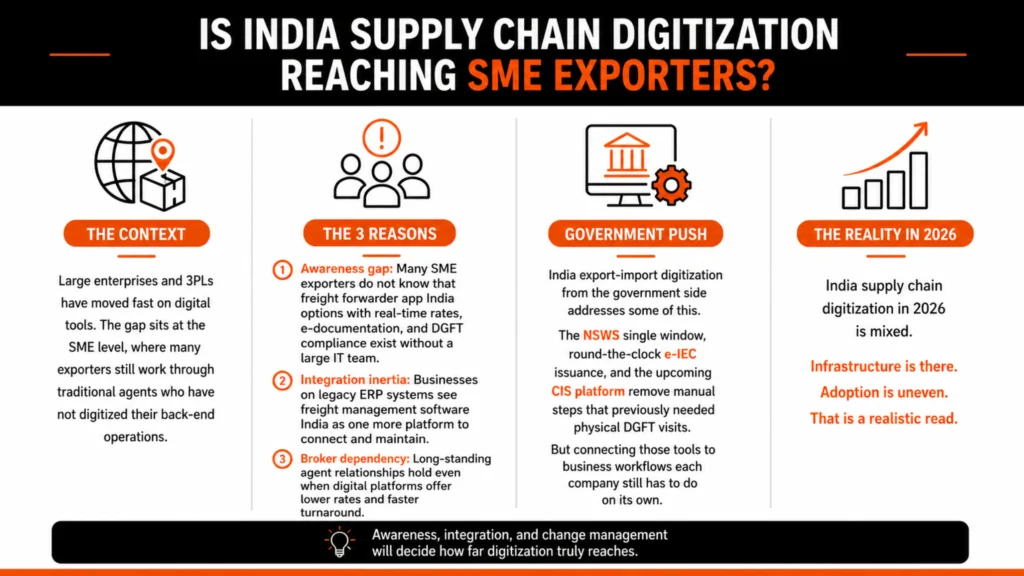
There are 3 reasons that gap persists:
- Awareness gap: Many SME exporters do not know that freight forwarder app India options with real-time rates, e-documentation, and DGFT compliance exist without a large IT team.
- Integration inertia: Businesses on legacy ERP systems see freight management software as one more platform to connect and maintain.
- Broker dependency: Long-standing agent relationships hold even when digital platforms offer lower rates and faster turnaround.
India export-import digitization from the government side addresses some of this. The NSWS single window, round-the-clock e-IEC issuance, and the upcoming CIS platform remove manual steps that previously needed physical DGFT visits. But connecting those tools to business workflows each company still has to do on its own.
India supply chain digitization in 2026 is mixed. Infrastructure is there. Adoption is uneven. That is a realistic read.
FAQs
What is digital freight forwarding in India?
Digital freight forwarding in India is software-managed EXIM logistics that automates rate discovery, booking, documentation, customs filing, and shipment tracking, replacing paper-based agent processes with connected, real-time workflows.
How does ULIP support online freight forwarding India platforms?
ULIP connects 44 government systems through 136 APIs, giving online freight forwarding India platforms real-time container tracking across 18 ports and 5,800 railway stations without manual updates.
What does DGFT digital freight compliance India cover?
DGFT digital freight compliance India covers EXIM regulatory requirements through DGFT’s online portal, including e-IEC issuance, SION filings, and advance authorisation applications. No physical visits needed.
How does freight management software India handle customs filing?
Freight management software India connects to ICEGATE, auto-populates customs entry fields from commercial invoices, validates HS codes, and generates shipping bills digitally, cutting manual errors and clearance time.
Which freight tech startups India are active in this space?
Active freight tech startups India include Cogoport for ocean freight, Shipsy for 3PL transport management, Portcast for vessel tracking, Shiprocket for e-commerce logistics, and Porter for last-mile freight across the EXIM digital freight India chain.
