

The UAE is becoming a stronger global trade and logistics hub. This makes its logistics problems quite complicated in 2026. The UAE is a crucial part of global supply chains because cities such as Dubai and Abu Dhabi are in key spots that connect top international markets. But this rapid growth means that freight forwarders have to deal with all the updated rules and regulations.
Businesses in the UAE are now dealing with several trade logistics problems that affect the efficiency, costs, and delivery times. These problems include changing compliance requirements and higher shipment volumes. Client expectations have also changed a lot. They now require faster deliveries and real-time tracking, as well as seamless coordination.
This blog examines the key problems freight forwarders in the UAE face and how to solve them.
Key Takeaways
- UAE logistics in 2026 is becoming more complex due to rapid growth and stricter regulations.
- Customs clearance and compliance remain the biggest operational bottlenecks.
- Port congestion and infrastructure pressure directly impact delivery timelines and costs.
- Rising freight, warehousing, and fuel costs are putting constant pressure on margins.
- Supply chain disruptions in the Middle East require flexibility and contingency planning.
- Many freight forwarders are moving more slowly because they don’t have the latest technology. Going digital is no longer an option.
- Last-mile delivery is becoming a major challenge due to urban density and customer expectations.
- Logistics systems that aren’t integrated and communicate in real time are less effective.
- Import-export complexity continues to demand expertise, automation, and global partnerships.
- The future of UAE logistics will be driven by AI, automation, sustainability, and smart infrastructure.
UAE Logistics Landscape in 2026
In 2026, a rapidly changing regulatory framework shapes the UAE’s logistics scene, and global trade is rising. With stricter rules to improve safety, efficiency, and transparency along supply chains, UAE freight forwarding regulations continue to grow. All of these rules make things uniform. But they also mean that freight forwarders have to keep up with new rules and regulations all the time.
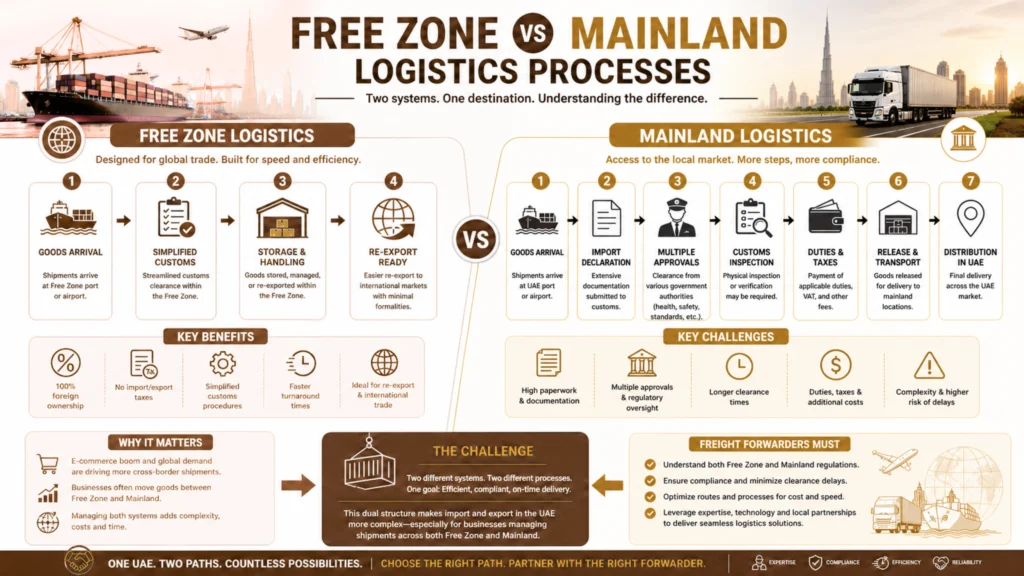
The major difference between free zones and mainland operations is one of the things that makes the UAE market unique. Free zones are great for international trade as they offer benefits such as no taxes and easier customs procedures. Mainland logistics needs a lot of paperwork, approvals, and regulatory oversight. All of these factors make things a lot more difficult.
This dual structure makes it difficult to import and export in the UAE. This situation is especially true for companies that have to manage shipments going through both systems.
Cross-border trade has grown because of e-commerce and increasing demand around the world. This situation has ultimately led to a lot more shipments. As a result, freight forwarders must deal with shorter deadlines, higher expectations, and quite complicated logistics networks. All of these things explain why operational problems are getting worse in the UAE logistics sector.
TOP 8 UAE Logistics Challenges in 2026
In 2026, the following are some of the most common logistics problems in the UAE:
Challenge 1: Complex Customs Clearance & Regulatory Compliance
The increasing complexity of paperwork and rules is one of the biggest problems UAE freight forwarders have with clearing customs. For every shipment, there must be correct invoices, certificates of origin, packing lists, and permits. Even a little mistake can cause huge delays that can cost a lot of money. UAE freight forwarding rules are changing constantly, so it’s difficult for logistics companies to stay in line.
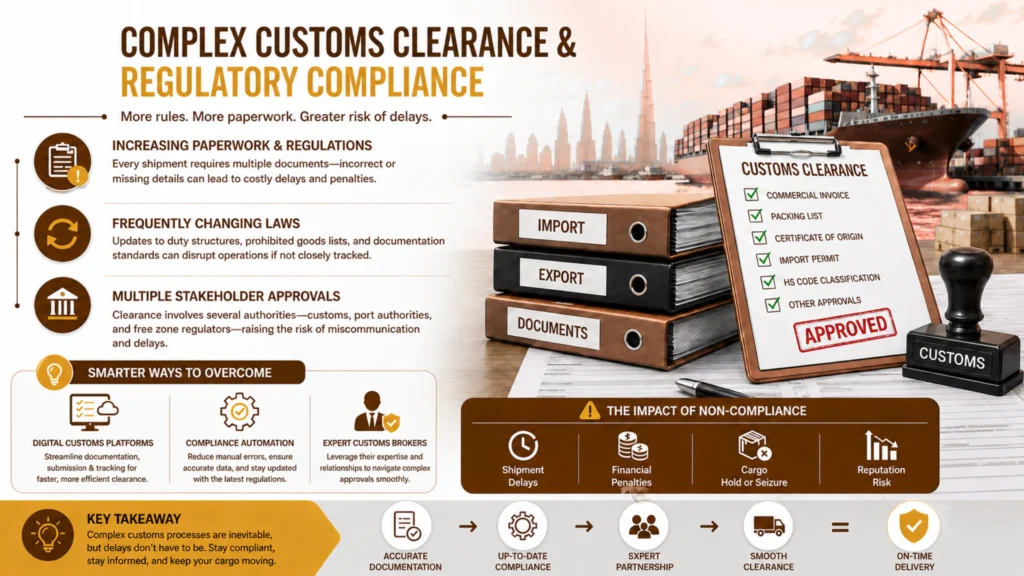
The problem worsens because laws regarding imports and exports keep changing. Changes to duty structures, the list of prohibited goods, or documentation standards can disrupt operations if they are not closely monitored. Freight forwarders also need permission from many different groups, such as customs departments, port authorities, and free zone regulators. This complicated process increases the chance of misunderstandings as well as delays. This makes UAE freight compliance a crucial operational issue.
To get around these sorts of problems, many businesses are using digital custom platforms that make the process of paperwork easier. Compliance automation tools help cut down on mistakes made by hand and make sure that shipments meet the most recent rules set by regulators. Working with skilled customs brokers is also crucial. Their knowledge helps get through the difficult approval process easily and keeps shipments moving without any kind of delays.
Challenge 2: Port Congestion & Infrastructure Pressure
As trade volumes continue to rise, port congestion at Jebel Ali has become a significant concern for freight forwarders operating in the UAE. As the busiest ports in the region, Jebel Ali handles massive cargo volumes on a daily basis. This leads to delays in vessel berthing, container handling and customs clearance. During peak seasons or global supply chain disruptions, these delays can keep increasing. It can impact the delivery timelines and increase operational costs at the same time.
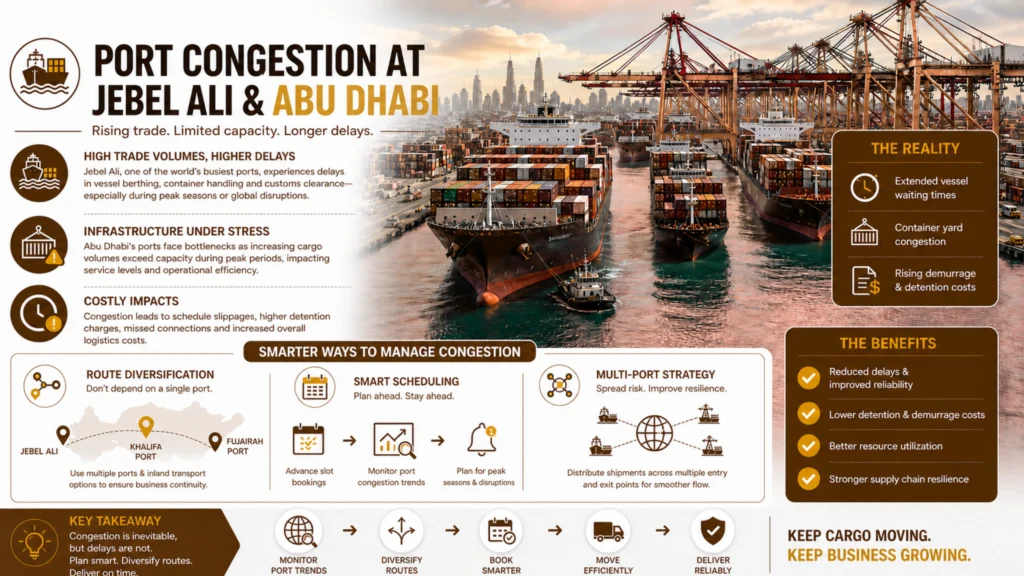
As the amount of cargo increases, Abu Dhabi is experiencing bottlenecks and putting its infrastructure under stress. Despite the growth of Abu Dhabi’s ports, they might not be able to manage all the cargo during peak hours. This is only because no one is using alternative ports or routes; the infrastructure is under stress. This situation makes it difficult for freight forwarders to keep up service levels.
To manage such problems, freight forwarders are using route diversification strategies. This includes using more than one port and inland transport options. This helps avoid being too dependent on one hub.
Smart scheduling, like booking time slots in advance and planning for potential events, helps avoid bad traffic times. Multi-port strategies, which spread shipments across multiple entry and exit points, improve logistics and help reduce delays in high-pressure situations as well.
Challenge 3: Rising Freight Costs & Margin Pressure
The top priority of freight forwarders is cost management, which helps control increasing costs. Fuel prices have a wonderful effect on the cost of transportation. This service is especially for long-haul and international shipments. In a competitive market like UAE even a little change in fuel price can hurt margins.
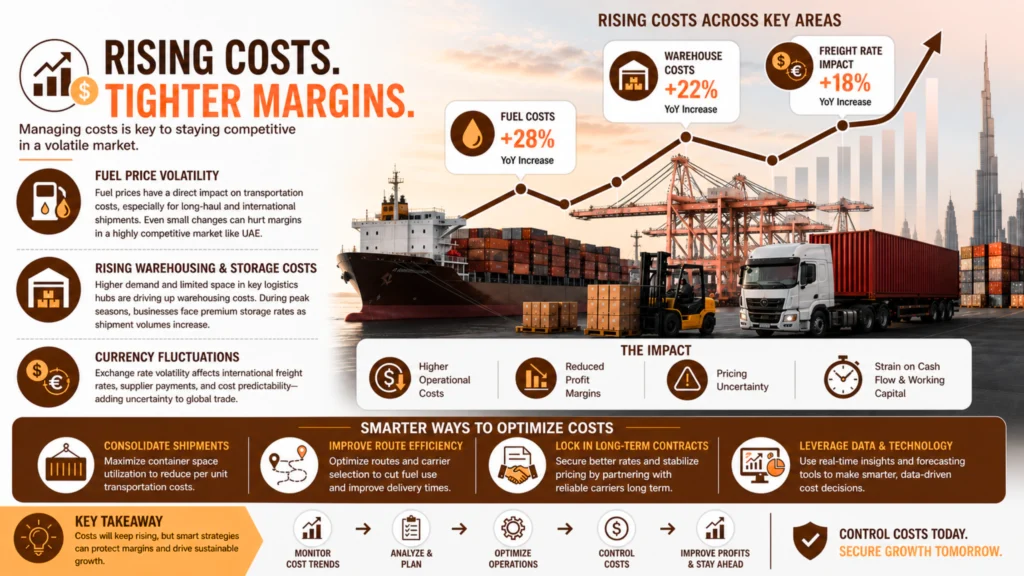
In key logistics hubs, higher demand and limited space have raised storage and warehousing costs in addition to fuel. Businesses must pay premium storage rates during peak seasons as shipment volumes rise. Currency fluctuations affect international freight rates, supplier payments, and cost predictability, adding uncertainty.
Freight forwarders are using smarter cost optimization to help address all issues. Consolidating shipments maximizes container space, which in turn reduces per unit transportation costs. This happens while route efficiency reduces fuel use and increases delivery. More and more companies are signing long-term contracts to help stabilize pricing and avoid market swings. All of these methods help companies to stay profitable in a volatile cost environment.
Challenge 4: Supply Chain Disruptions Across the Middle East
Freight forwarders worry about Middle East supply chain disruptions affecting delivery times, costs, and operational planning. The strategic importance of global trade means that any geopolitical tension, trade restriction, or route disruption can have an effect on international shipping networks. Any kind of event on key corridors such as the Red Sea or nearby trade routes faces rerouting, increasing transit times and freight costs.
Disruptions also affect shipment scheduling, inventory planning, and customer commitments. Freight forwarders often face last-minute route changes, port delays, and carrier availability. Unpredictability makes service levels difficult to maintain and increases supply chain delays.
Businesses are building resilient and flexible supply chains to help overcome these challenges. Route and supplier diversification reduces corridor or region dependence. Real-time tracking and predictive analytics help companies anticipate disruptions and act immediately. In addition, having backup carriers or transport modes ensures continuity at the time of global or regional disruptions.
Challenge 5: Technology Gaps in Freight Forwarding
Due to technology adoption gaps, many companies in advanced markets still have freight forwarder problems in Dubai. Several freight forwarders use legacy systems as well as manual processes to help with tracking, documentation and communication. This issue helps slow down operations, increase human error and reduce supply chain visibility as well.
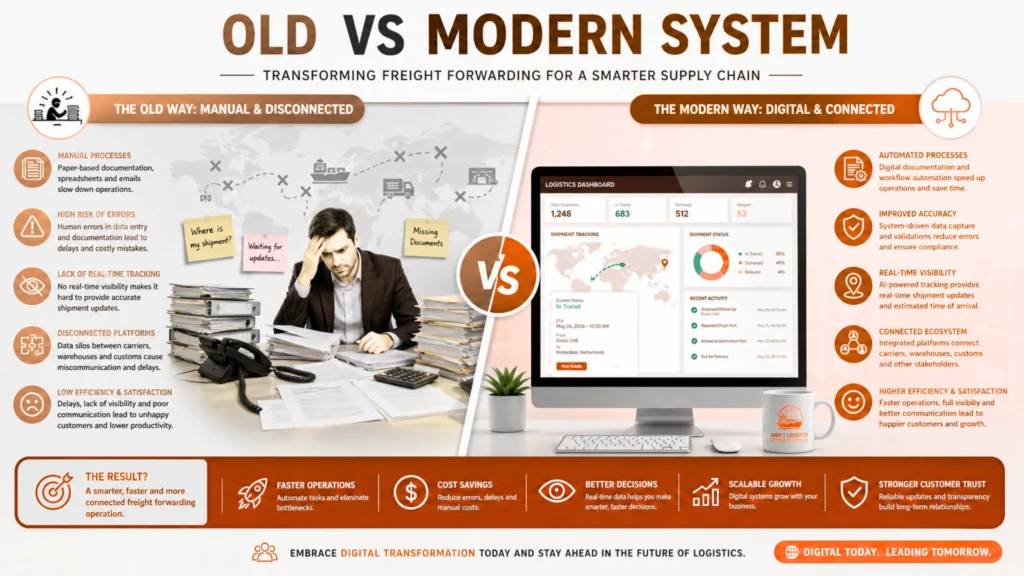
Lack of real-time tracking is another problem. Businesses struggle to provide accurate shipment updates without integrated systems, reducing efficiency and customer satisfaction. Disconnected platforms and data silos further complicate coordination between stakeholders such as carriers, warehouses, and customs authorities.
To help overcome all these challenges, freight forwarders should prioritize digital transformation. Modern logistics management systems automate documentation, streamline operations, and improve accuracy at the same time.
AI-powered tracking tools and cloud platforms provide real-time shipment visibility. This helps businesses make faster and better decisions. Once teams receive training, they find it easier to adopt and operate these technologies efficiently.
Challenge 6: Last-Mile Delivery Complexity in Urban UAE
Last mile delivery is the most difficult logistics task. This phenomenon is especially in densely populated places like Abu Dhabi and Dubai. Demand for faster deliveries increased last mile delivery UAE challenges. The current situation has been forcing freight forwarders to meet tight deadlines in any complex environment.
City congestion, high-rise buildings, and inconsistent addressing systems often cause disruptions in deliveries. Drivers waste time while trying to find drop-off points. This reduces efficiency as well as fuel use. Customer expectations have changed with same-day or next-day delivery. This process reduces delays as well as errors.
Real-time route optimization tools are useful for companies, as they help find the fastest and most efficient delivery routes. Microfulfillment centers present near cities speed up order fulfillment and help reduce delivery distances at the same time. Smart delivery technologies, such as GPS tracking, digital address mapping, and automated notifications, help improve accuracy, customer experience, and operational efficiency.
Challenge 7: Fragmented Logistics Ecosystem
The fragmented logistics ecosystem hinders UAE trade logistics. Some of the common stakeholders in freight forwarding include shippers, carriers, port authorities, customs officials, warehouse operators, and last-mile delivery partners. Inefficiencies across the supply chain result from these entities using systems without coordination. Data silos where it is not possible to share information are a major problem. Lack of proper visibility leads to miscommunication, delays, and duplication as well. For example, a port delay may not be communicated to the warehouse or transport provider. This, in turn, can cause many delays.
Gap in coordination can increase delivery time and increase operational cost as well. Freight forwarders are using integrated logistics platforms to centralize data and enable real-time stakeholder communication to overcome this challenge. API-driven systems allow seamless platform integration along with supply chain visibility. Clear communication and alliances help to reduce fragmentation and streamline logistics operations.
Challenge 8: Import-Export Complexity & Trade Barriers
Import-export issues in the UAE continue to plague freight forwarders in 2026. Tariffs, duties, product classifications, and documentation must be met for each shipment. Even minor paperwork errors like HS codes or missing permits can delay, fine, or reject shipments.
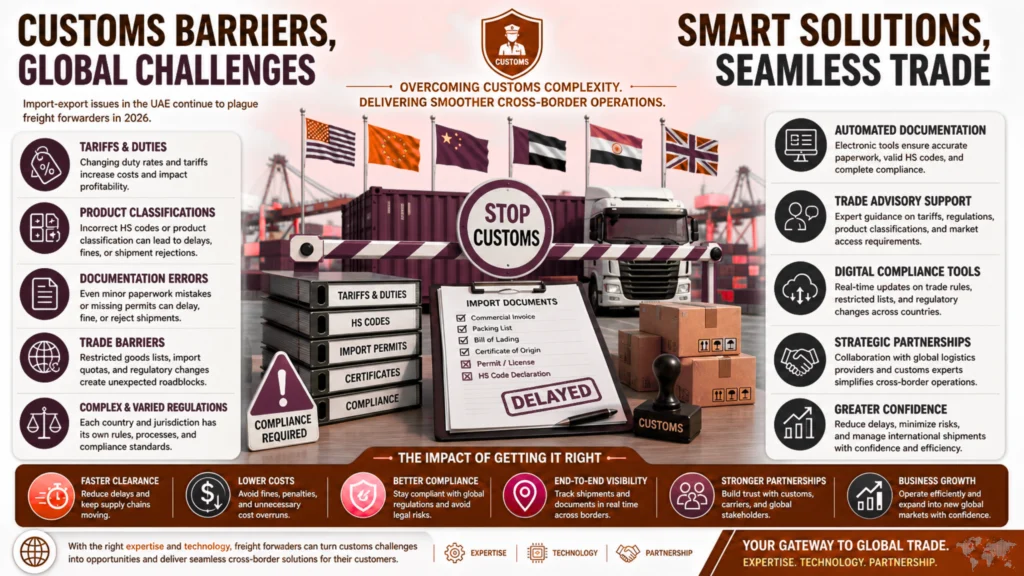
Complexity is increased by trade barriers. Freight forwarders must follow international regulations, restricted goods lists, and compliance standards depending on origin and destination. In a multi-country supply chain, each jurisdiction has its own rules and processes, making this difficult.
Businesses increasingly use trade advisory support and automated documentation systems to overcome these challenges. Electronic tools improve paperwork accuracy and reduce compliance errors. Strategic partnerships with global logistics providers and customs experts simplify international regulations. With expertise and technology, freight forwarders can reduce delays and manage cross-border operations more confidently.
Future of Freight Forwarding in UAE (2026 & Beyond)
The freight forwarding industry is rapidly adapting to new demands as the UAE becomes a global logistics hub.
Here are the most important trends that will affect freight forwarding after 2026:
- The UAE logistics industry is about to go through a period of rapid growth, which is being caused by rising trade volumes, the growth of e-commerce, and the integration of global supply chains. For freight forwarders to keep their speed and efficiency, they will have to expand their businesses.
- AI and automation will be very important in changing freight forwarding. Technology will cut down on manual work and improve operational accuracy by doing things like planning routes ahead of time, automating paperwork, and making decisions in real time.
- Smart logistics infrastructure is becoming the norm. IoT-enabled tracking, digital freight platforms, and integrated supply chain systems allow for visibility of shipments from start to finish.
- Autonomous and next-generation delivery options are becoming more popular, especially in cities like Abu Dhabi, where driverless last-mile delivery is already being tested in pilot projects.
- Sustainability will be a big deal, and companies will use fuel-efficient vehicles, optimize routes, and track carbon emissions to meet government rules and meet customer demands for greener logistics.
- Companies will be able to stay ahead of the competition by making decisions based on data. They will use analytics to predict demand, manage risks, and make the supply chain more resilient.
Conclusion
The UAE’s logistics scene is changing quickly, which gives freight forwarders both chances and problems. The way logistics are run is changing in 2026 because of issues like complicated rules, rising costs, a lack of technology, and problems in the supply chain.
But companies that use digital tools, improve their operations, and create strong supply chains can use these problems as opportunities to gain a competitive edge. Freight forwarders in the UAE can get around current problems and set themselves up for long-term growth in a global trade environment that is changing all the time by staying flexible and ready for the future.
FAQs
What are the biggest UAE logistics challenges in 2026?
In 2026, the biggest logistics problems in the UAE will be clearing customs, port congestion, rising freight costs, supply chain problems, and more people wanting last-mile deliveries. Because of these things, freight operations are getting more complicated and price-conscious.
Why are customs clearance issues common in the UAE?
There are often problems with customs clearance in the UAE because of strict documentation rules, changing rules, and the need for approvals from many authorities. Even small mistakes on paperwork can cause shipments to be held up or even get fined.
How can freight forwarders manage rising costs in the UAE?
In the UAE, freight forwarders can better manage freight costs by finding the best routes, grouping shipments together, using fuel-efficient transportation methods, and signing long-term contracts with carriers to keep prices stable.
What causes port congestion in Jebel Ali?
Port congestion in Jebel Ali is mostly caused by a lot of cargo, not enough berths during busy times, and problems in the global supply chain that cause shipments to be held up.
How are supply chain disruptions affecting the Middle East?
Problems in the Middle East’s supply chain are leading to delays, higher shipping costs, and changes in routes. Tensions in geopolitics and uncertainty in global trade are two main causes of these problems.
What are the key import-export challenges in the UAE?
In the UAE, it can be hard to import and export goods because of complicated paperwork, different international rules and tariffs, and different compliance requirements for each country and trade zone.
How can technology improve freight forwarding operations?
Freight forwarding is made better by technology that allows tracking in real time, automates paperwork, improves communication between stakeholders, and gives data-driven insights that help people make better decisions.
What are the main last-mile delivery challenges in the UAE?
In the UAE, problems with last-mile delivery include traffic jams, complicated address systems, customers who want fast delivery, and inefficient operations in crowded cities.
