

Did you know that India hosts over 1,700 Global Capability Centers employing around 1.9 million professionals and generating $64.6 billion in revenue, quietly powering some of the world’s largest enterprises? From the banking sector to healthcare, technology to retail, global companies are increasingly relying on GCCs to drive greater innovation, manage business operations, and stay competitive in this digital economy.
But this significant shift raises an interesting question: what if your next competitive advantage is not a new product, but a new location?
As global markets now grow more complex and competitive, organizations are realizing that where they operate is just as critical as how they operate. This is where Global Capability Centers (GCCs) in India come into the picture. For many multinational organizations, scaling GCC in India has evolved into a strategic growth model where they can get the chance to combine deep technical talent and strong digital capabilities in this rapidly maturing innovation ecosystem.
Global Capability Centers Market Dynamics
Recent industry projections highlight the rapid expansion of the Global Capability Center (GCC) ecosystem in India. The sector’s compound annual growth rate (CAGR) also reflects strong enterprise investment in the case of offshore innovation hubs. As a result, the GCC market is projected to surpass the US$100 billion mark by 2030, potentially reaching around US$110 billion.
Furthermore, the total number of GCCs operating in India is also anticipated to grow significantly, reaching almost 2,400 centers by 2030 and possibly exceeding 2,500. This further reinforces India’s position as a leading global technology hub, showing greater innovation and services as a powerhouse.
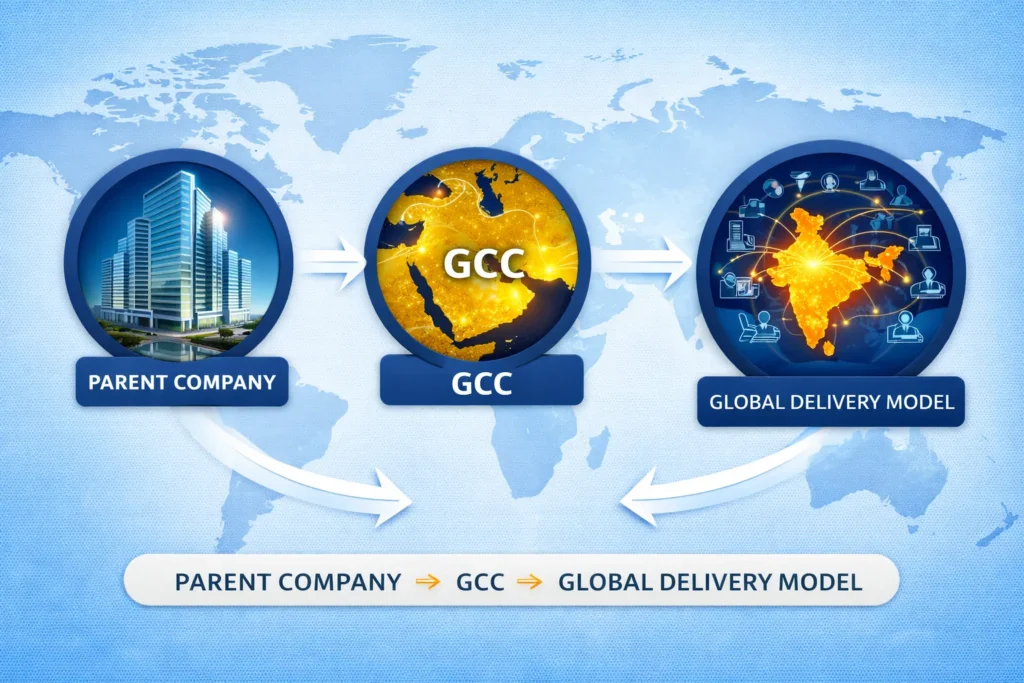
At present, Hyderabad, Bengaluru, Chennai, Pune, Mumbai, and Delhi NCR are considered as one of the major focus areas for setting up the GCCs in India. Also, there has been a growing trend which is already observed in tier-2 cities, such as Jaipur, Visakhapatnam, Kochi, Vadodara, and Chandigarh, that are focusing on adapting the latest technologies and modern infrastructure as a part of GCC expansion strategy.
Evolution of GCCs: From Cost Centers to Innovation Hubs
Over the past two decades, Global Capability Centers (GCCs) have undergone a remarkable transformation. What began as cost-focused offshore units has now evolved into highly strategic hubs that drive greater innovation, digital transformation, and global enterprise operations.
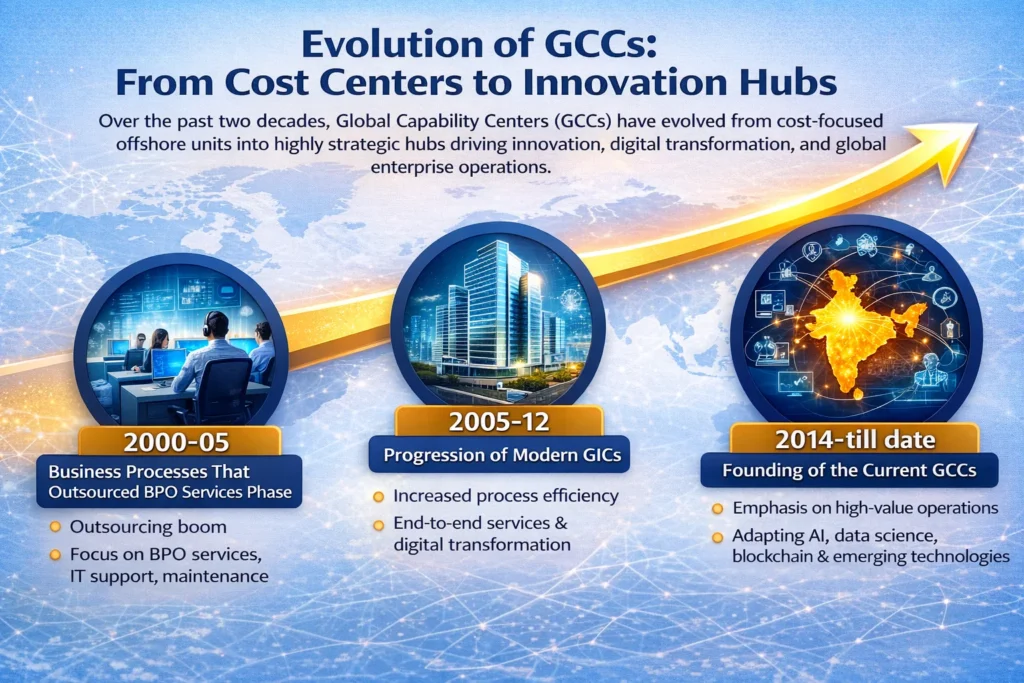
Today, in the aspect of global delivery scaling, GCCs play a critical role in shaping business strategies, developing new technologies, and also supporting different multinational corporations in scaling their business operations worldwide.
- 2000-05: Business Processes That Outsourced BPO Services Phase
With the outsourcing boom, MNCs started to consider India as an excellent and preferable destination for establishing BPOs/captive centres. During this phase, MNCs primarily focused on the back-office and supportive operations, which include customer support, IT services, maintenance, and help centres.
- 2005-12: Steady Progression of Modern GICs
Over the years, there have been multiple captive centres that took the center stage and left more impact on the parent organizations. These things were achieved due to the increased process efficiency while providing end-to-end services for the product lifecycle.
This actually showed certain enhancements of GICs that kept their focus on certain processes, including digital transformation and innovation.
- 2014-till date: Founding of the Current GCCs
Since the beginning of this phase, there has been a strong emphasis on certain high-value operational activities that include digitalization and adapting some emerging new-age technologies such as blockchain technologies, Artificial Intelligence (AI), data science, Machine Learning (ML), analytics, product conceptualization, and vendor management.
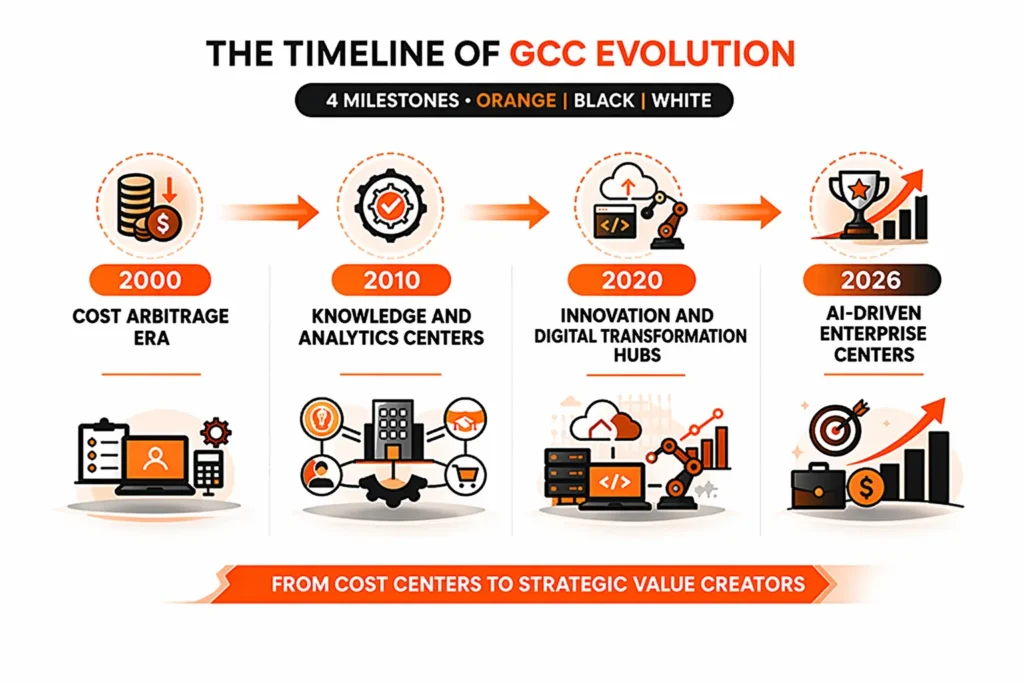
This timeline significantly highlights the steady transformation of Global Capability Centers from certain cost-optimized outsourcing units to modern strategic innovation hubs. With time, GCC operational scaling went through certain advanced stages where technology adoption, modern AI-driven enterprise operations, and digital transformation strongly add value and support global business innovation in the coming years.
Key Drivers Behind MNCs’ Choosing India for GCC Leadership
Several factors support India’s dominance as the preferred destination for Global Capability Centers and for GCC operational scaling. According to the report by Colliers India, Global Capability Centers will already account for almost 40% of India’s total office leasing activity in 2025. The number reflected the rapid expansion of multinational corporations establishing multiple large operational and modern innovation hubs across the country.
1. Skilled Talent Hub:
India has a diversified pool of talent who have excellent expertise in multiple domains, such as IT, engineering, analytics, and finance. The availability of such a skilled and talented workforce has enabled GCCs in India to successfully perform complex and high-value projects in India and from diversified domains.
2. Technological Innovations:
AI, ML, Blockchain, and IoT are some of the latest technical advancements that have been rapidly developed and adopted by most of the MNCs currently. This, in turn, has enabled scaling GCC in India to deliver certain innovative solutions while digitally transforming their parent companies.
3. Strategically Focused:
From being known as a cost-saving centre to becoming a popular strategic hub, MNCs prefer to choose India due to its strong potential and expertise in diversified fields. GCCs in India are also considered a strategic asset that enables businesses to successfully drive better growth and innovation while improving operational efficiency and gaining excellent competitive advantages.
4. Government Support:
Government support is another vital aspect that assists MNCs in relying on India for scaling their business operations. Also, as an enterprise capability center growth, Indian campaigns also allow businesses to continue their operations. All these have contributed to making an excellent and favourable environment in India to ensure the growth of GCCs.
Key Business Benefits MNCs Can Avail of by Scaling Operations Through GCCs in India
Global Capability Centers (GCCs) have become an excellent strategic model for multinational corporations that are seeking to scale their business operations efficiently while driving greater innovation and maintaining competitive advantage.
Furthermore, by establishing GCCs in talent-rich locations like India, companies can also strongly optimize certain modern resources while accelerating digital transformation and strengthening global business operations.
1. Cost Optimization
One of the most significant advantages of the GCC expansion strategy is cost optimization. By operating in certain regions with competitive labor markets and lower infrastructure costs, companies can successfully reduce certain operational expenses while maintaining high-quality service delivery.
2. Faster Innovation
GCCs also play a crucial role in accelerating greater innovation and product development. With a huge number of dedicated teams that are focused on applying the latest technology, analytics, and engineering, organizations can rapidly design, test, and deploy certain solutions.
3. Access to Global Talent Pool
As an ideal hub for enterprise capability center growth, Indian GCCs have access to highly skilled global talent. Here, MNCs can connect to a large pool of talented professionals who are specialized in software engineering, artificial intelligence, cybersecurity, and modern data analytics.
4. Scalability
Organizations these days expect greater flexibility and scalability that GCCs actually provide. As companies focus on expanding into new markets or decide to adopt some new technologies, GCCs strongly enable team expansion without the serious constraints of limited local talent or even high operational costs.
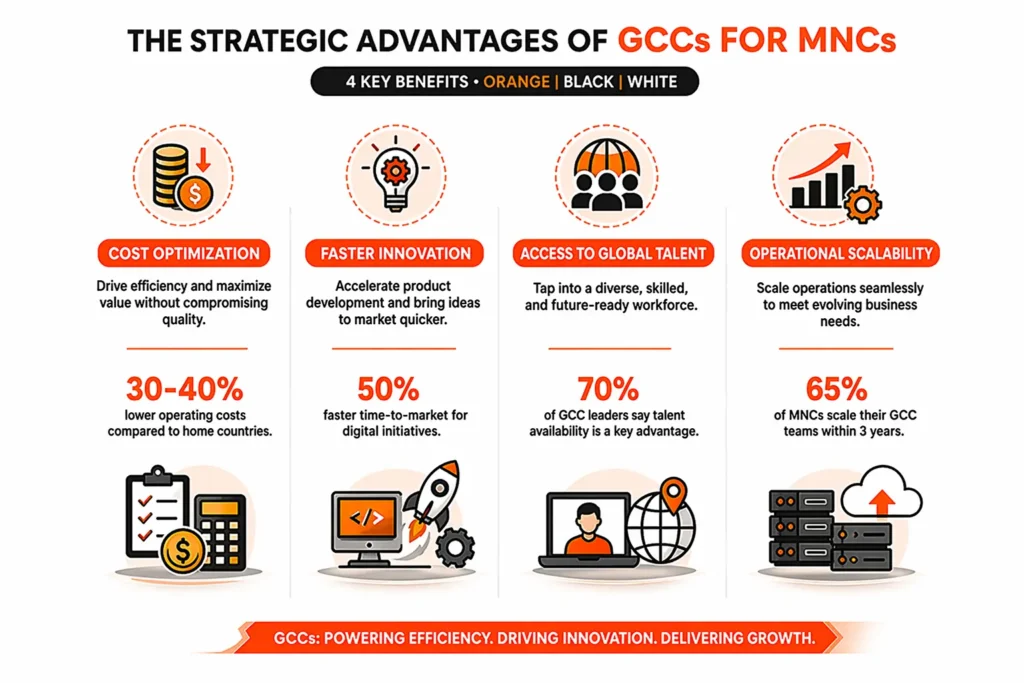
Together, these benefits highlight why Global Capability Centers are considered for global delivery scaling while applying the best enterprise strategy. Furthermore, by combining better cost efficiency, access to global talent, innovation capabilities, and scalable operations, GCCs also enable multinational corporations to strengthen their competitiveness while accelerating digital transformation and building resilient business models.
What Are the Impact of GCCs On India’s Corporate Landscape
India, known as an enterprise capability center growth has already left a remarkable impact on its corporate landscape. However, some of the strong impacts are mentioned below:
1. Economic Boom
By creating multiple high-value jobs and fostering greater innovation, GCCs have strongly enabled the economic growth in the country, notably contributing to the Gross Domestic Product (GDP). According to Nasscom and Zinnov, the GCC sector generated around $64.6 billion in revenue in 2024, reflecting its growing contribution to India’s knowledge economy.
- An example of this is Goldman Sachs. It operates one of its largest engineering and financial technology centers in Bengaluru. The center strongly supports global trading platforms, proper risk analytics, and financial technology innovation, contributing to India’s financial technology ecosystem.
2. Employment Generation and Skill Enhancement
When it comes to global delivery scaling, Indian professionals attached to multiple MNCs get the chance to work on various global projects. Such projects also require top talent from worldwide, signaling GCCs to provide more jobs. This has helped to develop a highly skilled workforce that is capable of delivering innovative solutions by working in both hybrid and distributed work models while driving excellent economic growth.
- For instance, JPMorgan Chase operates one of its largest global technology and operations centers in Hyderabad, where thousands of engineers, cybersecurity experts, and data scientists are employed. Employees at this center work on diversified prospects, gaining excellent exposure to large-scale global projects and advanced technologies.
3. Innovation and R&D Hubs
Developing new products, services, and solutions has been one of the primary functions of many GCCs that have already set up their R&D centres in India. This has helped India to become a global innovation and R&D hub, attracting a vast amount of investments..
- For example, Microsoft has already established its R&D centre in Hyderabad in 1998, which has now become India’s largest R&D center of this company outside the US.
4. Enhancement of Business Practices
Scaling GCC in India has adopted some of the best global practices in terms of business operations, governance, and security compliance. This has taken companies towards better enhancement in showing efficiency, productivity, and ultimately competitiveness. However, risk management, data analytics, and superior financial modelling has also become a part of these practices.
- For example, Walmart is known as a major technology and analytics hub with a center in Bengaluru. It has developed many global e-commerce platforms, data analytics systems, and supply chain technologies following the latest international governance standards and applying all the best practices in large-scale digital operations.
Further Implications for the Future with GCCs in India
The future of GCCs is bright with several implications. Though there has been a significant transformation in the corporate landscape in India through GCC operational scaling, several challenges have already emerged in the modern corporate world. These include talent competition, data security and compliance, cultural integration, and infrastructure expansion.
However, to overcome these challenges, certain implications present multiple opportunities for this sector to grow and improve further in the near future.
1. Increased Investment in Technology and Innovation
A strong emphasis on the adaptability of the latest technology and innovation can successfully stimulate the field of GCCs. Companies with such investments in advanced technologies, such as digital infrastructure and innovation, remain competitive and take help from the GCCs in India.
2. Greater Focus On Collaboration and Partnerships
Collaboration and partnerships are also expected to be the strong key drivers for the future of GCCs. Enterprises will also be expected to collaborate with local startups, academic institutions, and certain industry bodies to get access to external expertise while stimulating innovation.
3. Evolving Talent Strategies
The challenge of attracting and retaining top talent will follow the best GCC expansion strategy, where multiple modern enterprises will proactively craft genuine value propositions for employees. This will not only create pathways for career advancement but will also bring continuous learning opportunities while conveying a healthy work-life balance.
4. Resilience and Agility
Another strong emphasis on resilience and agility will also remain a key focus for GCCs. More enterprises will proactively invest in building superior and resilient business operations that will effectively mitigate the chances of disruptions while swiftly responding to changing market dynamics.
Conclusion
When it comes to scaling GCC in India, Global Capability Centres have significantly transformed the landscape for corporations in India. It has drastically shifted the perspective of MNCs viewing India as a global power hub as well as an excellent cost-saving medium.
With all these aspects, the future of GCCs in India looks so promising. Also, it is expected that GCCs will drive sustainable growth and contribute to India’s goal of becoming a US$ 5 trillion economy. All thanks to continued innovation, greater collaboration, and investment in a more talented pool and modern innovation.
FAQs
Which types of work best in a GCC?
GCCs can handle multiple types of work, and among them, product development, helping customers, analyzing proper information, and supporting the latest technology usually do very well.
How is GCC cost efficiency different from the concept of regular outsourcing?
GCC cost efficiency is different from regular outsourcing cost savings. Though outsourcing costs less at first, there is less flexibility. But, GCCs may cost you more up front, but deliver higher returns because of all improvements.
Can smaller companies use a GCC, or is it only for big enterprises?
No, both smaller and larger enterprises can take assistance from GCC, though traditionally, GCC worked best for large companies. Smaller firms now partner with GCCs to optimize costs while keeping full control of their business operations.
Is company information, proper control, and governance protected through a GCC?
Yes. Company information, control, and governance are all protected in a GCC. If you want to build strong security and run regular safety checks, you can get the chance to create clear governance to maintain complete protection.
How can we measure the ROI by GCC?
You can measure GCC ROI by taking certain steps. Start by tracking how fast new products are launched, how much automation saves, and how quickly your team can deliver the results. This can actually help your business a lot more than just money savings.
