

When a major retailer’s legacy ERP system can’t update prices across 5,000 stores in under six hours, the financial damage compounds silently. Every moment a competitor’s dynamic pricing adjusts to demand while your systems lag, you lose revenue on opportunities that competitors capture. This scenario defines the critical challenge retailers face today: legacy monolithic systems can no longer compete in a digital-first world.
The solution lies in a strategic transformation powered by cloud infrastructure, real-time data engineering retail capabilities, and AI-driven decision-making that transforms traditional retail operations into agile, data-informed enterprises.
Why Legacy Systems Are Becoming Liabilities in Retail Omnichannel Transformation
For decades, monolithic Enterprise Resource Planning (ERP) systems provided stability for back-office functions. A single system handled everything, user interfaces, business logic, and databases, all bundled together. The problem emerged when businesses needed to innovate. Change a pricing rule, and the entire system required regression testing. Deploy that change across stores? Wait weeks.
Today’s retail landscape operates differently. Consumers expect seamless experiences across digital storefronts, mobile apps, and physical locations simultaneously. Inventory must sync in seconds, not hours. When a customer buys online for in-store pickup, that order must route to the right location in real-time. Legacy monolithic systems treat these requirements as afterthoughts rather than core capabilities.
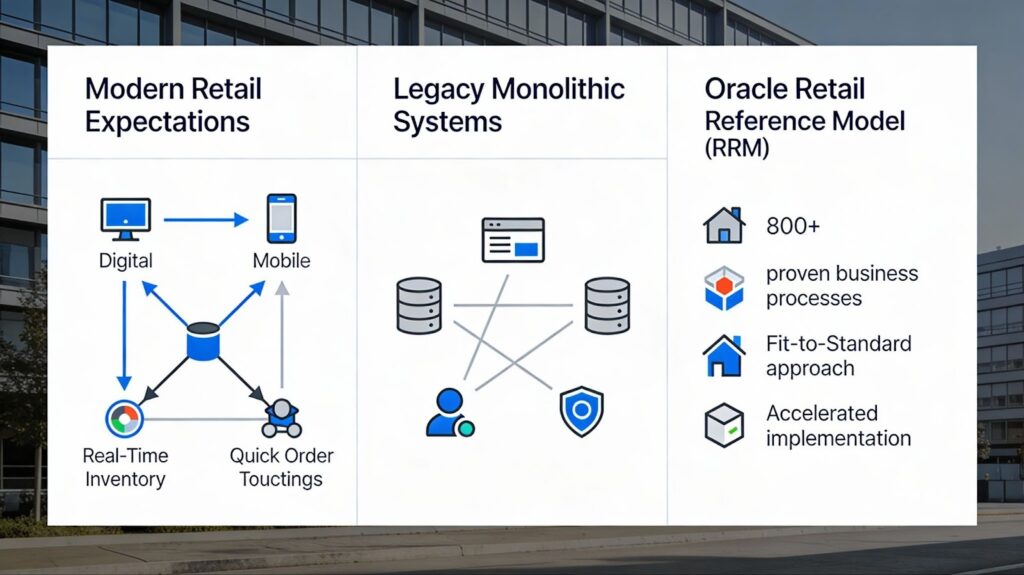
The Oracle Retail Reference Model (RRM) exists precisely because enterprises need better answers. This framework captures over 800 industry-leading business processes built from thousands of successful retail implementations. Rather than custom-building solutions, organizations using the RRM adopt proven “fit-to-standard” approaches that reduce implementation timelines and accelerate time-to-market for new capabilities.
The transition from monolith to composable commerce represents more than a technical shift, it’s a fundamental change in how retailers think about architecture. Breaking systems into independently deployable components means teams can modernize inventory management without waiting for other departments to finish their updates. This decoupling enables the agility required in today’s competitive omnichannel ERP environment.
Building Real-Time Data Engineering Retail Systems
A retailer’s POS system writes transactions in real-time, but analytics teams can’t access that data for 24 hours. That means demand signals are a day old, too late to adjust inventory or trigger promotions when it matters.
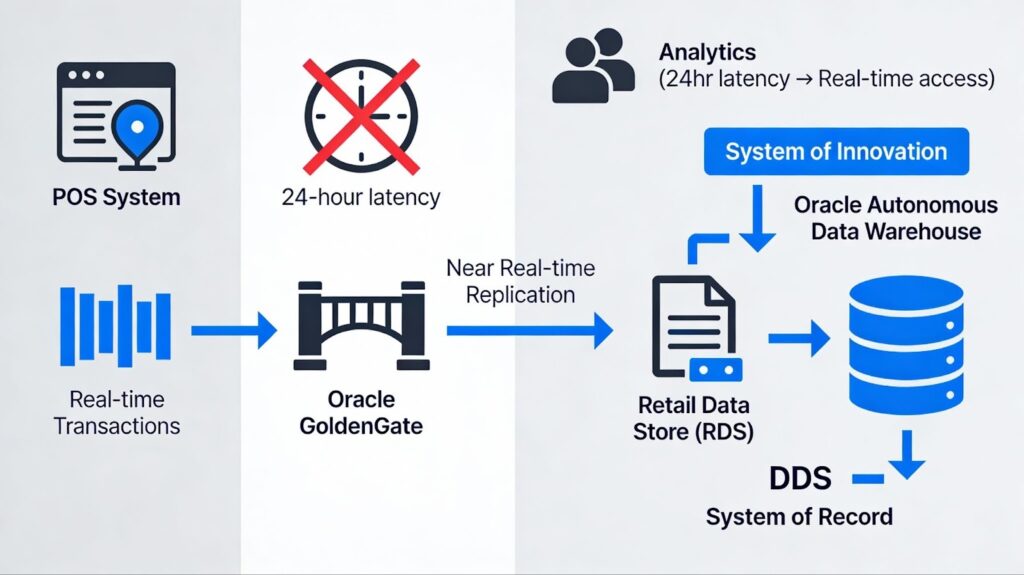
This latency problem disappears with proper data engineering retail architecture. The Retail Data Store (RDS) solves this by separating the “system of record” from the “system of innovation.” Oracle GoldenGate replicates data from operational applications like Merchandising Foundation Cloud Service into the RDS on an Oracle Autonomous Data Warehouse in near real-time.
What makes this architecture powerful is its democratization effect. When a store manager in New York updates inventory at 2 PM, an associate in California checking stock via the e-commerce system sees the updated quantities within seconds, not the next morning. This real-time synchronization prevents the frustrating scenario where customers order items shown as available, only to receive cancellation notices hours later.
Oracle GoldenGate
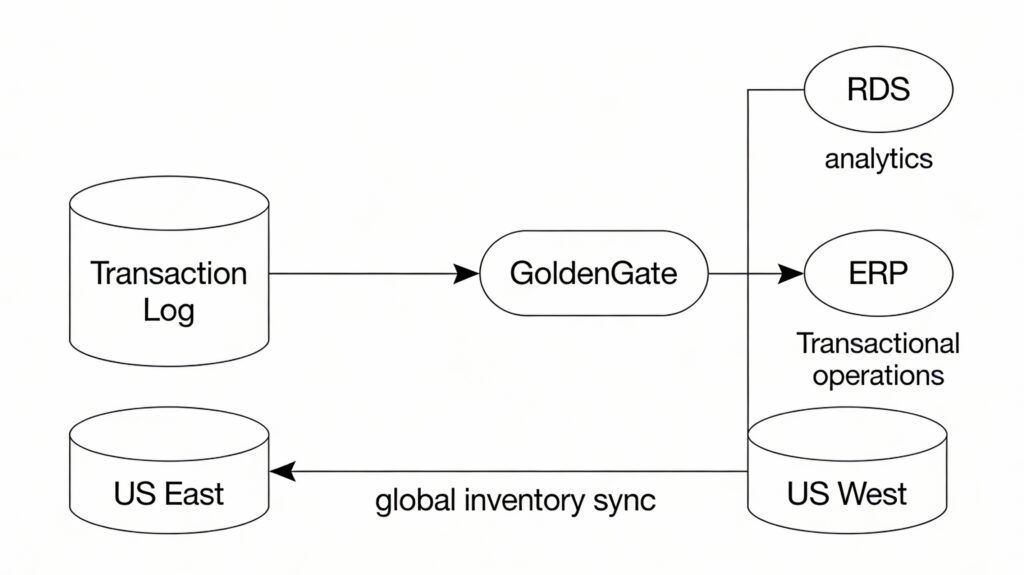
Behind this real-time magic sits Oracle GoldenGate, which captures database changes at the transaction log level rather than querying tables. This approach minimizes load on production systems while ensuring zero-latency replication. When a flash sale runs in-store, that data flows via GoldenGate into RDS within seconds, allowing recommendation engines to adjust suggestions in real-time for customers browsing online.
The architecture employs several intelligent patterns. Unidirectional replication feeds analytical systems while the ERP remains the single source of truth for transactional operations. For global retailers with multiple regional data centers, bi-directional replication keeps inventory synchronized across US East and US West regions, appearing as a single data center despite operating independently. This prevents the scenario where one region sells an item before another region’s inventory reflects the sale.
Oracle Data Lakehouse
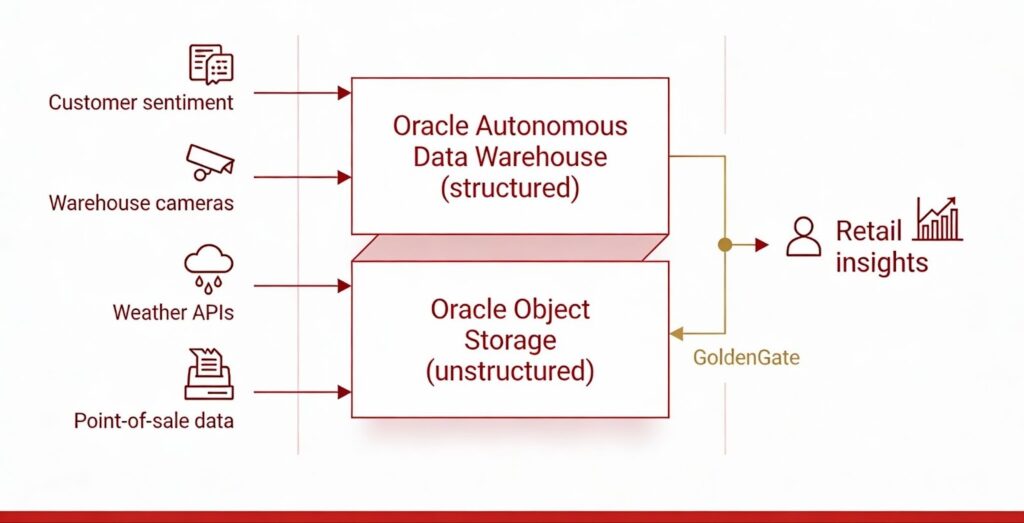
Modern retail analytics require more than transaction data. A category manager needs to understand customer sentiment from social media, inventory flow patterns from warehouse cameras, and demand signals from weather APIs, all connected to point-of-sale data.
The Oracle Data Lakehouse bridges this gap by combining Oracle Autonomous Data Warehouse for high-performance structured queries with Oracle Object Storage for raw unstructured data. When inventory arrives at a warehouse, that structured transaction flows via GoldenGate. Simultaneously, warehouse sensor logs and customer feedback arrive separately. SQL queries can join them seamlessly because the architecture treats both as native sources.
This convergence enables the 360-degree customer insights fundamental to omnichannel ERP success. Retailers see not just what customers bought, but where they engaged and why, information crucial for personalization and targeted promotions.
The Intelligence Layer: AI Retail Experience at Scale
With real-time data flowing into a unified platform, the next step is extracting actionable intelligence. The Oracle Retail AI Foundation transforms raw data into strategic decisions through “Retail Science”, algorithmic approaches refined across thousands of implementations.
Demand forecasting illustrates this principle perfectly. For stable products with years of historical data, the system automatically evaluates six candidate forecasting models, selecting the best fit based on noise, trend, and seasonality. For fast-fashion items or new product launches where historical data doesn’t exist, Bayesian analysis infers likely sales curves based on similar items and attributes. The system intelligently escalates sparse data to higher hierarchies, analyzing the subclass level or region when individual item data proves insufficient.
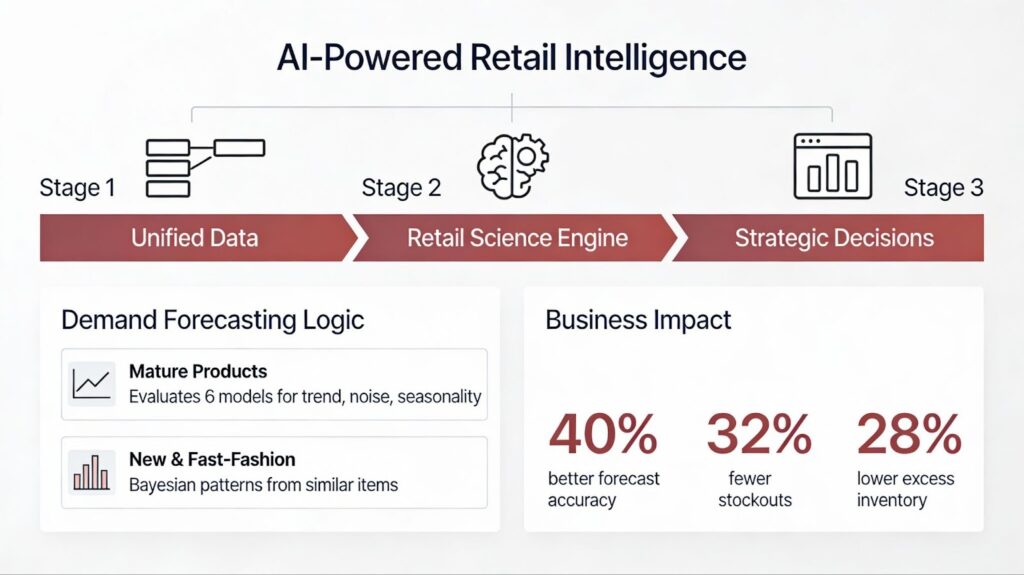
Retailers implementing these AI retail experience approaches see tangible results. Organizations with advanced demand forecasting achieve 40% accuracy improvements compared to traditional methods, reducing stockouts by 32% and excess inventory costs by 28%. These aren’t theoretical improvements; they translate directly to cash flow and customer satisfaction.
Custom AI Extensions Without Vendor Restrictions
One advantage of the Oracle ecosystem lies in its extensibility. Data scientists aren’t confined to black-box algorithms. Through OCI Data Science and Oracle Machine Learning for Python (OML4Py), teams build custom models using open-source libraries, then deploy them directly within the secure data environment.
Consider a fashion retailer with proprietary algorithms for predicting trends based on social media data. Rather than forcing this intellectual property into a commercial solution, teams keep it proprietary while still leveraging the robust data engineering retail pipeline and AI Foundation infrastructure. The trained model exports as a REST endpoint that the omnichannel ERP calls in real-time. This hybrid approach balances competitive advantage with operational efficiency.
Generative AI for Natural Language Data Access
The emergence of Generative AI is democratizing data access. A category manager can now ask, “Show me the top 5 selling items in the Northeast region last week compared to last year,” and Oracle Select AI generates the complex SQL query automatically. This natural language interface grounds responses in actual retail data rather than general knowledge, preventing the hallucinations that plague public language models.
This democratization means merchandise decisions no longer require IT involvement for every query. Business teams access insights directly, accelerating decision cycles and enabling more agile responses to market opportunities.
Xstore POS: Where Omnichannel ERP Meets Customers
The physical store remains a critical asset, it’s where omnichannel ERP meets the customer. Xstore Point-of-Service provides the resilience and flexibility required in modern retail environments.

When Network Failures Strike During Peak Shopping
Xstore’s most valuable feature often goes unappreciated: it functions offline. When a store’s internet connection drops, associates continue processing transactions against a local database. Once connectivity restores, the system syncs transactions without loss or duplication. This offline capability isn’t just nice-to-have, it’s a hedge against the network failures that happen in every enterprise.
The thick client architecture means Xstore operates independently at the register level, even if the connection to Oracle Cloud Infrastructure fails. Real transaction logs synchronize with the central Xcenter command center when service resumes. This architecture prevented widespread disruptions during infrastructure outages that would have devastated retailers dependent on constant cloud connectivity.
Real-Time Personalization at the Point of Sale
When a customer is identified at the POS, via mobile wallet, phone number, or loyalty card, Xstore calls Oracle Retail Customer Engagement (ORCE) via API in real-time. That API call returns the customer’s profile: loyalty points balance, customer segment (“VIP,” “At Risk,” “High Value”), and custom attributes like “Vegan Preference”.
Associates see context-rich prompts: “This customer returned our last purchase in this category. Offer a size exchange instead of a refund.” Or: “This is a high-value customer shopping out of category. Suggest items from their preferred brands.” These micro-moments of personalization drive loyalty and reduce returns.
Turning Stockouts into Fulfillment Opportunities
What happens when a customer wants an item that’s out of stock in the store? Traditional retail calls this a lost sale. Xstore, integrated with the Order Management System, transforms it into a “Save the Sale” moment. Associates can locate the item in another store or warehouse and ship it to the customer’s home from the POS itself.
This capability fundamentally changes the inventory problem. Retailers no longer need to maintain safety stock at every location for every SKU. Instead, they hold inventory more efficiently across the network, knowing the omnichannel ERP and Xstore integration will route orders to optimal fulfillment locations based on inventory, customer location, and cost.
Securing Retail Data in the Cloud
Retailers handle sensitive credit card data, making PCI-DSS compliance mandatory rather than optional. Cloud deployment requires a different security posture than on-premises data centers, where firewalls controlled all network boundaries.
PCI-Compliant Architecture on OCI
Oracle Cloud Infrastructure provides a PCI-compliant foundation, but organizations must configure correctly. The architecture strictly separates the Cardholder Data Environment (CDE) from the rest of the network using Private Subnets within a Virtual Cloud Network. Direct internet access is disabled. Instead, traffic flows through a NAT Gateway that masks internal IPs.
Administrators cannot SSH directly into servers handling payment data. They must connect through a hardened “Bastion Host” in a public subnet that logs every session. The Oracle Web Application Firewall inspects incoming traffic for XSS, SQL Injection, and other OWASP Top 10 threats before they reach applications. This layered approach reduces the surface area attackers can target while maintaining operational access for legitimate administration.
Governance and Cost Management
With cloud flexibility comes the risk of uncontrolled spending. OCI Compartments isolate resources by department, e-commerce, supply chain, stores, enabling cost allocation and governance policies. Rather than committing to specific compute SKU types, the Universal Credits model allows flexible spend allocation between Infrastructure-as-a-Service (Compute) and Platform-as-a-Service (Autonomous Database). This flexibility supports the unpredictable nature of retail, where resource consumption spikes dramatically during holiday seasons.
Conclusion
Retail omnichannel transformation is complex. It requires rearchitecting systems unchanged for decades, migrating terabytes of data, retraining teams, and managing risk continuously. Yet retailers operating at customer speed, updating prices in minutes, personalizing experiences in real-time, fulfilling orders from anywhere in their network, build competitive advantages competitors can’t match.
The combination of composable commerce architecture, real-time data engineering retail capabilities, AI retail experience engines, and digital commerce infrastructure provides a proven roadmap. Organizations embracing this transformation methodically unlock the agility and customer-centricity required to thrive in modern retail. The destination is clear: a retail enterprise moving at market speed, allocating inventory with precision, and serving customers with personalization at scale.
