

It’s 6 AM at your terminal operations center. Your team is juggling three different systems, trying to figure out why a vessel is running 90 minutes late. One system shows customs clearance as pending. Another says it’s complete. A third hasn’t been updated since yesterday. Your operations manager turns to you: “Which one is right?” You’re not sure. You’ll spend the next two hours calling brokers, checking spreadsheets, and making educated guesses. Meanwhile, that vessel is costing the shipping line $10,000 per hour in demurrage.
This scenario plays out daily across Middle East ports, even the high-performing ones. Oracle Fusion SCM addresses exactly this fragmentation, connecting the dots across your operations so you get one clear answer instead of three conflicting ones.
Why does this matter right now? GCC ports handled over 720,000 TEUs in May 2024 alone, a 13% jump year-over-year. Saudi Arabia’s Vision 2030 and the National Industrial Development and Logistics Program (NIDLP) are positioning the region to become a global logistics powerhouse.
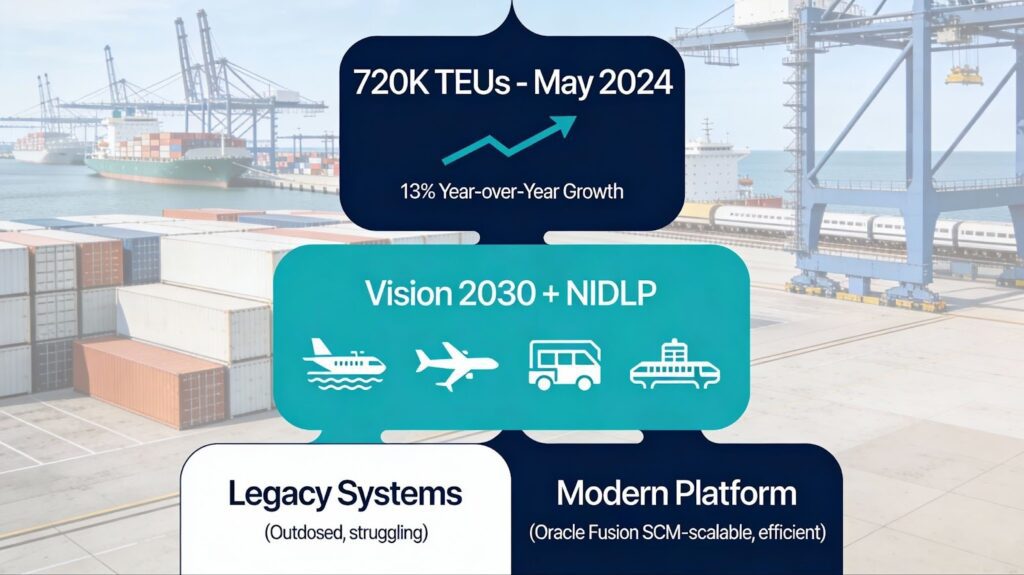
The UAE is building itself as a “Global Super-Connector” where cargo flows seamlessly across maritime, air, and rail infrastructure. This growth demands modern ports and terminals solutions, but your legacy systems weren’t designed for this scale or complexity. Oracle Fusion SCM isn’t optional anymore; it’s the difference between leading this growth or getting left behind.
The Real Problem: Fragmentation Costing You Millions
Let’s be direct: your current port operations are siloed. Inventory is scattered across multiple terminals. Manual documentation workflows. Customs clearance status is visible to some teams but not others. Container dwell time, that’s literally money sitting in your yard, and every extra day costs your clients demurrage charges they’ll remember at contract renewal.
Your customs broker calls asking for clearance status, and you’re checking three different systems just to give them an answer. Your yard team doesn’t know when a vessel will actually dock, so they’re guessing at container positioning. Your shipping line partners can’t see real-time updates, so they’re calling every two hours asking where their cargo sits.
In GCC logistics, the coordination nightmare is even tighter. You’re managing Saudi customs requirements, UAE regulations, and international IMO standards simultaneously. When this information lives in separate systems, or worse, in manual logs and spreadsheets, predictive optimization becomes impossible. The result: vessels queue longer than they should, berths sit idle, and costs climb.
Container dwell time perfectly captures this problem. Reducing it by even one day frees up yard space, cuts demurrage costs for shippers, and improves your throughput metrics. But dwell time depends on transportation modes, delivery locations, customs timing, and inland logistics coordination, factors no single terminal system can optimize alone. Without real-time visibility across this entire ecosystem, you’re operating reactively, unable to flag bottlenecks before they cascade into delays.
Here’s Where Oracle Fusion SCM Actually Helps
Instead of separate modules, imagine one system where your operations team, customs brokers, shipping lines, and freight forwarders all see the same data in real-time. That’s Oracle Fusion SCM.
Real-Time Visibility Across Everything. Every container gets a sensor reporting position every 15 minutes. You’ll know exactly where your cargo is and what’s holding it up, not when someone manually checks a log and updates a spreadsheet. This continuous data stream replaces episodic checkpoint tracking, enabling early detection of bottlenecks and exceptions.
Predictive Analytics That Actually Work. Machine learning looks at patterns in your historical cargo volumes, seasonal peaks, and ship schedules to predict what’s coming next week. So you can staff berths ahead of time and allocate cranes intelligently, not reactively scramble when a surge hits. Ports using this approach have reduced tug operation distances by 20% and slashed vessel waiting times from 2.5 hours to just 30 minutes.
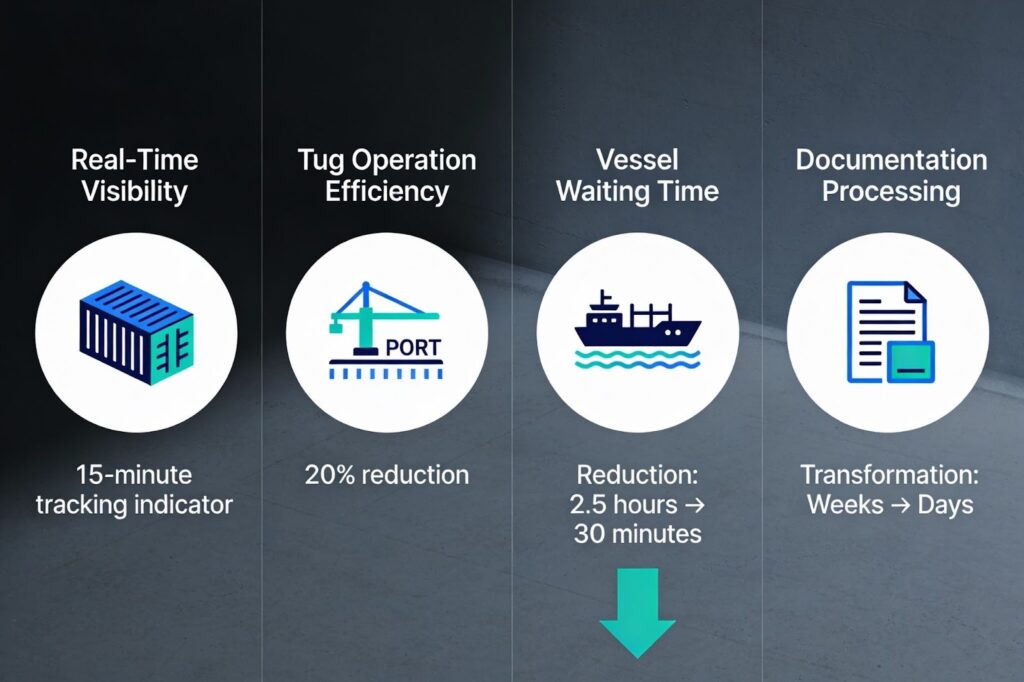
Automated Vessel Call and Berth Optimisation. Forget the manual juggling. Oracle Fusion SCM automates the complex orchestration of vessel arrivals, berth assignments, and dock operations, considering vessel specs, cargo configuration, equipment availability, and customs requirements simultaneously. Berth utilization improves dramatically, and vessel turnaround times drop noticeably.
Blockchain-Secured Trade Documentation. Imagine a digital record of your customs clearance that can’t be forged, can’t be lost, and automatically triggers the next step. Smart contracts embedded in the platform automate compliance verification, letters of credit, export permits, and regulatory screenings, reducing documentation processing from weeks to days. For GCC maritime digital transformation initiatives juggling multiple regulatory jurisdictions, this is transformative.
Connected Ecosystem Integration. Shipping lines, freight forwarders, and customs authorities integrate directly with your system. No more email chains. No more duplicate data entry. Everyone accessing the same current information drives better decisions across the entire supply chain.
What Actually Improves: Real Numbers, Not Hype
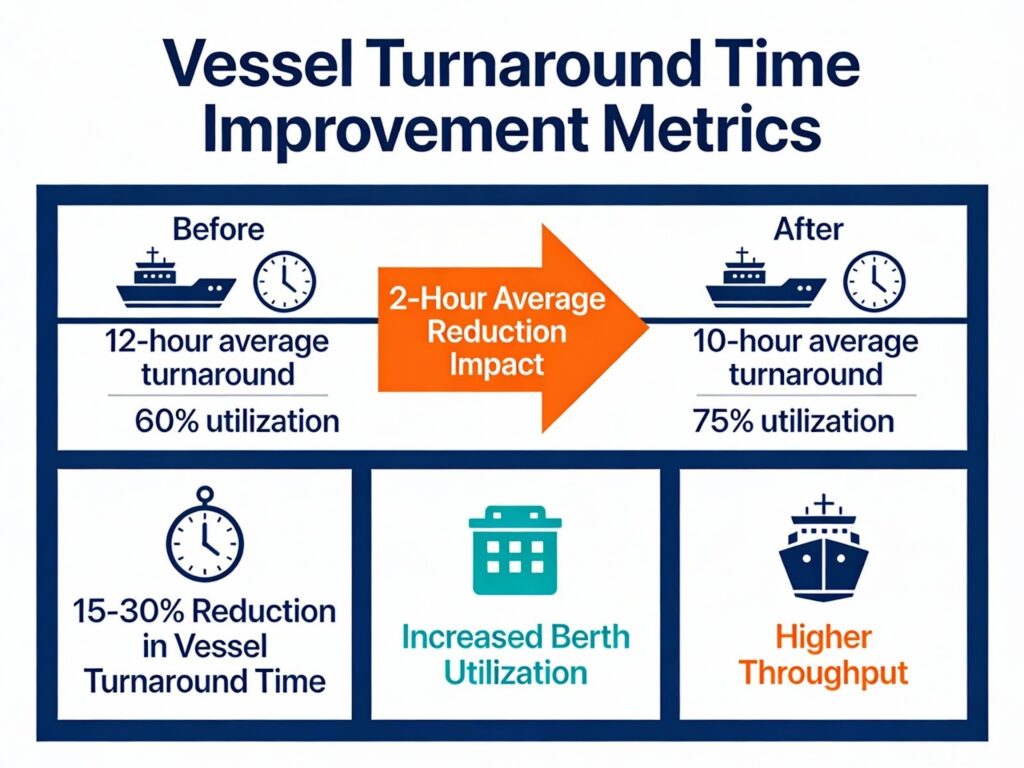
Vessel Turnaround Time & Throughput. When you reduce vessel turnaround time by 15-30%, you immediately increase berth utilization without expanding physical infrastructure. Fewer idle hours means higher throughput and improved competitiveness. For a major Middle East port processing millions of TEUs annually, even a 2-hour average reduction per vessel yields significant advantages and attracts premium carrier partnerships.
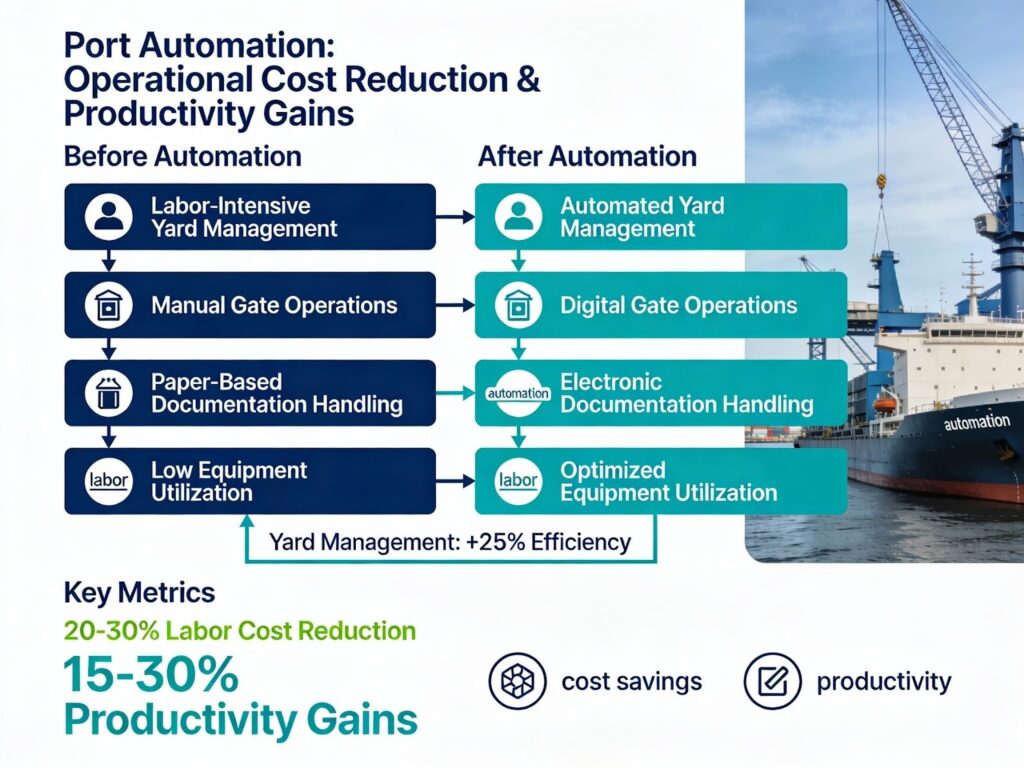
Operational Cost Reduction. Automation reduces labor-intensive manual processes, yard management, gate operations, documentation handling, while improving equipment utilization. Automated port operations have demonstrated labor cost reductions of 20-30% with simultaneous 15-30% productivity gains. These aren’t theoretical. These are numbers from ports like Rotterdam and Chinese facilities pioneering automation.
Revenue Uplift & Capacity Expansion. Processing significantly more cargo within existing yard constraints becomes possible because your assets are deployed more intelligently. Capacity effectively expands. You attract premium service contracts, offer value-added logistics, and improve stakeholder satisfaction.
Compliance Risk Elimination. Automated documentation, permanent audit trails via blockchain, and real-time regulatory reporting eliminate inadvertent violations. For GCC ports operating under Vision 2030 frameworks and IMO sustainability mandates, compliance excellence isn’t optional.
Sustainability Leadership. Oracle Fusion SCM enables granular tracking of port emissions, from automated vehicle routes to shore-side power consumption to crane efficiency. Real-time dashboards show progress toward IMO decarbonization targets. For Middle East ports positioning as premium global hubs, this sustainability credibility matters to carrier partnerships and financing.
The Real Talk: Implementation Isn’t Quick, But It’s Worth It
Yes, implementation takes 2-4 years and requires tough change management conversations. Migration is messy. Your legacy data won’t be perfect. You’ll hit integration delays with external partners. This is normal. This isn’t a project you’ll “complete.” It’s a journey toward operational excellence, and the alternative is watching neighbouring ports capture your market share.
Legacy System Migration. Most Middle East ports operate decades-old systems. Migrating to Oracle Fusion SCM requires careful data auditing and validation. Smart implementations partner with Oracle specialists to establish robust data governance upfront.
Workforce Reskilling. Automation alters your workforce requirements. Manual labor for repetitive tasks decreases, but demand increases for technical roles, system monitoring, data analysis, GCC ports coordination, supply chain modernization. Successful ports invest in upskilling programs, transforming labor pools toward higher-value work while managing transition risks through phased deployment.
External Dependencies. Port operations don’t exist in isolation. Shipping lines, customs authorities, and freight forwarders must integrate their systems for efficiency gains to materialize. Engage external stakeholders early and establish clear integration standards.
Phased Deployment (Risk Mitigation). Smart implementations follow staged rollout: Phase 1 focuses on a single cargo category or operational module; Phase 2 expands to integrated yard and berth management; Phase 3 adds predictive analytics. This reduces risk and demonstrates ROI incrementally, crucial for securing ongoing executive sponsorship.
ROI Timeline. Most ports see positive returns within 18-24 months post-deployment, but that’s after 2-3 years of heavy lifting. Budget accordingly and manage stakeholder expectations realistically.
Port of Fujairah’s MarHub: What’s Actually Happening Now
Port of Fujairah’s 5-year digital transformation deal with Endava shows what’s operationally possible right now. MarHub, their Port Community System, integrates vessel management, gate security, and real-time analytics with blockchain-secured trade documentation.
Key elements of their approach:
- Modular, API-First Architecture: Progressive phases beginning Q4 2025, enabling continuous innovation and external integration
- Real-Time Visibility: Immediate performance tracking and data-driven decision-making
- Blockchain Integration: Immutable records and smart contract automation of compliance workflows, directly addressing cross-border trade challenges
- Sustainability Focus: Cloud-native infrastructure supporting emissions tracking and ESG compliance
This isn’t theoretical. This is funded, resourced, and underway across GCC maritime hubs right now.
Your Next Steps: From Assessment to Execution
Step 1: Operational Maturity Audit. Map current systems, data flows, pain points, and stakeholder requirements. Define success metrics, vessel turnaround targets, dwell time reduction goals, cost baselines, compliance metrics.
Step 2: Build Your Business Case. Work with Oracle and implementation partners to model ROI specific to your terminal’s scale, cargo mix, and growth trajectory. Link improvements directly to financial impact.
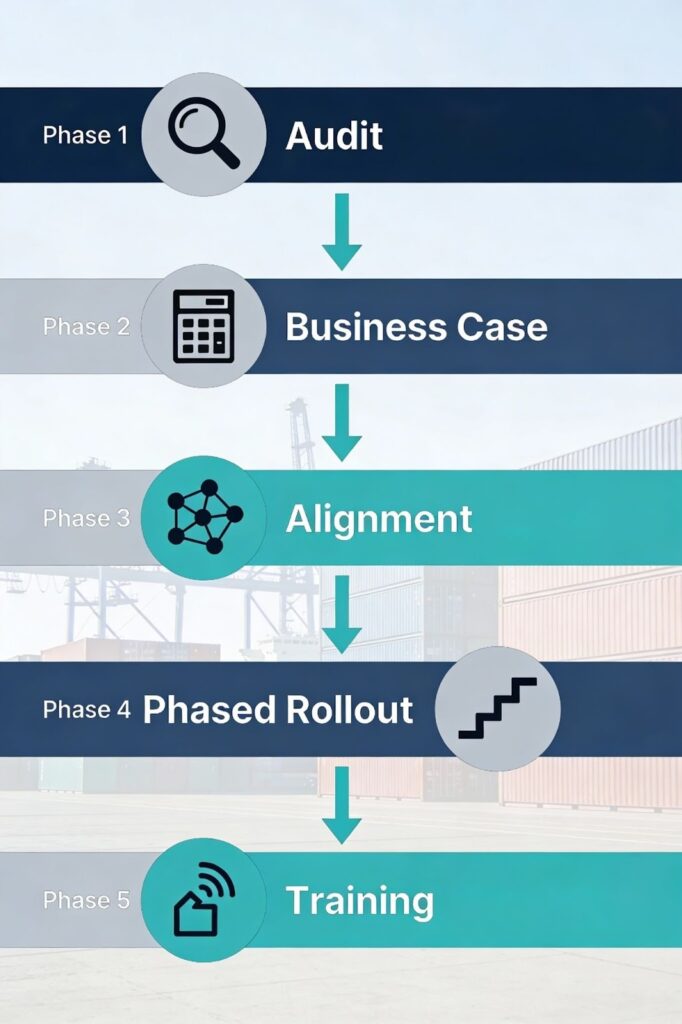
Step 3: Stakeholder Alignment. Secure commitment from terminal operators, IT leadership, customs authorities, and shipping partners. Digital transformation succeeds only when all ecosystem participants embrace new processes.
Step 4: Phased Roadmap. Start with a pilot module, order management for container operations or inventory visibility. Prove value quickly, then expand to adjacent modules.
Step 5: Investment in Training. Allocate budget for comprehensive training addressing both technical users and stakeholder communities. Adoption drives success or failure.
The Opportunity is Now
Oracle Fusion SCM won’t fix everything, but it will fix the operational fragmentation that’s costing you millions. GCC ports have secured global recognition for efficiency, but this achievement is fragile without modernization of underlying systems. Saudi Vision 2030, UAE’s Super-Connector vision, and regional aspirations to capture nearshoring opportunities all depend on ports operating with the speed, transparency, and intelligence demanded by modern global supply chains.
The question isn’t whether Oracle Fusion SCM will transform Middle East ports. Port of Fujairah’s MarHub and initiatives across regional ports and terminals prove it’s already happening. The question is whether your terminal will lead this transformation or follow. The competitive window is open, but it won’t stay that way indefinitely.
Evaluation, engagement, and planning should begin today.
