

At most medium-sized terminals, the terminal gate is the core of operations. Every truck entering or leaving represents time, cost, and throughput, three metrics that determine profitability. Yet, gate congestion, manual inspections, and outdated check-in processes often lead to operational inefficiencies. In fact, McKinsey research found that the ROI for automation projects at ports reduces by up to 1% below the industry norm of 8%.
That’s where terminal gate automation systems can help by streamlining the operation and improving ROI. Automating check-ins, container identification, and traffic flow, these systems optimize logistics and achieve measurable ROI. However, the question is HOW?
- How do organizations calculate ROI?
- What is a terminal gate automation system?
- What are the key technologies and components of such a system?
This article answers all your queries, including what terminal gate automation ROI is, how to calculate it, how the system works, and key components and technologies. Let’s first understand ROI and how the terminal gate automation system helps generate it.
What Is Terminal Gate Automation ROI?
Terminal gate automation ROI is a measurable KPI that organizations use to measure how rapidly they improve operational efficiency, reduce costs, and ensure higher throughput. Terminal gate automation systems offer several benefits, including improved ROI, reduced processing time, and reduced gate congestion.
This is the reason why the global terminal gate automation market is growing rapidly with a CAGR of 4.21% and is expected to reach $10.66 billion by 2032.
How does Terminal Gate Automation Generate ROI?
Terminal Gate Automation (TGA) provides a strong ROI by improving efficiency, reducing costs, and boosting revenue for container terminals. Automating gate processes allows for significant savings and increased throughput, often with a payback period of just two years.
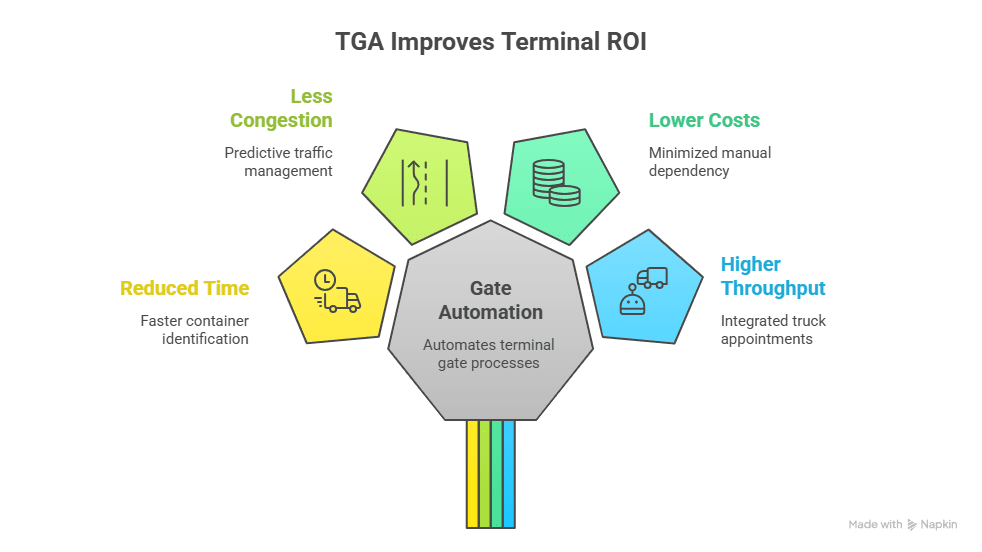
1. Reducing Gate Processing Time with OCR and RFID
Using Optical Character Recognition (OCR) and Radio Frequency Identification (RFID), terminals can automatically identify containers, chassis numbers, and license plates, eliminating the need for manual checks. These systems instantly capture and verify data as trucks pass through gates, cutting down waiting times and eliminating paperwork.
For instance, a medium-sized port that processes 1,200 trucks daily can save over 70 truck-hours per day, directly reducing idle costs and delays.
2. Minimizing Gate Congestion Through Predictive Traffic Control
AI-based traffic management systems analyze truck arrival data to predict congestion patterns. By dynamically adjusting gate scheduling, terminals prevent bottlenecks during peak hours. This not only reduces driver idle time but also improves air quality and carbon footprint, aligning with sustainability goals.
3. Lowering Operational Costs via Automated Data Capture
Automation minimizes the dependency on manual gate clerks and paper forms. Every transaction — from entry authorization to container handoff becomes digitized and traceable. The result? Lower administrative overhead and improved accountability across logistics chains.
4. Enhancing Throughput with Integrated Truck Appointment Systems
By integrating Truck Appointment Systems (TAS) with gate automation, terminals can distribute vehicle arrivals evenly throughout the day, ensuring a more efficient workflow. Trucks receive scheduled time slots, avoiding overcrowding at peak hours. This improves yard utilization and ensures that cranes, operators, and storage zones work at optimal capacity.
What are Terminal Gate Automation Systems?
A terminal gate automation system is an integrated technologies that use a combination of software and hardware. It automates and controls the flow of trucks, containers, and cargo through the terminal gate.
These systems help organizations improve the efficiency of terminal operations. Plus, it offers better operational security and productivity by automating processes like vehicle identification, access control, and data capture. Some of the major technologies used for terminal gate automation systems are OCR, RFID< and barcode scanning.
Key Components in Modern Gate Automation
Some of the key components of a modern terminal gate automation system are,
- A gate opener is a component of terminal gate automation systems that utilizes a motor to open and close the gate. It can move sliding and swinging gates.
- The control panel, often referred to as the ‘brain’ of the system, is responsible for receiving commands and managing the gate’s operation, safety, and other functions. The reliability of this key component provides a sense of security regarding the system’s overall performance.
- Safety sensors comprise devices such as photo eyes, edge sensors, and loop detectors that detect obstacles in the gate’s path and prevent it from closing on people or vehicles.
- A power supply is a stable power source, often equipped with a backup battery system for use during power outages, and features options for solar power to reduce energy costs.
- Gates and tracks are physical barriers, as well as the mechanical parts that enable gates to open and close.
What are the Technologies Used in Terminal Gate Automation Systems?
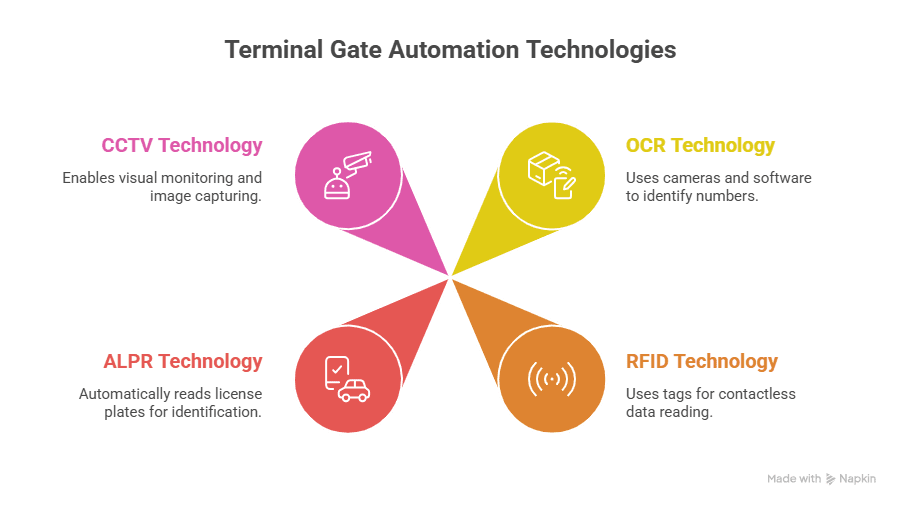
A terminal gate automation system leverages Optical Character Recognition (OCR), Radio Frequency Identification (RFID), Automated License Plate Recognition (ALPR), and Closed-Circuit Television (CCTV) to automate key operations. Using these technologies, it can automatically identify trucks and containers. These systems utilize AI to enhance data accuracy, expedite gate operations, and provide real-time visibility.
- Optical Character Recognition (OCR) uses cameras and software to identify container numbers, chassis numbers, and license plates on trucks.
- Radio Frequency Identification (RFID) utilizes RFID tags affixed to containers or equipment to facilitate the quick and contactless reading of data as vehicles pass through the gate.
- Automated License Plate Recognition (ALPR) automatically reads license plates for identification purposes.
- Closed-Circuit Television (CCTV) enables visual monitoring and can be utilized to automatically capture images of trucks and containers for verification and record-keeping purposes.
- AI-based custom algorithms enable your systems to manage terminal gate movements automatically.
Now that you know what a terminal gate automation system is, its components, and the core technologies, it’s time to understand how to measure its ROI.
How to Measure ROI in Terminal Gate Automation Systems
Measuring the Return on Investment (ROI) in terminal gate automation isn’t just about financial savings. It’s about quantifying time efficiency, throughput, operational accuracy, and cost reduction. Ports and terminals operate in high-volume, time-sensitive environments. Hence, the real value of automation lies in how effectively it enhances gate productivity, reduces manual intervention, and optimizes truck flow.
To understand the true ROI, terminal operators must benchmark several key performance metrics both before and after the deployment of automation.
Key ROI Metrics in Gate Automation
1. Gate Processing Time per Truck
This metric tracks the average time it takes for a truck to pass through the gate from entry to exit.
- Manual process: Typically 5–10 minutes per truck, including document verification and driver checks.
- Automated process: Using OCR and RFID, check-ins can be completed in under 2 minutes.
- Impact: A reduction of even 3 minutes per truck can lead to significant productivity gains for terminals handling thousands of vehicles daily.
2. Throughput Capacity
Throughput capacity measures the number of trucks that can be processed within a given time frame, typically per hour or per shift.
- Pre-automation: 40–50 trucks/hour.
- Post-automation: 60–70 trucks/hour with optimized flow control and reduced manual steps.
- Why it matters: Higher throughput means greater operational capacity without requiring physical infrastructure expansion.
3. Operational Cost Reduction
Automation drives tangible cost savings by minimizing labor, paperwork, and idle fuel consumption.
- Labor costs: Fewer staff are needed for manual verification, data entry, or physical inspections.
- Fuel savings: Reduced truck idling due to quicker processing times.
- Energy efficiency: Smart power systems and solar-enabled gate controls lower electricity costs. These combined reductions contribute to a measurable 10–25% cut in operational expenditure (OPEX).
4. Error Rate in Data Capture
In manual gate systems, human error is a significant cause of delays and inaccurate cargo records.
- Manual error rate: Around 2–5% in data capture or identification.
- Automated error rate: OCR and RFID systems bring this down to less than 0.5%.
- Result: More reliable data synchronization with Terminal Operating Systems (TOS), fewer disputes, and smoother customs clearance.
5. Truck Turnaround Time
Turnaround time measures how long it takes for a truck to enter, process, load/unload, and exit the terminal.
- Manual average: 60–90 minutes.
- Automated average: 30–45 minutes.
- Improvement: A 30–40% reduction means higher truck availability and better fleet utilization for logistics partners.
When all these factors are combined, most terminals experience a full ROI recovery within 18–24 months after implementing gate automation. Now that you know the factors needed to calculate the measurable ROI for your terminal operations, it’s time to understand practical application through a real-life world scenario.
INTECH Helped Reduce Container Placement Time Using AI
The client was a leading logistics company, managing over 26,000 container locations across multiple yards, and faced inefficient manual container placement. Frequent reshuffling, long search times for available slots, high fuel consumption, and operational delays reduced throughput and increased costs.
INTECH implemented an AI-powered Yard Management System (YMS) that optimized container placement in real time. Key features included automated container classification, zone-based sequential placement, lower-level prioritization, and proximity scoring. The system was integrated with existing logistics platforms and used AI algorithms to guide fast, precise placement decisions.
Here are the outcomes INTECH achieved for the client,
- Placement time was reduced from 30 minutes to 3 seconds.
- Yard throughput increased, and workflows became more predictable.
- Operational costs decreased, and teams shifted focus from manual management to strategic planning.
- Real-time insights and automation enabled scalable, efficient yard operations.
How INTECH can Help you Build Long-Term ROI with Smart Gate Automation?
Terminal gate automation is a strategic investment in operational intelligence and sustainability. By combining AI, OCR, RFID, and predictive analytics, terminals can achieve higher throughput, faster turnaround, and measurable cost reductions.
Every minute saved per truck adds exponential value to your terminal’s bottom line, and the ROI becomes visible not only in profits but also in customer satisfaction and carbon efficiency.
Suppose you’re looking to quantify or accelerate your ROI from gate automation. In that case, INTECH’s ports and terminals solutions offer end-to-end integration, real-time analytics, and proven results across global terminals. Get in touch with INTECH today to explore how automation can transform your terminal’s efficiency and ROI trajectory.
FAQs
How do gate automation systems reduce truck turnaround time?
By using OCR, RFID, and AI-driven scheduling, gate automation systems speed up entry-exit processes, cutting truck turnaround time.
What technologies are used in terminal gate automation?
Key technologies include Optical Character Recognition (OCR), Radio Frequency Identification (RFID), Automated License Plate Recognition (ALPR), and AI-based analytics.
How can terminals calculate ROI from gate automation?
Terminals track metrics like gate processing time, throughput, cost reduction, and error rates to quantify ROI improvements over time.
What are the benefits of adopting automated gate systems?
Automated gate systems reduce congestion, enhance data accuracy, increase daily throughput, and lower operational costs for ports and terminals.
