

Why North American Manufacturing Is Shifting Now
North American manufacturers stand at a critical turning point. Factories aren’t simply adding automation tools, they’re fundamentally rethinking how production works. The combination of artificial intelligence, cloud computing, and real-time data collection is reshaping what manufacturing can accomplish.
Missing this shift carries real consequences. Competitors installing these systems today gain measurable advantages: reduced downtime, better inventory accuracy, faster decision-making.
The numbers reflect this urgency. According to the National Association of Manufacturers’ 2024 Smart Factories and Digital Production Survey, approximately 40% of manufacturers are pursuing smart factory strategies specifically to cut costs and boost customer satisfaction. Half of them plan to integrate AI and machine learning in production facilities by 2026.
Government backing strengthens the business case. The CHIPS and Science Act created a 25% Advanced Manufacturing Investment Credit for semiconductor manufacturing facilities. These incentives translate into real capital flowing to factory modernization.
Reshoring and nearshoring reshape the competitive landscape. High labor costs in North America mean factories can’t compete on headcount. They must compete on efficiency, automation, and decision speed. Labor shortages force the issue. Factories deploy systems that amplify worker productivity and handle complex operations without human intervention.
The Collision Between IT and OT
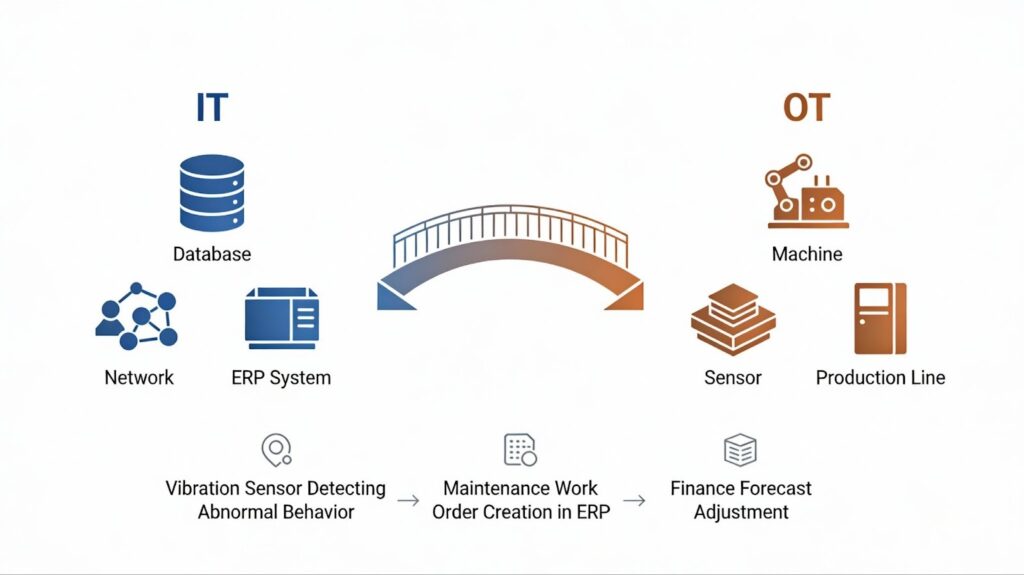
For decades, two completely separate worlds existed on factory floors. IT teams managed databases, networks, and ERP systems. OT teams controlled machines, sensors, and production lines. These worlds ran independently. That separation is ending.
When IT and OT converge, unexpected possibilities emerge. A vibration sensor on a CNC machine detects abnormal behavior. The system instantly creates a maintenance work order in the ERP. Finance automatically adjusts delivery forecasts. This coordination happens without human intervention.
But most factories operate in “brownfield” environments. Shop floors have decades-old PLCs (Programmable Logic Controllers) running Modbus RTU or other legacy protocols, systems designed before cloud connections existed. Ripping out and replacing this equipment isn’t realistic or smart.
The practical approach is “wrap and extend.” Hardware gateways from vendors like Red Lion or Moxa translate legacy serial signals into modern Ethernet packets that reach the cloud. Data flows out without disrupting production or requiring massive capital expenditure.
Once data enters the cloud, tools like Oracle IoT gateways bridge the gap. These gateways run on standard Windows or Linux servers, even a Raspberry Pi works for pilot projects. On one side, they connect to PLCs via EtherNet/IP or OPC-UA protocols. On the other hand, they package data securely using MQTT over TLS 1.2 with X.509 certificate authentication. If internet connectivity drops, gateways buffer data locally and sync when connectivity returns. Production records never get lost.
That data maps to digital twins, virtual copies of physical machines. An injection molding machine becomes a digital object in the cloud with live attributes: temperature, pressure, mold condition. Machine learning establishes what “normal” looks like for each machine. When vibration levels drift outside normal parameters, even before alarm thresholds trigger, the system flags an anomaly. This shifts manufacturing from reactive to predictive.
Building the Data Foundation
Smart factories generate overwhelming volumes of data. A single robotic arm produces gigabytes of telemetry daily. Traditional databases can’t handle this efficiently or affordably.
A data lakehouse architecture solves this.
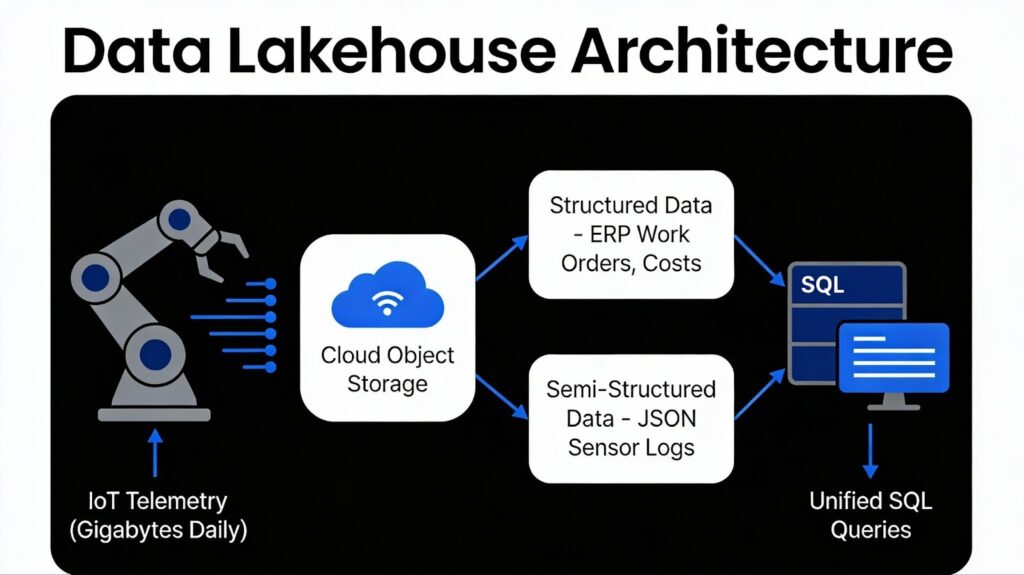
It combines a data lake’s flexibility and low cost with a data warehouse’s structure and performance. Raw IoT data flows into cloud object storage. SQL queries then run across structured business data (ERP work order costs) and semi-structured IoT data (JSON sensor logs) simultaneously. No unnecessary data movement. Both speed and cost improve.
Manufacturing intelligence extends beyond numbers. Critical knowledge lives in unstructured formats: PDF maintenance manuals, shift notes, defect images, video feeds. Modern cloud data warehouses use vector search to convert unstructured text and images into mathematical vectors, then perform semantic searches. A technician encountering an unfamiliar error code queries the system. It searches thousands of pages of manuals and historical repair logs to find “semantically similar” past issues. The relevant repair procedure appears even if keywords don’t match exactly. Mean time to repair drops significantly.
Consistent data across systems is non-negotiable. If one plant measures temperature in Celsius and another uses Fahrenheit, and that data merges without normalization, AI predictions become worthless. Successful implementations invest in master data management. A part number like “Bolt-M10” must refer to the identical physical item across PLM, ERP, MES, and WMS systems. Central repositories enforce data quality enterprise-wide.
AI That Prevents Downtime
Unplanned downtime destroys manufacturing economics. Traditional maintenance approaches waste money: reactive maintenance costs more when machines fail unexpectedly. Preventive maintenance wastes resources replacing parts on schedules rather than by actual need.
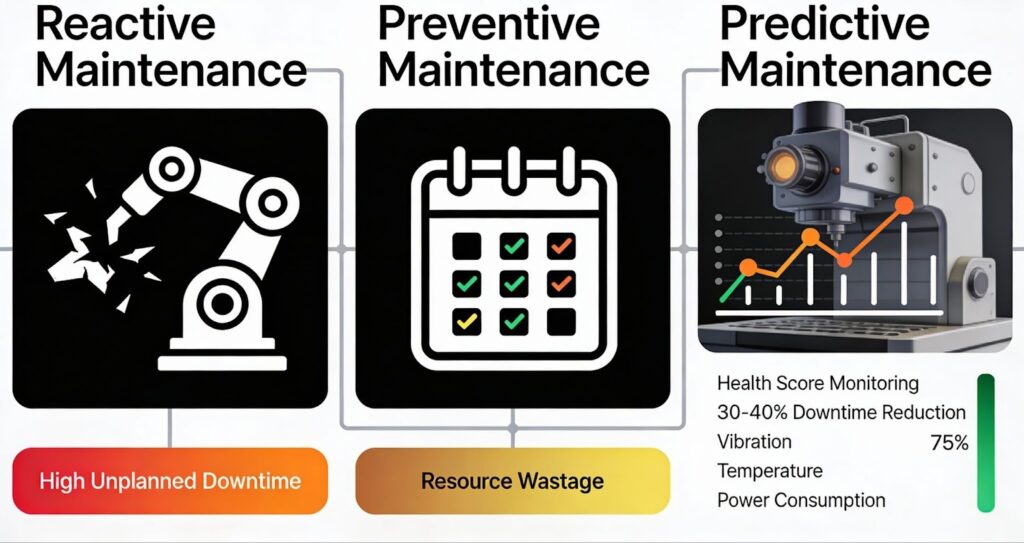
Predictive maintenance flips this equation. Machine learning systems correlate multiple variables: vibration, temperature, power consumption. The system calculates a “health score” for each machine. When scores drop below a threshold (say 75%), the system triggers a maintenance work order automatically. Spare parts get ordered. Repairs schedule during shift changes, not peak production. This approach eliminates 30-40% of unplanned downtime by addressing problems before they become emergencies.
Quality inspection transforms similarly. High-resolution cameras capture images of every product on the line. Deep learning models are trained to recognize defects, scratches, dents, missing components, and analyze each image. When defects appear, the system triggers non-conformance reports, routes units to rework, and can quarantine entire lots. This happens in milliseconds. Bad products never leave the factory.
Generative AI streamlines another bottleneck. Manufacturing supervisors spend hours compiling shift reports. Generative AI now ingests production logs, alarm histories, and quality data, then auto-generates summaries: “Shift 1 produced 500 units. Press 3 stopped for 10 minutes due to sensor fault. Quality yield was 98%.” Critical context transfers to the next shift automatically.
Advanced AI agents take autonomous action. An AI agent monitoring the supply chain detects a potential shortage due to weather. It autonomously searches approved suppliers, checks availability and pricing, and presents a purchase recommendation to procurement, or executes it automatically within preset limits.
Connecting Everything in Real Time
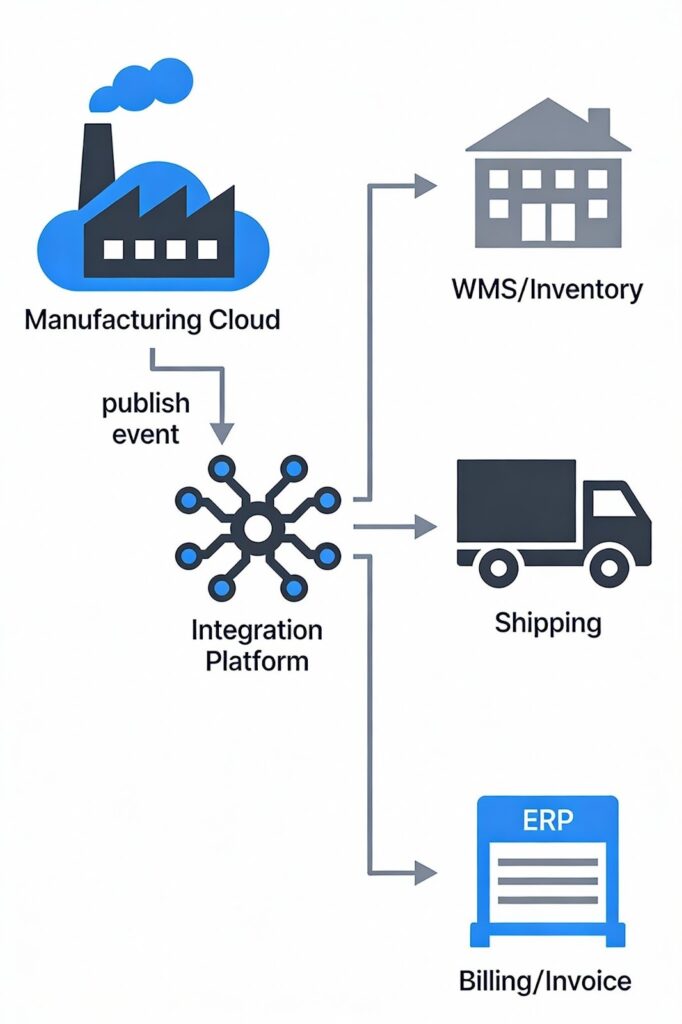
Factories can’t wait for nightly batch updates anymore. Systems must respond immediately. Event-driven architectures power this. When a work order completes in the Manufacturing Cloud, the system publishes an event. Integration platforms subscribe and instantly trigger cascading updates: inventory changes in WMS, shipping notifications, billing events in ERP. Everything synchronizes in real time.
Data migrations from legacy mainframes follow a different pattern. File-based import automation retrieves CSV files, transforms them to required formats, packages everything with a manifest, uploads it, and triggers the import job. Complex manual processes become reliable and repeatable.
Navigating Regulatory Requirements
Defense and Aerospace: ITAR Compliance
Defense and aerospace manufacturers face strict ITAR requirements. Technical data for items on the U.S. Munitions List must be controlled and accessible only to U.S. persons. Standard public clouds don’t meet these requirements. Dedicated government cloud regions, FedRAMP High authorized and DISA Impact Level 5 certified, run in physically isolated data centers managed exclusively by U.S. citizens. Manufacturers encrypt data end-to-end: before leaving facilities, in transit, and at rest. They retain their own encryption keys so even cloud providers can’t access sensitive data.
Life Sciences and Pharmaceutical: FDA 21 CFR Part 11
Pharmaceutical and life sciences manufacturing faces equally strict FDA 21 CFR Part 11 requirements. Electronic records must be as trustworthy as paper. Manufacturing Cloud systems include native support for electronic signatures and records. When critical steps occur, weighing active ingredients, releasing batches, the system prompts for secure electronic signatures. An immutable audit trail records who signed, when, and the signature’s meaning. This traceability is essential for FDA audits.
Cybersecurity: Protecting Industrial Systems
Cyber risk intensifies when factories connect to the internet. Ransomware attacks on industrial control systems rose by 46-87% in 2024. In the first five weeks of 2024, Cyble recorded 152 ransomware attacks against U.S. organizations, matching the pace seen in late 2023. Zero-trust security architecture mitigates this. By default, no traffic flows between resources. Administrators explicitly define network security groups acting as firewalls. Access governance enforces least-privilege principles. Third-party maintenance contractors access only the specific machines they service during scheduled windows. This granular control prevents lateral movement if vendor credentials are compromised.
What Leaders Are Actually Doing
Titan International: From Reactive to Predictive
Titan International, a global leader in off-highway wheels and tires headquartered in Illinois, faced unpredictable machine breakdowns and inaccurate inventory due to manual reporting systems. They deployed sensors and PLCs across the shop floor, feeding data directly into Oracle Manufacturing Cloud.
The results:
- System predicts failures before they occur, enabling proactive maintenance
- Scrap counts and production numbers now report in real time
- Just-in-time delivery becomes feasible
- Inventory accuracy improved dramatically
The Wonderful Company: Integrating After Rapid Growth
The Wonderful Company, a multi-billion-dollar agribusiness known for POM Wonderful and Fiji Water, inherited fragmented systems from multiple acquisitions during rapid expansion. They implemented a “wall-to-wall” Oracle Cloud deployment covering ERP, supply chain planning, and warehouse management to standardize operations across all entities.
Measurable improvements include:
- Financial planning cycles reduced by 35%
- Truck turnaround times under two hours for 96% of shipments
- Elimination of on-premise data centers reduced corporate carbon footprint significantly
Magna International: Digital Twins for Complex Assembly
Magna International, one of the world’s largest automotive suppliers, operates in a high-stakes “just-in-sequence” environment where precision matters and integrating new vehicle programs is complex and risky. They adopted a sophisticated digital twin strategy, creating digital simulations of entire manufacturing facilities before physical changes.
This approach allows teams to:
- Test tool changes and process flows in a virtual environment first
- Implement changes with confidence
- Integrate diverse vehicle platforms on the same assembly line
- Maximize flexibility and asset utilization
- Minimize production stoppages
Moving Forward: A Realistic Implementation Roadmap
Most smart factory projects unfold in four distinct phases:
Phase 1: Foundation: Install IoT gateways, connect bottleneck machines, visualize real-time overall equipment effectiveness (OEE)
Phase 2: Integration: Connect MES to ERP, automate work order creation, enable automatic inventory updates
Phase 3: Intelligence: Activate asset monitoring, train machine learning models on historical data, enable predictive failure detection
Phase 4: Autonomy: Launch AI agents for supply chain replanning and self-healing workflows
The Often-Overlooked Challenge
Technology implementation is frequently easier than cultural change. If the new system requires ten clicks to record a scrap event where the previous system took two, operators will resist adoption. Consumer-grade, mobile-friendly interfaces like Oracle’s Redwood design minimize friction and reduce training burden.
The factory worker’s role is evolving from pure machine operator to data interpreter. Organizations that invest heavily in training programs, helping staff understand and act on AI-driven insights, see significantly better adoption rates and outcomes.
What Manufacturing Looks Like in 2030
By 2030, smart factories in North America will evolve from “connected” to truly “autonomous.” Private 5G networks will replace fixed cabling, allowing dynamic reconfiguration of production lines. Data from 5G Americas and Omdia shows global 5G connections have reached 2.4 billion and are expected to grow to 8 billion by 2029. Generative design algorithms will move upstream, creating part geometries optimized for additive manufacturing. This changes not just how things get made, but what gets made.
Supply chains will continue regionalizing within North America, driven by trade agreements and security considerations. Cloud manufacturing platforms will embed themselves as the digital backbone of this continental manufacturing ecosystem, connecting factories, suppliers, and logistics providers into a seamless network.
