

The global maritime industry and port operations are seeing a shift in their market dynamics. Once an oil and gas-dominated cargo delivery freight market, it is now dominated by dry cargo, with 62% of total global shipments. What this means for a global logistics company or a port terminal operator is a challenging path of ensuring that the cargo containers are continuously monitored. This is where an AI-based damage detection system can help.
It is an automated system that uses multiple cameras, sensors, computer vision, and artificial intelligence to ensure real-time detection of container damage. And if you are a logistics company, an AI-powered damage detection system helps not only to minimize product damage but also to reduce the cost of terminal operations. However, there are specific questions that you may have before investing in such a system, like,
- What is a damage detection system?
- What are its benefits?
- How does it work?
All of these queries are answered in this article. Right from what an AI-based system is to detect container damage to its types, benefits, and challenges of adoption. So, let’s get started.
What are Container Damage Detection Systems?
A container damage detection system is an automated system that uses artificial intelligence (AI) to identify and log defects in shipping containers. Using this system, you can automate the inspection process, ensuring faster detection of defects, greater accuracy, and lower supply chain costs.
How Automated Systems Work in Port Environments?
Automated port systems utilize various technologies, including sensors, AI-driven control systems, and automated machinery such as cranes, to perform tasks without human intervention. This results in improved efficiency, speed, and safety in cargo handling.
Here is how it works
- Sensors track real-time data on container location, condition, and specific parameters throughout port operations. This includes the detection of any particular damage, loss of cargo, or even changes in cargo conditions.
- A centralized terminal powered by AI serves as the brain of operations, integrating with multiple components, equipment, and digital twins to ensure streamlined operations. It handles demand management, scheduling tasks, and streamlining the workflow.
- Automated equipment is then automatically triggered through commands based on specific operational needs. AI ensures automation of tasks using this equipment. For example, there are automated cranes that ensure container pickup and drop-off as per the requirements. Plus, there are automated guided vehicles that transport containers as per operational need.
- Automated Gate Systems (AGS) utilizes technologies such as RFID, QR codes, and OCR to efficiently track cargo without requiring human intervention.
- Lastly, there are customized digital platforms or software that help port operators with deeper operational insights through data visualizations, reporting, and real-time data tracking.
What are the Types of Container Damages Identified by AI Solutions?
If you run port operations, damage to shipments is a regular occurrence. What makes this complex is the lack of data. The specific container’s damage and the product’s exposure to certain conditions are the data you need. It helps you ensure operational safety and reduce damage. So, what kind of damage can an AI-powered system detect?
Physical damage is one of the most prominent issues in shipping containers. With cargo being moved across the globe during shipping and port operations, issues can arise.
- Moisture penetration
- Corrosion
- Product deterioration
- Contamination due to hazardous material
- Temperature-based damage
- Structural damage
Moisture penetration and corrosion have a direct correlation. However, if you can detect corrosion and moisture penetration early, you can prevent rusting of products. Moisture penetration can be a major issue if your product is reactive to water.
Structural damage can include dents, deformation of containers, and sometimes damage to the product inside the cargo. An AI-based container damage detection system detects such damage through multiple sensors, visual components, cameras, and a custom interface.
Some other damages that it can detect are,
- Misaligned doors and lock mechanism failure
- Damage to wooden or metal floors
- Water damage due to heavy rain or flooding
- Deformation or damage to corner fittings
- Leakage of hazardous cargo
Detecting these damages needs multiple technologies, customized software, and APIs that can easily help connect heterogeneous systems. So, what are the technologies that power an AI-based container damage detection system? Here is the answer.
What are the Key Technologies Behind Automated Damage Detection?
AI is not the only technology behind an automated damage detection system. It has computer vision, deep learning, sensor fusion, edge computing, and other data acquisition methods. These methods can be cameras, LiDAR, and laser scanners.
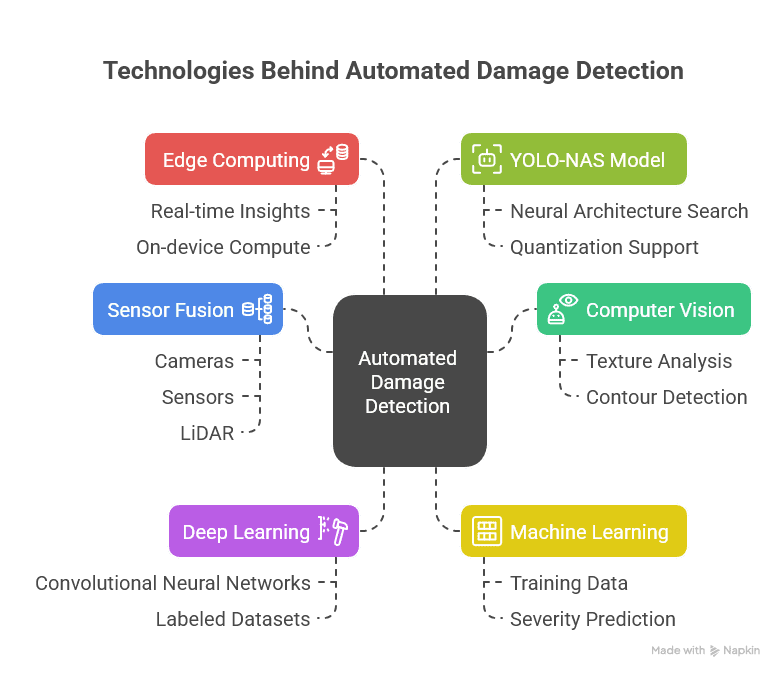
The entire AI-based container damage detection system works like a well-oiled machine with multiple components working in sync. Let’s understand each of these components and how they work together.
1. Computer Vision
Damage detection systems leverage computer vision algorithms to interpret images. It identifies visual anomalies, such as dents, cracks, or scratches, by analyzing textures, contours, and surface patterns.
2. Deep Learning
The ability to identify damage in containers during port operations using AI is rooted in thorough training and data analysis. This is where deep learning comes into play. Think of deep learning as the technology behind the training of models. Artificial neural networks with multiple layers enable algorithms to learn from vast amounts of data.
Models like Convolutional Neural Networks (CNNs) can help you customize the damage detection systems. It is trained on labeled datasets that ensure accurate classification of damage types.
3. Machine Learning (ML)
ML technologies ensure your AI models are trained extensively without the need for explicit programming. Based on the training, systems can easily detect and predict the severity of the container damage.
4. Sensor Fusion
This technique enables you to combine data from multiple sources, including cameras, sensors, and LiDAR. Combining the data creates an accurate understanding of damages.
5. Edge Computing
Processing data on the device is vital during the container operations. Especially when you need real-time insights, edge computing technology enables it through on-device compute.
6. YOLO-NAS Model
YOLO-NAS model (You Only Look Once- Neural Architecture Search) is an object detection model that you can use to optimize accuracy. It leverages NAS to improve the architecture performance of the AI vision systems. What this means for your operations is improved accuracy-latency trade-offs and support for quantization.
From YOLO-NAS to ML and deep learning, the technologies used for automated inspection at the ports and container damage detection offer multiple benefits.
What are the Benefits of AI-Powered Container Inspections?
AI-powered container damage detection systems offer multiple benefits, including improved accuracy in detecting deformations, enhanced port efficiency, and streamlined compliance checks. Plus, you can reduce the container damage costs and ensure optimal output.
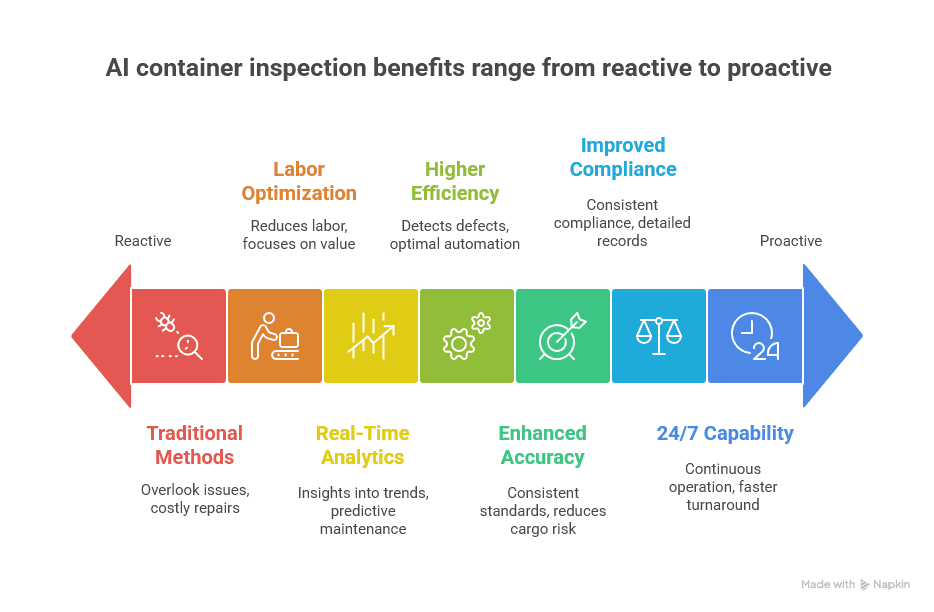
1. Higher Port Efficiency
AI algorithms detect minute defects and help achieve optimal terminal automation. Leveraging such capabilities, you can not only improve the port efficiency but also ensure higher profitability. Take, for example, the Surround dashboard by FedEx. It leverages AI and ML algorithms to provide real-time visibility across its logistics network, enabling faster decision-making and streamlined operations.
2. Reduced Container Damage Costs
Traditional inspection methods often overlook critical structural issues, resulting in costly repairs and operational delays. An advanced container damage detection system identifies problems early, preventing minor issues from escalating into major expenses. You can expect to reduce your container damage costs by up to 35% through proactive maintenance scheduling and early detection of structural compromises.
3. Enhanced Accuracy and Detection
AI vision systems capture high-resolution images and analyze thousands of data points within seconds, detecting cracks, dents, and corrosion that human inspectors might overlook. The technology maintains consistent inspection standards regardless of weather conditions, inspector fatigue, or time constraints. This precision ensures that only containers meeting safety standards enter your supply chain, reducing the risk of cargo damage during transit.
4. Improved Compliance
Automated inspection technology ensures consistent compliance with international shipping regulations while maintaining detailed digital records of every inspection. The system provides comprehensive audit trails that satisfy regulatory requirements and demonstrate due diligence. You can streamline compliance reporting and protect your organization from liability issues through standardized documentation processes.
5. 24/7 Operational Capability
Unlike manual inspections that require scheduled shifts and breaks, AI-powered systems operate continuously without interruption. Your port efficiency benefits from round-the-clock container processing, enabling faster turnaround times and improved customer satisfaction. The system performs equally well during night shifts, holidays, and adverse weather conditions when human inspection quality might be compromised.
6. Cost-Effective Labor Optimization
The container damage detection system reduces dependency on specialized inspection personnel while allowing your existing workforce to focus on higher-value tasks. You can reallocate human resources to strategic operations and maintenance activities rather than routine inspection duties. This optimization can help you reduce 25-30% in inspection-related labor costs while improving overall operational productivity.
7. Real-Time Data Analytics
AI vision systems generate actionable insights about container condition trends, damage patterns, and maintenance requirements. The technology enables predictive maintenance scheduling, helping you identify recurring issues before they impact operations.
You gain valuable insights into container fleet performance, enabling you to make data-driven decisions that optimize your logistics strategy and minimize unexpected downtime. Despite the benefits of AI-powered damage detection systems, deciding to use them can be complex- WHY?
At an enterprise level or even in a small business, many stakeholders need to be onboarded. And this is not the only challenge.
What are the Challenges of Adopting an AI-Powered Damage Detection System?
Challenges of adopting AI-powered damage detection include data issues, technical hurdles, and handling imperfections. You must also ensure optimal operational costs and address ethical AI concerns.
Here are all the challenges in detail,
1. Data Challenges
AI-powered damage detection systems rely on high-quality, well-labeled datasets for accurate defect identification. Incomplete or inconsistent data can lead to misclassification, false positives, or the overlooking of defects. Ports and logistics companies may face difficulties in gathering historical inspection data, especially if records are stored in disparate systems or lack standardized formats.
2. Technical Integration Hurdles
Integrating AI inspection systems with existing port management software, IoT infrastructure, and ERP platforms can be a complex process. Legacy systems may not support real-time data exchange, necessitating the development of custom APIs or middleware, which can be costly. AI models require regular updates and recalibration to adapt to new container designs, changing environmental conditions, and evolving operational workflows.
3. Handling Detection Imperfections
Even advanced AI models can produce inaccuracies under specific scenarios. This can be poor lighting, camera obstructions, extreme weather conditions, or surface contamination on containers. Over-reliance on automation without manual verification processes can lead to operational risks. Establishing a robust human-in-the-loop review process helps catch anomalies that AI may miss, ensuring accuracy and reliability.
4. Operational Cost Management
While AI-powered inspection can reduce long-term costs, the initial investment in hardware (such as high-resolution cameras and sensors), software licenses, and integration can be substantial. Ongoing maintenance expenses, including system upgrades, cloud storage for inspection records, and retraining of AI models, must also be factored into the budget.
5. Ethical and Regulatory Concerns
AI inspections involve capturing and processing massive amounts of visual data, which may inadvertently record sensitive cargo details or personal information. Ensuring compliance with regulations such as GDPR or country-specific data protection laws is crucial.
How can INTECH Help With a Custom Damage Detection System?
Modern-day shipping operations need effective damage detection systems. And not just the ones that detect damage after issues occur, but right during the operations. This is where AI-powered damage detection, leveraging technologies such as AI, ML, cameras, and computer vision, can help. Such systems detect damages, including structural flaws, rust, material damage, and corrosion, in real-time.
However, integrating your system with the existing infrastructure and digital assets, while maintaining compliance, requires a strategic solution. This is where INTECH can help by providing AI-enabled damage detection systems tailored to your specific enterprise needs. Contact us now for a custom port and terminal solution.
FAQs
What are the biggest challenges in AI‑powered container damage detection at ports?
The primary challenges include harsh lighting variations, diverse container conditions (including rust, dirt, and weathering), and background noise from cranes. Plus, there are challenges of stacked containers that can trigger false positives.
Which models perform best for real-time detection of container damage?
YOLO-NAS achieves the performance with 91.2% mAP, 92.4% precision, and 84.1% recall, significantly outperforming YOLOv8 (63.6% mAP) and Roboflow 3.0 Fast Detector (57.9% mAP) on port container damage datasets. Modified YOLOv8 with clustering-based anchor optimization reaches 83.4% mAP, while RF-DETR excels at rare defect classes but sacrifices inference speed.
How can AI damage detection integrate with gate automation, TOS, and PLCs in live terminals?
AI damage detection uses OCR portals with multi-angle cameras to capture container IDs, seals, and damage. It feeds data via APIs to TOS and YMS in real time. Gate PLCs trigger cameras, manage barriers, and route containers based on inspections. The edge servers process images locally and send structured data to central databases.
How to reduce false positives in damage detection?
Deploy custom preprocessing to normalize varying lighting conditions, domain-specific augmentation simulating rust and dirt, and adaptive confidence or overlap thresholds that adjust to real-time visibility.
