

Companies from all over the world are setting up Global Capability Centers (GCCS) all across the world. India is home to 1700+ GCCs and employs more than 1.9 million professionals. They use these centers to control operations while building teams to handle tech, analytics, finance, customer service, and other important tasks.
A lot of these companies are planning to set up GCC in India. This is because the country has a few skilled workers, strong digital infrastructure and low costs.
Cities like Pune, Hyderabad, Gurgaon, and Bengaluru have grown into important hubs of innovation.
But there needs to be careful planning, following the rules, and a clear idea of how things will work to start a GCC. This GCC implementation guide shows you how to set up a global capability center and the most important things you need to do to get GCC up and running in India.
Key Insights
- Global companies choose India for their technology, analytics, finance, and shared service operations. The country has become a global hub for GCCs.
- For the GCC to work well in India, there needs to be clear strategic planning, adherence to rules, and the right talent strategy.
- Companies need to figure out early on what the main goal of the GCC is, whether it’s to develop technology, come up with new ideas, help customers, or share business services.
- It is very important to choose the right city, like Bengaluru, Hyderabad, Pune, or Gurgaon, because each one has its benefits when it comes to infrastructure, industry knowledge, and talent availability.
- When setting up a captive center in India, many global companies choose the wholly owned subsidiary model because it gives them full control over operations and management.
- As part of setting up a global capability center, it is important to obey the rules for things like company registration, tax compliance, and FDI.
- A good hiring plan that includes leadership roles, engineering teams, and operational staff is important for long-term success.
- Setting up strong infrastructure, safe IT systems, and collaboration tools helps global operations run smoothly.
- The GCC can work as an integral part of the global organization thanks to its strong governance frameworks and communication structures.
- Over time, many capability centers change from operational units to growth and innovation engines that help with AI projects, product development, and global digital transformation.
Why Are Global Enterprises Choosing India for GCCs?
It’s important to know why India keeps drawing international groups before we look at how to set up the GCC there.
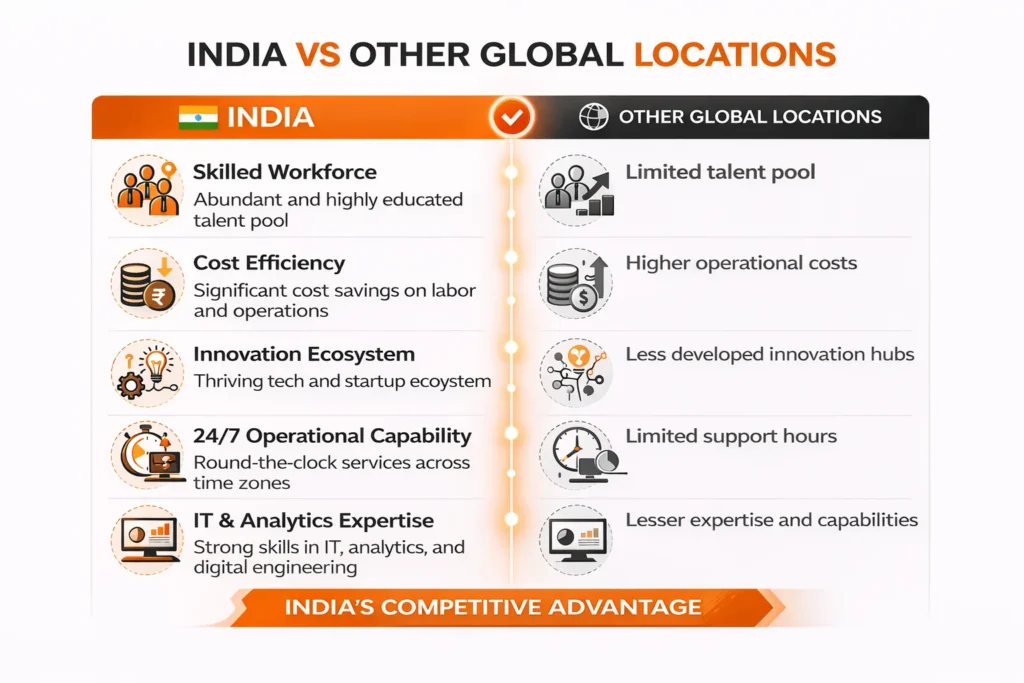
- Easy access to skilled workers: India produces over 1.5 million engineering graduates every year, creating one of the largest technology talent pipelines globally.
- Cost-effectiveness: The costs of doing business here are much lower than in many Western markets.
- Innovation ecosystem: India’s digital infrastructure and entrepreneurial community help the country create new technologies.
- 24/7 operational capability: Teams that are spread out can help businesses run their operations around the clock.
- Excellent IT and data analysis skills: India has turned into a global hub for digital transformation projects.
More and more companies are setting up captive center India to handle important tasks because of these benefits.
Step-by-Step GCC Setup in India
Here is a complete guide on the global capability center setup process. Take a look at the steps on how to establish GCC in India:
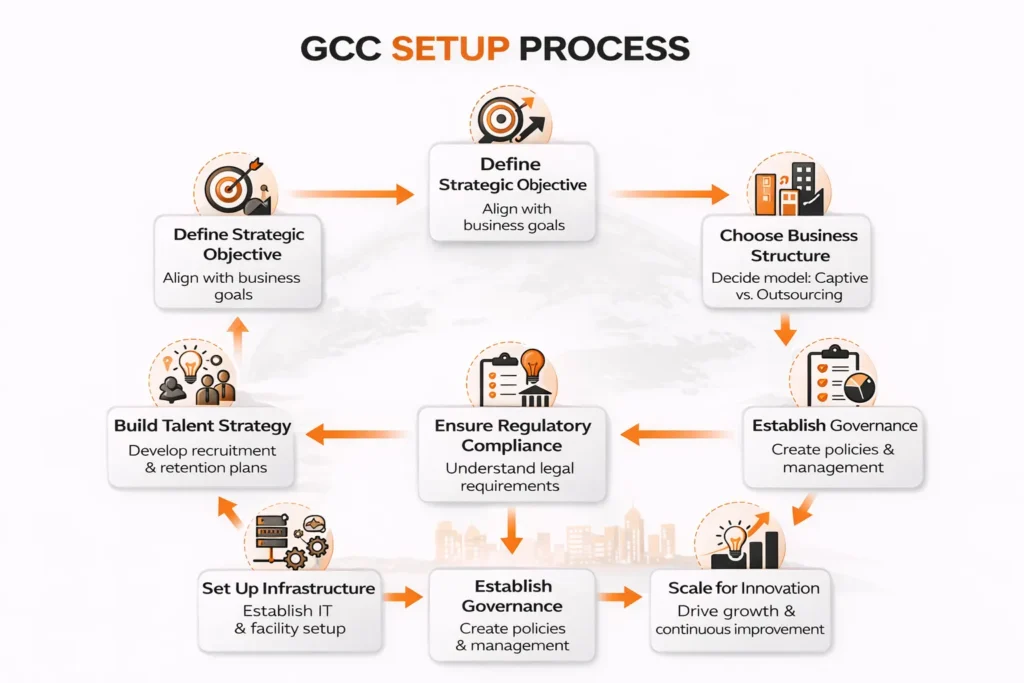
1. Defining the Strategic Objective of the GCC
Setting up a GCC starts with figuring out what its main purpose is within the organization. This is the first and most important step. In the early days of the GCC model, a lot of centers were set up mainly to save money and help with operations. But these days, the GCCs are becoming more and more like innovation hubs that help make global product development and digital transformation possible.
It is important for organizations to be clear about what functions the center will support. Some of these are research and development in technology, data analytics, financial operations, managing the customer experience, and shared business services.
By setting the center’s strategic goals early on, businesses can make sure that the GCC works with the overall business goals and doesn’t just work as an independent offshore unit. A clear purpose also helps with planning how to hire people, build infrastructure, and make long-term investment decisions.
2. Select the Right City for Your GCC
The choice of location is very important to the long-term success of a GCC. India has a number of mature capability center hubs, and each one has its own benefits when it comes to talent, infrastructure, and industry specialization.
Bengaluru is known as India’s technology capital and is home to many software engineers, AI experts, and tech companies from around the world. With its good infrastructure and low costs, Hyderabad has quickly grown into a major center for IT and life sciences. Product engineering and manufacturing technology are robust in Pune. Consulting, finance, and business services are especially strong in the Gurgaon–Noida region.
To pick the right city, you need to look at things like how easy it is to find talented people, how much it costs to run a business, how old the infrastructure is, and how close it is to industry clusters. When choosing a GCC location, many companies also look at how scalable it is to make sure that the center can grow with the company’s long-term global strategy.
3. Select the Appropriate Business Structure
Before starting a GCC in India, global companies need to figure out the best way to set up their legal structure. The most common model is a wholly owned subsidiary, which provides full operational control and allows companies to manage hiring, governance, and internal operations directly.
In some situations, other types of structures, like joint ventures or liaison offices, may be useful, but they usually have limits on how they can be used. Legal requirements change depending on the structure chosen, so businesses usually work closely with lawyers to make sure they follow Indian corporate regulations.
It is very important to choose the right structure so that operational flexibility is maintained and global governance frameworks are met.
4. Check Regulatory and Compliance Requirements
In India, opening a GCC requires a number of regulatory steps to make sure the business follows the country’s laws. In order to do business in India, a company needs to register with the Ministry of Corporate Affairs, get a tax identification number (PAN or TAN), and open a bank account.
Companies may also need to sign up for Goods and Services Tax (GST), depending on the type of business they run. The rules for Foreign Direct Investment (FDI) must also be looked at again to make sure that the way the business is set up fits with India’s FDI policies.
India has made regulatory procedures much easier for multinational companies to set up operations in recent years, even though these steps may seem complicated. Setting up can be done quickly and easily with the right legal help and planning.
5. Building a Strong Talent Strategy
Getting good people is one of the most important things for any GCC to do well. In contrast to traditional outsourcing models, capability centers need highly skilled workers who can directly contribute to the operations of a global business.
Companies usually start by hiring people to be leaders who can build and run the center. Most of the time, these leaders have already set up or grown GCC operations. Companies hire more people in engineering, analytics, operations, and support once they have a leadership team in place.
A lot of businesses also work with universities, staffing agencies, and professional networks to speed up the hiring process in the beginning. Having a clear talent strategy helps businesses build teams that work well together and help the business grow in the long term.
6. Build Infrastructure and Technology Stack
Planning for infrastructure is another important part of setting up the GCC. Companies need to set up safe IT environments, collaboration platforms, and enterprise systems that work well with operations around the world.
Many businesses now use hybrid workspace models in the early stages of their GCC launch. Flexible office spaces let teams grow slowly while still being able to do their jobs quickly.
Prioritizing data security and cybersecurity frameworks is also important to keep sensitive business data safe and make sure that global security standards are met.
7. Develop Operational Governance and Processes
Strong governance structures must be set up from the start for a GCC to work well within a multinational organization. This includes figuring out who is responsible for what, what the operational metrics and performance indicators are, and how to communicate with the global headquarters.
Clear governance frameworks make sure that the capability center works as an extension of the global organization, not as a separate unit in another country. To keep operational transparency and accountability, it’s important for leaders to communicate clearly and work together.
8. Scale the GCC for Innovation and Growth
Once the center is fully operational, companies usually start to make it bigger and better. A lot of GCCs go beyond being operational support hubs and become strategic hubs in charge of innovation projects.
Industry analysts estimate that 400-500 new GCCs could be established in India by 2030, driven by the growing demand for artificial intelligence, digital engineering, and global product development capabilities.
These centers play a bigger role in product engineering, the development of artificial intelligence, automation programs, and big digital transformation projects. When businesses put money into leadership development, innovation programs, and advanced technology skills, their GCCs often turn into powerful growth engines for the business.
As the last step in setting up a global capability center, GCC will be launched in India. The center will become an important part of the company’s global operations in the future.
Conclusion
India keeps improving its reputation as a place where Global Capability Centers can be set up. Multinational companies can easily set up scalable and innovative operations in this country because it has a large pool of skilled workers, a strong digital ecosystem, and regulations that are friendly to business.
When organizations go through the GCC setup process, they are more likely to get the most out of their capability centers if they have clear strategic planning, strong governance structures, and well-thought-out talent strategies. Over time, these centers can change from being operational units to strategic innovation hubs that shape business and technology transformation efforts around the world.
Setting up a GCC in India is a great way for global companies to build capabilities that will be useful in the future and improve their long-term operational efficiency.
FAQs
What is a Global Capability Center (GCC)?
A Global Capability Center (GCC) is a unit that multinational companies set up offshore or nearshore to handle strategic tasks like research, data analysis, technology development, customer service, and finances. These centers help businesses become more efficient while also encouraging new ideas and working together around the world.
Why are companies choosing India for the GCC setup?
India is a popular choice for many businesses because it has many skilled workers, a strong technology ecosystem, lower costs, and a regulatory environment that is friendly to business. India also has advanced digital infrastructure and can support operations around the world that happen in different time zones.
What are the main steps involved in launching a GCC in India?
To start GCC in India, you need to decide on a strategic goal, pick the right city, pick a legal structure that works for you, make sure you follow all the rules, come up with a hiring plan, set up infrastructure, make rules for governance, and make the center bigger for growth and innovation.
What is the best legal structure for setting up a captive center in India?
When they set up a captive center in India, most multinational companies choose a wholly owned subsidiary. This structure gives companies full operational control and makes it easier to handle things like hiring, compliance, and internal processes.
Which cities in India are best for GCCs?
Bengaluru, Hyderabad, Pune, and Gurgaon/Noida are some of the most important GCC hubs in India. These cities have many skilled workers, up-to-date infrastructure, and tech ecosystems that are fully developed to support large-scale global operations.
How long does the GCC setup process take in India?
The time it takes to set up a global capability center can change depending on what laws need to be changed, how ready the infrastructure is, and how many people need to be hired. Most of the time, businesses can start up within a few months if they plan well and follow the right procedures.
What functions can a GCC handle?
A GCC can handle many tasks, like making software, engineering products, financial services, data analysis, research and development, customer service, and shared business services.
What are the long-term benefits of setting up a GCC in India?
Long-term benefits include having access to highly skilled workers, running operations more efficiently, being able to support global digital transformation initiatives, and being able to come up with new ideas. A lot of the GCCs end up becoming strategic hubs that help businesses grow and come up with new products.
